

What Does Caterpillar (CAT) Actually Do?
A plain-English map of Caterpillar’s end markets, segment engines, and what to monitor in the 10-K each quarter
By Michael Chen

Table of Contents
A plain-English explanation of Caterpillar’s business model (equipment + services + dealer network + financing)
What does Caterpillar (CAT) actually do? Caterpillar is a global manufacturer of construction and mining equipment, engines and power systems, and related services. In its annual filings, Caterpillar describes a portfolio built around heavy-duty machinery and power solutions, distributed primarily through a large independent dealer network, with financing support provided through its Financial Products segment.
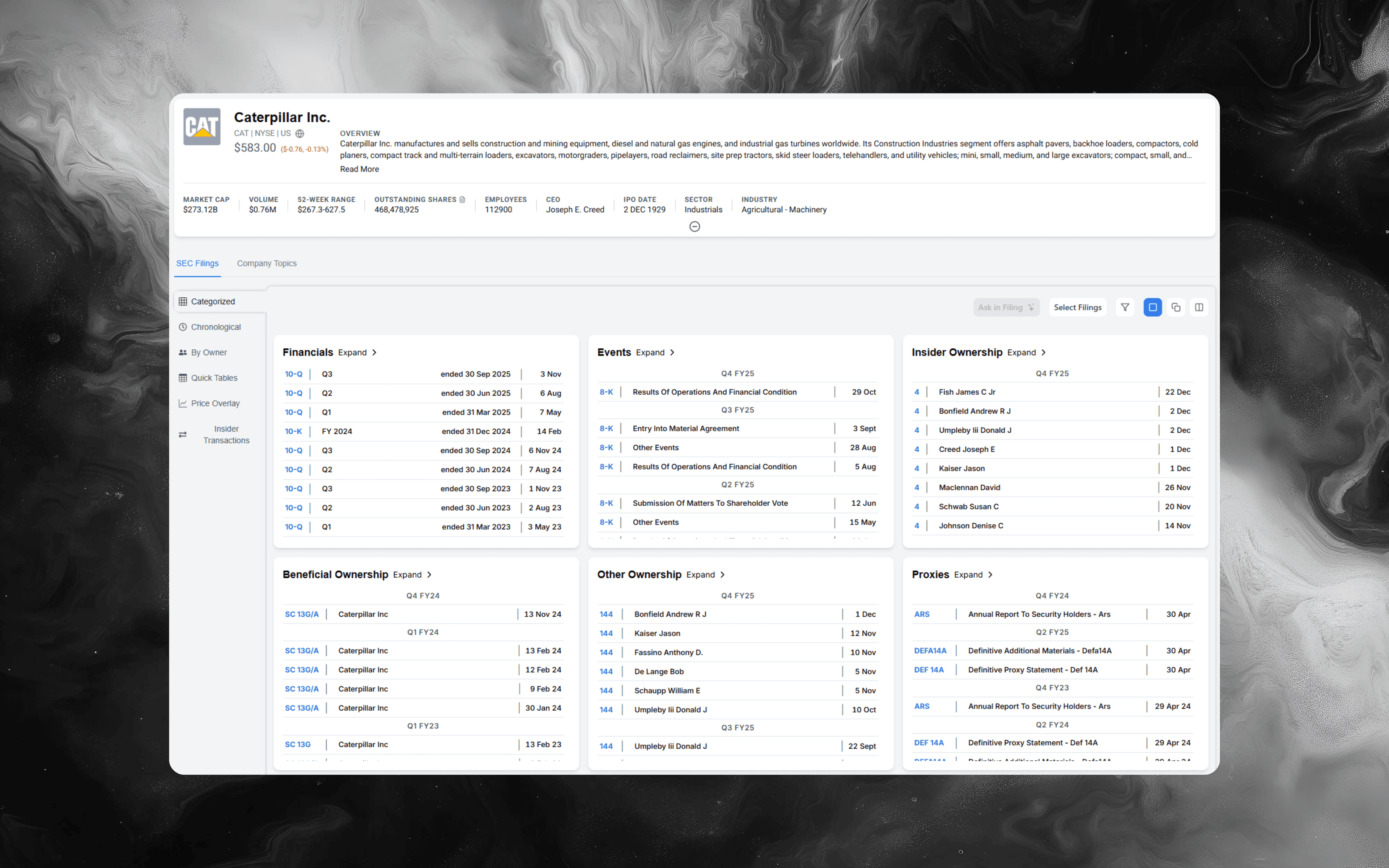
If you want the primary-source foundation (segment definitions, product portfolios, end-market language, and what management highlights when demand shifts), start with the filings in Alpha Analyst here: Caterpillar Inc. (CAT)
For a high-level look at how the segment model for a global industrial giant compares to other sector leaders, see What Does Exxon Mobil (XOM) Actually Do? or Manufacturing Trends 2025: 5 Signals to Monitor.
The fastest mental model: Caterpillar sells productive uptime, not just yellow iron
A useful way to explain Caterpillar to a non-specialist is:
Caterpillar makes big machines and power systems that help customers move earth, extract materials, build infrastructure, and generate power. It also earns meaningful revenue after the initial sale through parts, service, and customer support delivered largely through dealers.
Three ideas make the company click:
-
Cycles matter, but the installed base creates a longer tail
New equipment demand can swing with construction, mining, and energy capex, but parts and service tend to follow the installed fleet. -
Dealers are not a footnote; they are the distribution system
Caterpillar’s go-to-market is built around a global dealer network that sells and services equipment locally. -
Financing is a strategic enabler
The Financial Products segment exists to support equipment sales and dealer/customer relationships, especially when buyers want to finance or lease.
For a plain-English view of how recurring service/parts economics work in a segment model, consider What Does Apple (AAPL) Actually Do? which covers a different industry but with ecosystem revenue logic.
How Caterpillar turns demand into revenue (a step-by-step operating loop)
Here’s a practical “how money moves” map that you can use when reading the 10-K and quarterly commentary:
-
Customer economics improve or deteriorate
Construction activity, infrastructure spending, commodity dynamics in mining, and energy demand influence customer willingness to invest. -
Dealers place orders and manage inventory
Caterpillar sells primarily to dealers, who then sell to end users. Changes in dealer inventory can amplify or dampen reported sales. -
Equipment is delivered and the installed base grows
Each machine sold becomes a multi-year service and parts opportunity. -
Aftermarket flows through parts, maintenance, and rebuilds
Once a fleet is in the field, customers need uptime. That pulls through parts, service labor, and rebuild activity. -
Financing supports purchases and fleet decisions
Financing and insurance services can help customers acquire or lease equipment and can influence the pace of buying in tight credit conditions.
Analyst takeaway: try to label each quarter as primarily (1) end-user demand change, (2) dealer inventory change, (3) aftermarket intensity change, or (4) financing/credit change.
What Caterpillar reports: the core segments in one map
In filings, Caterpillar describes four reportable segments built around three “primary” industrial segments plus financing:
-
Construction Industries
Focused on machinery used in infrastructure and building construction applications. This is where you’ll see language tied to construction activity, rental fleets, and regional demand differences. -
Resource Industries
Focused on mining, heavy construction, and quarry and aggregates. Caterpillar describes offerings that span surface and underground equipment, along with technology and services such as fleet management systems and autonomous machine capabilities. -
Energy & Transportation
Focused on engines and power systems serving oil and gas, power generation, marine, rail, and industrial applications. Filings discuss portfolios such as reciprocating engines, generator sets, integrated systems, turbines and related services, and remanufacturing. -
Financial Products
Financing and insurance subsidiaries (including Cat Financial and insurance services) that support customers and dealers in purchasing and leasing Caterpillar and other equipment.
When you read management commentary, a simple check is: which segment is driving the narrative, and is it an end-market story, a product-cycle story, or a services story?
For another breakdown of diversified segments and what to check in quarterly reports, see What Does Broadcom (AVGO) Actually Do?.
The demand signals that usually matter most for CAT (repeatable each quarter)
If you cover Caterpillar regularly, consistency beats novelty. These are the questions worth asking every time:
-
What does management say about end-user demand by segment?
Construction and mining can diverge. Within each, regions can tell different stories. -
Are dealer inventories expanding or contracting?
Dealer inventory changes can create misleading strength or weakness if you read only consolidated revenue. -
Is aftermarket (parts and service) holding up?
Watch for language about utilization, maintenance, rebuilds, and customer behavior (stretching maintenance, delaying overhauls, etc.). -
What is the backlog saying about near-term production visibility?
Caterpillar discloses order backlog in the annual report. Use it as a directional context tool rather than a precise forecast. -
What is happening in Financial Products?
Financing rates, earning assets, credit performance, and access to capital markets are recurring themes that can matter most when the cycle turns.
A quick “CAT translation guide” for reading filings like an analyst
A lot of Caterpillar research is pattern recognition. This mini-dictionary helps you translate disclosures into a working model:
-
“Sales to end users” vs dealer dynamics
End-user demand is the underlying market. Dealer inventory changes can move reported sales even if end-user demand is flat. -
“Price realization” vs “volume”
Price realization helps you separate pricing power from unit demand. -
“Services” and “product support” language
This often points to the installed base monetization engine and can signal resilience even when new equipment sales soften. -
“Commodity dynamics”
In Resource Industries and parts of Energy & Transportation, customer capex is often tied to commodity expectations and utilization. -
“Regulatory emissions standards”
In Energy & Transportation, regulatory language often implies ongoing R&D and product refresh investment requirements.
For a sector-wide view on how policy and demand shifts affect industrial and energy markets—including cycle swings and regulatory factors—see Tariffs and Energy & Industrials: A Sector Impact Playbook.
A practical checklist for tracking Caterpillar in the 10-K (and then each quarter)
Use this as a repeatable workflow you can run on every filing cycle:
-
Step 1: Confirm segment definitions and what management emphasizes
Start in the business section where the segments and portfolios are described. Capture any new product families or end-market emphasis. -
Step 2: Build a one-page segment scorecard
For each segment, note:- demand drivers mentioned
- dealer inventory commentary (if applicable)
- mix or pricing commentary
- parts/service tone
- any unusual items that affect comparability
-
Step 3: Run a keyword sweep across MD&A
Suggested recurring terms to search in Alpha Analyst:- “dealer inventories”
- “sales to end users”
- “price realization”
- “backlog”
- “aftermarket”
- “parts”
- “services”
- “mining”
- “oil and gas”
- “power generation”
- “remanfacturing” and “remanufacturing”
- “autonomous” and “fleet management”
- “credit rating” and “capital markets” (for Financial Products context)
For practical search workflows and how to speed up disclosure-to-analysis cycle time, see One-Click 10-K & 10-Q Financials to Excel.
- Step 4: Track what actually changes
Risk factors are long, but edits matter. Focus on what evolves around:- commodity volatility exposure
- supply chain constraints and cost pressures
- credit availability for customers and dealers
- regulatory and emissions-related requirements
How to research CAT faster in Alpha Analyst (and make it reusable)
If Caterpillar is on your coverage list, the goal is to turn recurring questions into a repeatable system:
-
Save your best Caterpillar searches once
Use Document Search with phrases, NOT filters, and proximity operators to reduce noise, then save the searches so you don’t rebuild them every quarter. -
Build a monitoring dashboard for filing season
Add widgets like Recent Filings and your saved Caterpillar keyword searches so new disclosures surface automatically when documents publish. -
Use AI Chat to pressure-test your read of the cycle
Examples of useful prompts:- “Summarize how Caterpillar describes demand in Construction Industries vs Resource Industries in the latest 10-K.”
- “Where does Caterpillar discuss dealer inventory impacts on sales volume?”
- “What does the filing say about Financial Products and access to capital markets?”
For a realistic view of how modern AI tools are changing research patterns for analysts across sectors, see Day in the Life of an Investment Analyst: A Realistic Playbook.
- Annotate the passages you’ll want to revisit
Highlight the key segment definition paragraphs, recurring risk language, and the sections that explain drivers like price realization vs volume. Then use the annotations hub to search your own notes later.
Explore Caterpillar filings in Alpha Analyst
If you want to validate how Caterpillar describes its segments, why dealer and end-user dynamics matter, and what management highlights when markets change, go straight to the primary-source filings: Caterpillar Inc. (CAT)
CTA: Use Alpha Analyst to search across Caterpillar filings with advanced keyword operators, save your best CAT queries, and pin them to a dashboard so new Caterpillar disclosures surface immediately when they’re published.
Related Posts
View all posts →
January 31, 2026
Fed Chair Nomination News: What Hassett’s Comments Signal
A practical guide to tracking Fed leadership changes, confirmation risk, and market reactions using filings, search, and dashboards

January 29, 2026
New York Fiscal Crisis: A Company Impact Playbook
How to map NYC budget stress to revenue, taxes, real estate, and credit risk across US equities

January 29, 2026
Monetary Debasement and the US Dollar: A Company Playbook
What “currency going to hell” really means, what could come next for USD, and how US businesses can defend margins, cash flows, and valuation

January 16, 2026
Amgen (AMGN) Deep Dive: Products, Pipeline, and Key Risks
A practical equity-research playbook for underwriting the next leg of growth, margin durability, and biosimilar exposure

January 16, 2026
Daikin Industries (6367): A Deep-Dive Equity Research Playbook
Business model, segment drivers, key risks, and how to build a thesis faster in Alpha Analyst
Explore More
View all posts →
February 4, 2026
Software Stocks and AI Disruption Fears: Investor Playbook
How to evaluate “AI risk” claims, pressure-test seat-based pricing, and track what matters in filings using Alpha Analyst

February 4, 2026
Enphase (ENPH) Upgrade After Earnings: What Changed
A practical investor brief on the BMO upgrade, Q4 beat, 2026 guideposts, and how to track follow-through in Alpha Analyst

February 4, 2026
Tether fundraising report: what changed and how to track it
A practical framework for monitoring stablecoin issuer valuation, liquidity, and regulatory signals with Alpha Analyst