

What Does Apple (AAPL) Actually Do?
A plain-English map of Apple’s product lines, Services engine, and how the ecosystem compounds revenue
By Michael Chen

Table of Contents
A simple explanation of Apple’s business model (beyond “it sells iPhones”)
What does Apple (AAPL) actually do? In plain terms, Apple sells premium consumer devices and then monetizes the installed base over time through paid services, digital content, subscriptions, advertising and platform commerce (including commissions), plus accessory upgrades that keep customers in the ecosystem.
Apple’s filings give you the cleanest “source-of-truth” map of what the company sells and how it recognizes revenue. If you want the primary-source version (business description, risks, segment/geography disclosures and financial statements), start with Apple’s filings in Alpha Analyst here: Apple Inc. (AAPL)
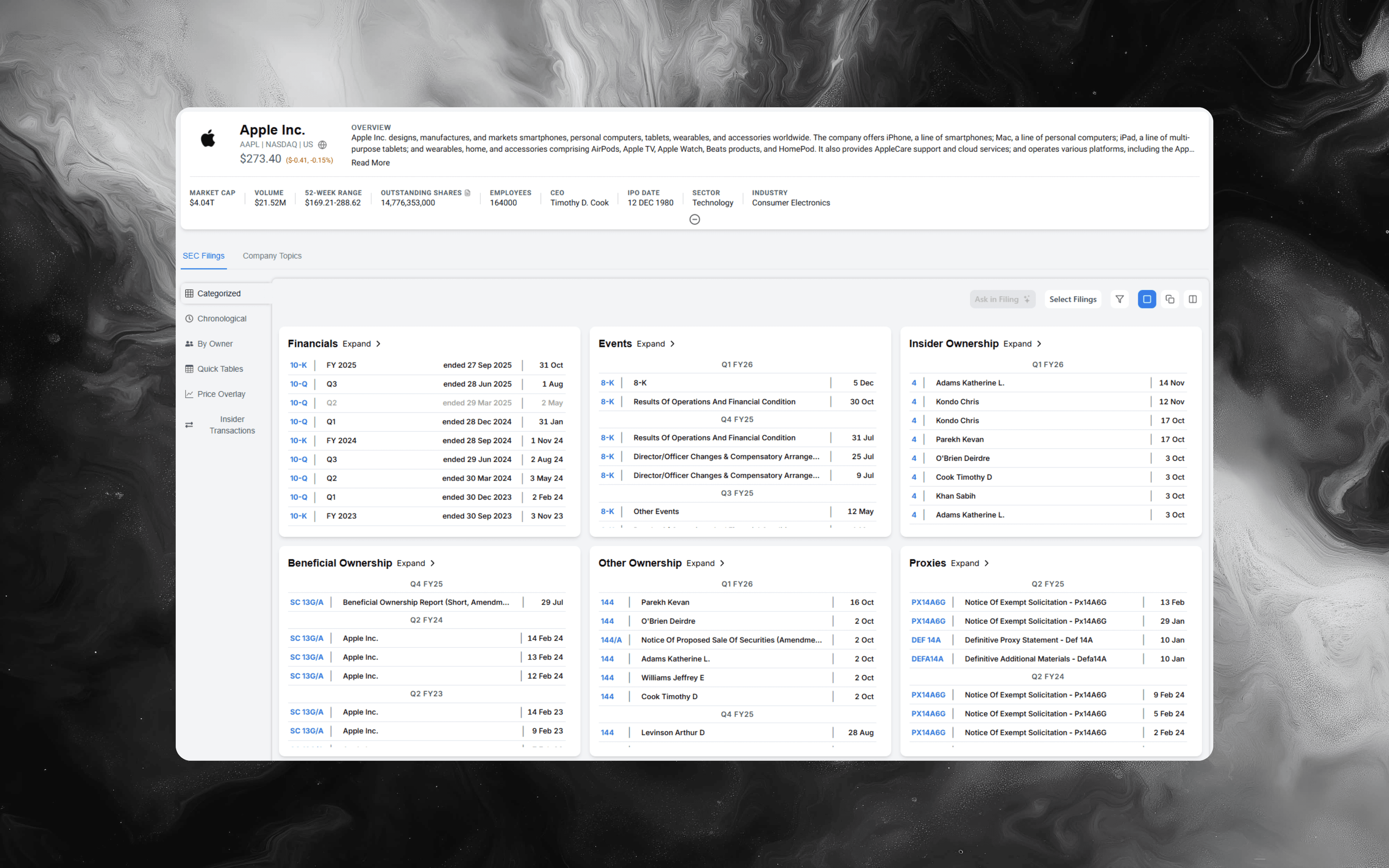
Table of contents
- The fastest mental model: Apple monetizes an installed base
- How Apple breaks out net sales in filings (the categories that matter)
- iPhone: the “gateway product” with upgrade cycles and premium pricing
- Mac and iPad: productivity devices with education and enterprise angles
- Wearables, Home and Accessories: attachment and ecosystem reinforcement
- Services: Apple’s recurring and high-retention revenue engine
- A quick checklist for reading AAPL filings like an analyst
- Explore Apple filings in Alpha Analyst
The fastest mental model: Apple monetizes an installed base
Apple is easier to understand if you separate two things:
- Acquisition: selling a device that brings a customer into (or deeper into) the ecosystem
- Monetization: earning revenue over time as that customer buys subscriptions, apps, storage, accessories, content and upgrades
A simple “Apple loop” looks like this:
- Land a customer with a flagship device (often iPhone)
- Increase stickiness via seamless integration across devices (iPhone + Watch + AirPods + Mac/iPad)
- Expand monetization through Services (subscriptions, platform commerce and payments, advertising)
- Refresh hardware over time (upgrades, replacements, trade-ins)
- Keep churn low by making the ecosystem convenient and familiar
This is why Apple can look like a hardware company in headlines, but behave like a platform business underneath.
For insights on how other platform-based businesses compound value over time and the shift toward platform models in hardware and manufacturing, you might also explore Manufacturing Trends 2025: 5 Signals to Monitor.
How Apple breaks out net sales in filings (the categories that matter)
In Apple’s annual report, you’ll see net sales disaggregated into the product and Services categories that most investors use as the operating map:
- iPhone
- Mac
- iPad
- Wearables, Home and Accessories
- Services
If you only track one thing quarter to quarter, track how the mix shifts between iPhone and Services. It’s often the simplest way to understand whether results are being driven by device cycles, installed-base monetization, or both.
iPhone: the “gateway product” with upgrade cycles and premium pricing
iPhone is Apple’s largest category and the product that typically anchors customer acquisition and ecosystem pull-through.
Business-model intuition:
- Demand can be cyclical (upgrade timing, macro sensitivity, carrier promos)
- Pricing and mix matter as much as units (premium models, storage tiers)
- iPhone tends to create follow-on sales: cases, AirPods, Apple Watch, AppleCare and Services
Analyst mindset: treat iPhone as both revenue and customer acquisition cost. If iPhone is strong, it can be a leading indicator for future Services and accessories attachment.
Mac and iPad: productivity devices with education and enterprise angles
Mac and iPad sit at the intersection of consumer and professional productivity.
Business-model intuition:
- These categories can be lumpy, influenced by refresh cycles and broader PC/tablet conditions
- They contribute to ecosystem depth: once a user has multiple Apple devices, switching becomes more annoying and less likely
- They can support Services attach (storage, content, productivity subscriptions) even when unit growth is modest
A practical way to frame them: Mac and iPad help Apple increase “devices per user,” which increases retention and lifetime value potential.
Wearables, Home and Accessories: attachment and ecosystem reinforcement
Wearables, Home and Accessories is where Apple often turns a single-device customer into a multi-device customer.
This bucket commonly serves three strategic roles:
- Attachment: accessories and add-on devices increase revenue per customer
- Habit formation: daily-use wearables can raise engagement and reduce switching
- Ecosystem glue: devices work better together than separately, increasing perceived value
If you’re monitoring Apple as a business (not just a stock), this category is a good place to look for signals about ecosystem momentum.
Services: Apple’s recurring and high-retention revenue engine
Services is the most “platform-like” part of Apple.
In filings language, Services net sales can include things like digital content, subscription offerings, licensing, warranties and platform commerce mechanics. A key business-model detail is how Apple recognizes certain third-party sales: for example, for third-party applications sold through the App Store, Apple typically recognizes in Services net sales only the commission it retains (rather than the full price paid by the customer).
Business-model intuition:
- Services tends to be recurring or repeat-purchase in nature (subscriptions, ongoing usage, renewals)
- It scales with the installed base: more active devices generally create more Services opportunities
- It diversifies the business away from pure hardware cycle dependence
Common pitfall: treating Services as a single line item. In practice, Services can be a blend of subscriptions, usage-linked activity, licensing, and commerce take rates, each with different growth and margin dynamics.
To understand platform-driven recurring revenue models and the expansion of subscription services beyond consumer technology, see Electric Vehicle Trends 2025: What to Watch Next.
A quick checklist for reading AAPL filings like an analyst
When you want to understand what is changing at Apple, use a repeatable checklist:
- Net sales mix across iPhone, Mac, iPad, Wearables/Home/Accessories and Services
- Commentary on demand drivers (upgrade cycles, regional dynamics, channel inventory)
- Any changes in how Apple describes Services components or revenue recognition mechanics
- Risk factors that evolve (regulatory, platform rules, supply chain, competitive dynamics)
- Geographic discussion (where growth is strengthening or weakening)
- Language changes: new emphasis can matter as much as the numbers
The goal is consistency. If you ask the same questions every quarter, you’ll spot narrative shifts early.
For research teams looking to structure workflow and filings analysis across companies, Day in the Life of an Investment Analyst: A Realistic Playbook offers practical tips for building repeatable habits.
Explore Apple filings in Alpha Analyst
If you want to validate how Apple describes its product categories, understand how Services works mechanically, and track what’s changing (without getting lost in noise), go straight to the primary-source filings in a searchable format: Apple Inc. (AAPL)
CTA: In Alpha Analyst, set up a repeatable AAPL workflow by saving a few high-signal searches (for example: “Services net sales”, “commission it retains”, “deferred revenue”, “installed base”, “Wearables, Home and Accessories”), then pin those saved searches to a dashboard filtered to your watchlist so new disclosures surface as soon as Apple files.
Related Posts
View all posts →
January 31, 2026
Fed Chair Nomination News: What Hassett’s Comments Signal
A practical guide to tracking Fed leadership changes, confirmation risk, and market reactions using filings, search, and dashboards

January 29, 2026
New York Fiscal Crisis: A Company Impact Playbook
How to map NYC budget stress to revenue, taxes, real estate, and credit risk across US equities

January 29, 2026
Monetary Debasement and the US Dollar: A Company Playbook
What “currency going to hell” really means, what could come next for USD, and how US businesses can defend margins, cash flows, and valuation

January 16, 2026
Amgen (AMGN) Deep Dive: Products, Pipeline, and Key Risks
A practical equity-research playbook for underwriting the next leg of growth, margin durability, and biosimilar exposure

January 16, 2026
Daikin Industries (6367): A Deep-Dive Equity Research Playbook
Business model, segment drivers, key risks, and how to build a thesis faster in Alpha Analyst
Explore More
View all posts →
February 4, 2026
Software Stocks and AI Disruption Fears: Investor Playbook
How to evaluate “AI risk” claims, pressure-test seat-based pricing, and track what matters in filings using Alpha Analyst

February 4, 2026
Enphase (ENPH) Upgrade After Earnings: What Changed
A practical investor brief on the BMO upgrade, Q4 beat, 2026 guideposts, and how to track follow-through in Alpha Analyst

February 4, 2026
Tether fundraising report: what changed and how to track it
A practical framework for monitoring stablecoin issuer valuation, liquidity, and regulatory signals with Alpha Analyst