

What Does Broadcom (AVGO) Actually Do?
A plain-English breakdown of Broadcom’s two segments and how chips plus software create recurring cash flows
By Michael Chen

Table of Contents
A simple explanation of Broadcom’s business model (it’s not “just chips”)
What does Broadcom (AVGO) actually do? Broadcom is a global technology supplier with two big engines: it sells semiconductor products that move data and power critical electronics, and it sells infrastructure software that helps large enterprises run and secure complex IT environments.
Broadcom describes itself as having two reportable segments: semiconductor solutions and infrastructure software. If you want the primary-source map (business description, segment reporting, risks, and financial statements), start with Broadcom’s filings in Alpha Analyst here: Broadcom Inc. (AVGO)
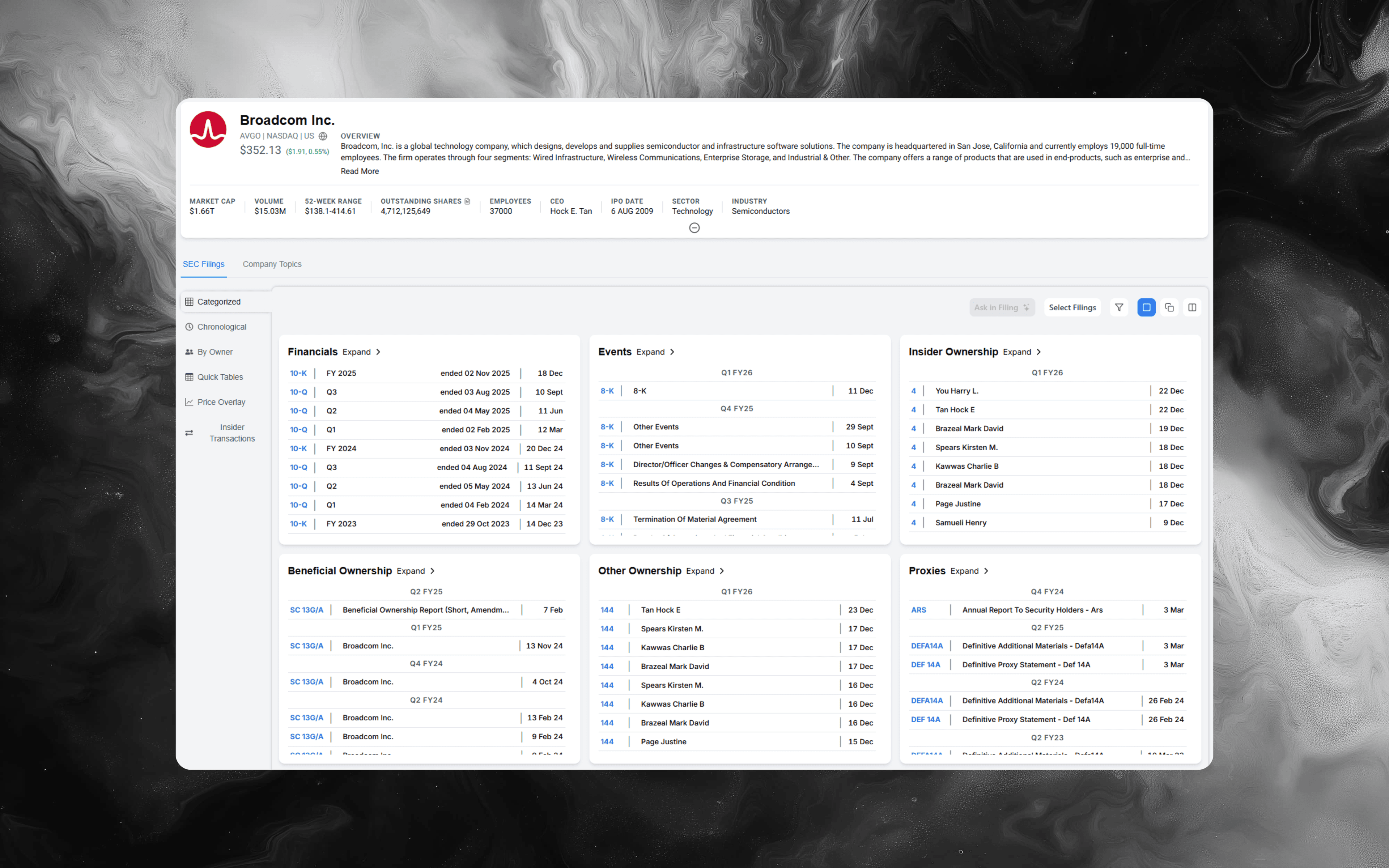
Table of contents
- The fastest mental model: Broadcom sells “infrastructure building blocks”
- The two segments Broadcom reports (and why that structure matters)
- Semiconductor solutions: the parts that make networks, storage, and connectivity work
- Infrastructure software: tools that run, manage, and secure enterprise IT
- Where recurring revenue shows up in AVGO (and where it doesn’t)
- A quick checklist for reading AVGO filings like an analyst
- Explore Broadcom filings in Alpha Analyst
The fastest mental model: Broadcom sells “infrastructure building blocks”
Broadcom is easiest to understand when you stop thinking in consumer gadgets and start thinking in infrastructure.
A practical way to picture the company is as two complementary layers:
- Hardware layer (semiconductor solutions): Broadcom designs and supplies components that enable data to be processed, stored, and transported inside data centers, enterprise networks, telecom systems, broadband equipment, and other embedded electronics.
- Software layer (infrastructure software): Broadcom sells software portfolios that help enterprises run, automate, and secure IT across environments like mainframe, distributed systems, private cloud, hybrid cloud, and edge.
The key idea: Broadcom’s products often sit inside systems that customers cannot casually swap out. That tends to create long product lifecycles, repeat design wins, and a meaningful “renew and expand” motion in parts of the software business.
For a practical lens on how infrastructure and AI hardware are converging in the data center, you may also want to explore AI Data Center Optics Stocks: COHR, LITE, MRVL + More, which highlights the technologies underlying modern cloud and networking platforms.
The two segments Broadcom reports (and why that structure matters)
In its filings, Broadcom reports two segments:
- Semiconductor solutions
- Infrastructure software
This matters because the demand drivers and revenue dynamics can look very different:
- Semiconductors can be sensitive to product cycles, customer inventory digestion, and end-market swings (even if the underlying products are “sticky” once designed in).
- Infrastructure software typically has more contract and renewal-like behavior (plus services and support), and filings can reveal changes in mix, licensing, or subscription models.
When you’re trying to explain AVGO to a non-specialist, segment framing prevents you from mixing up “chip cycle” narratives with “enterprise software” narratives.
For more on how companies segment financial reporting and why it matters for analysis, see Day in the Life of an Investment Analyst: A Realistic Playbook.
Semiconductor solutions: the parts that make networks, storage, and connectivity work
Think of semiconductor solutions as “the plumbing of modern computing.”
Broadcom’s filings describe a broad portfolio of semiconductor and semiconductor-based products used across environments and end markets, including enterprise and AI data centers, servers, networking and connectivity equipment, storage systems, broadband and set-top box equipment, wireless devices and base stations, industrial applications, and more. The segment also includes IP licensing.
Business-model intuition:
- Design-in and lifecycle: Many chips are chosen early in a system design. Once selected, suppliers can benefit from long lifecycles and repeat purchases tied to the customer’s shipments.
- Route to market: Semiconductors often go through OEMs, contract manufacturers, and distributors, which can create quarter-to-quarter variability even when underlying demand is stable.
- Mix matters: “Semiconductors” isn’t one product. Networking versus broadband versus storage can behave very differently, and filings often explain which sub-areas are driving growth or declines.
A useful way to explain this segment in one sentence:
Broadcom sells specialized components that help data move faster and more reliably through the systems that run the internet, cloud computing, and enterprise IT.
Infrastructure software: tools that run, manage, and secure enterprise IT
Think of infrastructure software as “operating the enterprise.”
Broadcom’s filings describe infrastructure software solutions that help enterprises simplify their IT environments and run mission-critical workloads across private cloud, hybrid cloud, edge, and traditional enterprise systems. The segment includes software arrangements (licenses), related support, and professional services, along with certain storage networking products and related software (often referenced as FC SAN).
Business-model intuition:
- Renewals and support: A meaningful portion of enterprise software economics comes from ongoing support/maintenance and multi-year relationships, not just initial sales.
- Revenue recognition can be a tell: Filings may discuss how license revenue is recognized depending on contract terms (for example, differences between non-cancelable arrangements versus contracts with termination for convenience).
- Platform “surface area”: The more central the software is to IT operations, the more it tends to expand into adjacent needs (automation, security, networking, operational tooling), which can increase wallet share over time.
A plain-English explanation:
Broadcom sells software that helps large organizations plan, operate, and secure complicated IT environments where downtime, migration risk, and security exposure are expensive.
Relevant to understanding how AI and language technologies are now being embedded into enterprise stacks, NLP in Financial Research: Practical Use Cases and Playbook illustrates how these dynamics play out in modern infrastructure.
Where recurring revenue shows up in AVGO (and where it doesn’t)
If you need a clean revenue map for Broadcom, these buckets are usually enough:
-
Product shipments (often more cyclical) Semiconductor revenue is frequently tied to unit volumes and customer demand cycles. Even with sticky design wins, the revenue pattern can swing with end-market conditions.
-
IP licensing (can be lumpy) Licensing can behave differently from physical products, depending on contract structures and customer cycles.
-
Software subscriptions, licenses, and support (more recurring) Infrastructure software can include subscription-like patterns and ongoing support that renews over time. Filings may highlight shifts in licensing models or mix, which can change the recurring profile.
-
Professional services (supporting revenue) Services can help adoption and expansion, but they typically support the larger software relationship rather than being the primary long-term value driver.
A simple summary sentence:
Broadcom blends a hardware revenue engine that can be cycle-influenced with a software engine that can be renewal- and contract-shaped, and the segment mix helps you see which story is dominating in a given period.
This blend of cyclical hardware and sticky software is similar to business models discussed in Manufacturing Trends 2025: 5 Signals to Monitor, with trends impacting both electronic and software-driven sectors.
A quick checklist for reading AVGO filings like an analyst
When monitoring Broadcom, these are high-signal areas to track consistently:
-
Segment mix and segment commentary Look for what management says is driving semiconductor solutions versus infrastructure software in the period.
-
End-market demand language Watch for changes in phrases around networking, AI/data center, broadband, storage, and industrial demand, especially when the company calls out product mix.
-
Customer concentration and channel dynamics Pay attention to disclosures about large customers or distributor/OEM concentration, since they can affect volatility and negotiating leverage.
-
Software contract language that changes revenue shape Scan for discussion of subscription transition, license terms, termination clauses, contract liabilities, and remaining performance obligations disclosures (when provided).
-
Acquisition integration signals Broadcom’s history includes material acquisitions, and filings often show integration effects through amortization, restructuring, or changes in segment results and unallocated expenses.
A practical habit: keep the same keyword list each quarter so you can spot narrative shifts early, not just headline numbers.
For a hands-on guide to tracking sector shifts and analyst workflows, Day in the Life of an Investment Analyst: A Realistic Playbook shares practical strategies that can be adapted for AVGO research.
Explore Broadcom filings in Alpha Analyst
If you want to validate how Broadcom defines its two segments, track how management explains semiconductor demand versus software momentum, and surface the disclosures most likely to move your thesis, go straight to the primary-source filings: Broadcom Inc. (AVGO)
CTA: Use Alpha Analyst to search across AVGO filings with advanced keyword operators (for example, phrases like “reportable segments”, “Semiconductor solutions”, “Infrastructure software”, “remaining performance obligations”, “contract liabilities”, “customer accounted for”), save those searches, and add them to a dashboard filtered by your watchlist so new disclosures surface as soon as they land.
Related Posts
View all posts →
January 31, 2026
Fed Chair Nomination News: What Hassett’s Comments Signal
A practical guide to tracking Fed leadership changes, confirmation risk, and market reactions using filings, search, and dashboards

January 29, 2026
New York Fiscal Crisis: A Company Impact Playbook
How to map NYC budget stress to revenue, taxes, real estate, and credit risk across US equities

January 29, 2026
Monetary Debasement and the US Dollar: A Company Playbook
What “currency going to hell” really means, what could come next for USD, and how US businesses can defend margins, cash flows, and valuation

January 16, 2026
Amgen (AMGN) Deep Dive: Products, Pipeline, and Key Risks
A practical equity-research playbook for underwriting the next leg of growth, margin durability, and biosimilar exposure

January 16, 2026
Daikin Industries (6367): A Deep-Dive Equity Research Playbook
Business model, segment drivers, key risks, and how to build a thesis faster in Alpha Analyst
Explore More
View all posts →
February 4, 2026
Software Stocks and AI Disruption Fears: Investor Playbook
How to evaluate “AI risk” claims, pressure-test seat-based pricing, and track what matters in filings using Alpha Analyst

February 4, 2026
Enphase (ENPH) Upgrade After Earnings: What Changed
A practical investor brief on the BMO upgrade, Q4 beat, 2026 guideposts, and how to track follow-through in Alpha Analyst

February 4, 2026
Tether fundraising report: what changed and how to track it
A practical framework for monitoring stablecoin issuer valuation, liquidity, and regulatory signals with Alpha Analyst