

What Does UnitedHealth Group (UNH) Actually Do?
A plain-English map of UnitedHealthcare vs Optum, how the four segments make money, and what to track in filings each quarter
By Michael Chen

Table of Contents
A plain-English explanation of UnitedHealth Group’s business model (insurance + health services)
What does UnitedHealth Group (UNH) actually do? In simple terms, UnitedHealth Group combines a large health benefits business (UnitedHealthcare) with a large health services platform (Optum). In its filings, the company describes these as two distinct, yet complementary businesses designed to help people access care, pay for care, and run the health system more efficiently.
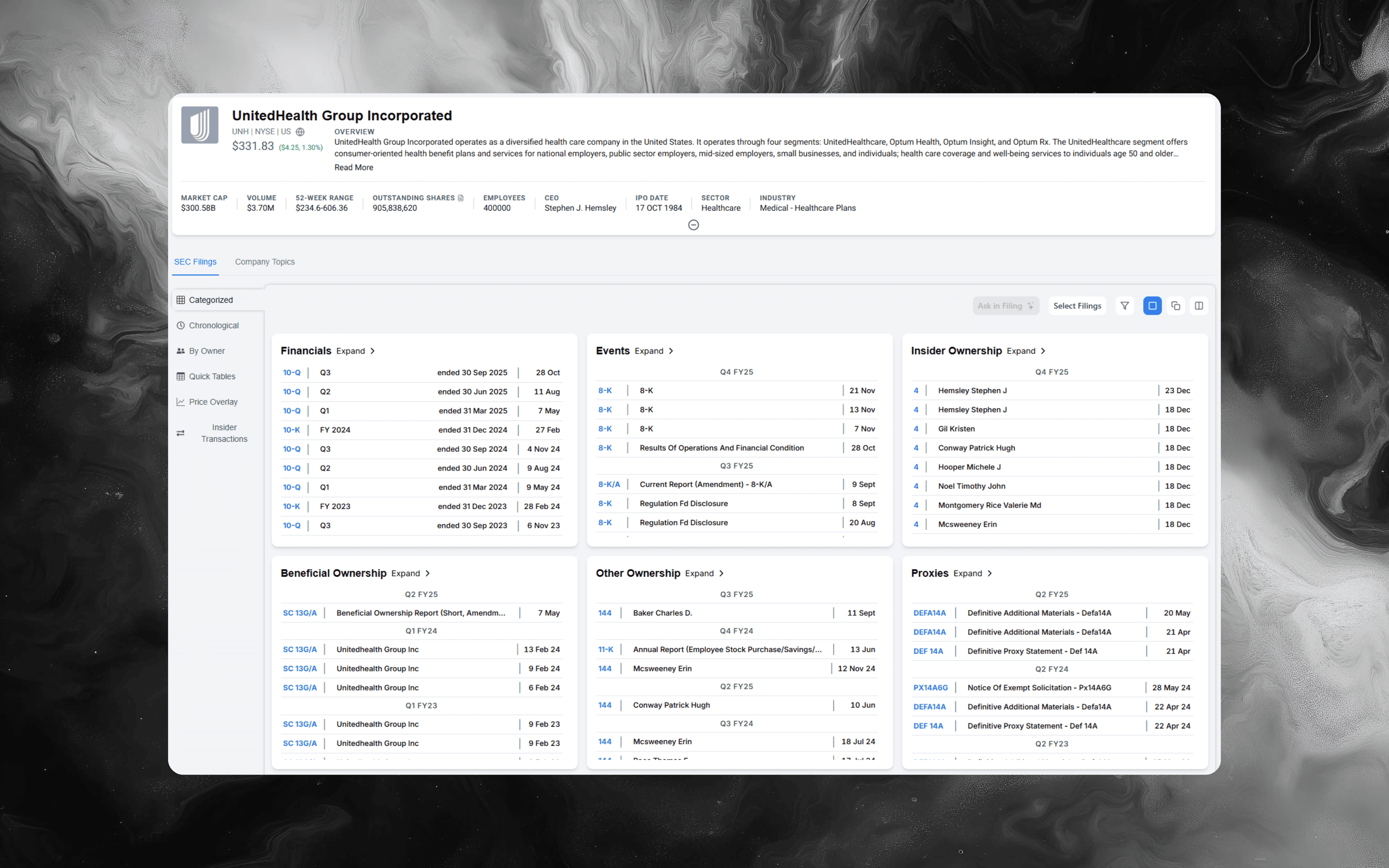
If you want the primary-source foundation (segment definitions, how revenue is described, what metrics management uses, and what changed quarter to quarter), start with the filings in Alpha Analyst here: UnitedHealth Group Incorporated (UNH)
The fastest mental model: UNH is a loop, not a straight line
A helpful way to explain UnitedHealth Group to a non-specialist is:
UnitedHealthcare organizes health benefits (how people get coverage and how providers get paid), while Optum provides the care delivery, pharmacy, data, analytics, and technology services that make the system run.
Three points make the model click:
-
It’s not just “an insurer” UnitedHealthcare is the benefits side, but Optum is a major health services engine with multiple revenue models (care delivery, pharmacy, and technology-enabled services).
-
Optum is also an internal supply chain for the benefits business In the filings, the company describes transactions between segments (for example, pharmacy services and care services supporting UnitedHealthcare customers). That matters because it affects how you interpret segment performance and operating leverage.
-
The core product is the combination: coverage + care + capabilities Investors often miss that the value proposition isn’t one line item. It’s the ability to coordinate benefits design, provider networks, pharmacy, and data-driven care management at scale.
For another deep dive into how diversified models operate across segments and the metrics investors should track, see What Does IBM (IBM) Actually Do?.
How UnitedHealth Group turns its strategy into revenue (step-by-step)
Here’s a practical operating loop you can map to the income statement and MD&A language:
-
People and organizations need coverage and predictable costs Employers, seniors, and public programs need benefit plans with networks, pricing, and operational support.
-
UnitedHealthcare earns premium and fee-based revenue The benefits business generally earns revenue based on people served, plan design, and funding arrangements, then pays medical costs and administers care.
-
Optum runs services that monetize health system “work” Optum’s businesses monetize care delivery and care management, pharmacy fulfillment and clinical programs, and technology/analytics services used by health plans, providers, governments, employers, and life sciences organizations.
-
Scale and integration create cost and experience advantages The thesis is that integrated data, clinical programs, and operations can improve outcomes and reduce avoidable cost while improving customer experience.
-
Contracts renew, people churn, and mix shifts drive results In health benefits and health services, the recurring question is not only “did revenue grow?” but “what changed in mix, care activity, funding pressure, and operating costs?”
Analyst takeaway: each quarter, try to identify which part of the loop moved most: enrollment/membership, care utilization patterns, rate/funding, pharmacy dynamics, or technology/services demand.
What UNH reports: four segments under two businesses
In filings, the company reports four segments:
-
UnitedHealthcare The health benefits segment. In the filings, UnitedHealthcare includes Employer & Individual, Medicare & Retirement, and Community & State.
-
Optum Health Care delivery and care management, plus related wellness/engagement and health financial services offerings.
-
Optum Insight Data, analytics, research, consulting, technology, and managed services solutions for health system participants.
-
Optum Rx Pharmacy care services spanning retail network contracting, home delivery, specialty pharmacy, and related clinical programs.
A simple reader-friendly way to remember it: UnitedHealthcare is “coverage and benefits administration,” while Optum is “care delivery + pharmacy + health tech/analytics.”
What each segment “sells” (plain English, aligned to filings)
Instead of memorizing corporate language, map each segment to what a customer is buying.
-
UnitedHealthcare: benefit plans + administration Customers are employers, individuals, seniors, and government programs. The “product” is access to care (via networks) and financial protection, plus administrative capabilities like claims processing and care management.
-
Optum Health: care, navigation, and value-based arrangements This segment is about delivering care (in-person, in-home, virtual, digital), managing chronic/complex needs, and helping providers move from fee-for-service to performance-based models. It also includes health financial services offerings described in filings.
-
Optum Insight: software, platforms, and services that reduce admin friction Think revenue cycle, payment simplification, compliance/modernization, and analytics-enabled performance improvement. This segment tends to include multi-year service and platform relationships.
-
Optum Rx: pharmacy services (a blend of product flow + programs) Pharmacy services include network contracting, specialty and home delivery, infusion, and clinical programs such as formulary and utilization management. A big analyst habit here is separating “revenue growth” from what’s happening in drug costs, rebates, and mix.
For a broader perspective on transformation in healthcare business models and how to break down the drivers behind segment reporting, you might also be interested in What Does Eli Lilly (LLY) Actually Do?.
The few metrics that explain most quarters
In its filings, the company highlights that it uses operational metrics to evaluate and manage segments. If you only track a handful of items consistently, these tend to be the most “explanatory”:
-
People served (UnitedHealthcare) Track changes by major market segment and funding arrangement. When membership shifts, you should expect knock-on effects in revenue, medical cost ratio dynamics, and mix.
-
Medical costs and medical care ratio (MCR) The MCR is where utilization, pricing/unit costs, and funding pressure show up. It’s also where “surprises” often live, especially when care patterns shift.
-
Optum Rx adjusted scripts Script volume can help contextualize pharmacy segment momentum, but it’s still crucial to read management’s explanation of mix and pricing dynamics.
-
Operating cost ratio and operating cost management language Watch whether operating cost changes are explained as scale benefits, investment cycles, one-time response costs, or business mix.
What tends to drive volatility: the “health care reality checks”
UnitedHealth Group often looks stable until one of these variables moves quickly. These are recurring topics worth building into a repeatable reading process:
-
Funding pressure in government programs (especially Medicare Advantage) Filings discuss rate notices and risk adjustment changes as structural pressures that can require benefit/pricing/network adjustments.
-
Elevated care patterns and outpatient utilization Utilization shifts can raise medical costs even when membership is steady.
-
Medicaid redeterminations and timing mismatches Changes in who remains enrolled (and their health status) versus when state rates update can create a mismatch that shows up in margins and commentary.
-
Specialty pharmacy and high-cost drug dynamics Even if you don’t model drug trend, you can track the narrative around specialty growth, formulary strategy, and clinical program expansion.
-
Cybersecurity and operational disruption risk The company has discussed impacts from the Change Healthcare cyberattack in its filings, including response efforts and disruption-related impacts. When operational disruptions occur, they can affect multiple segments at once, so it’s worth reading for cross-segment spillovers.
For context on cross-segment organizational risks and trends to track, see Pharmaceutical Industry Trends 2025: 5 Shifts Reshaping Pharma, which covers evolving pressures and externalities relevant to UNH and its peers.
A practical checklist for reading UNH filings like an analyst
Use this as a repeatable process each quarter so you’re not starting from zero every earnings cycle.
-
Step 1: Anchor on segment definitions (confirm nothing changed) If presentation or descriptions shift, your “apples-to-apples” comparisons can quietly break.
-
Step 2: Build a one-page segment scorecard For each of the four segments, capture:
- revenue direction
- earnings from operations direction
- the stated drivers (membership, pricing, care activity, mix, response costs, investments)
-
Step 3: Create a recurring keyword set for MD&A Suggested terms to save and reuse in Alpha Analyst:
- “UnitedHealthcare Employer”
- “Medicare Advantage”
- “Community and State”
- “medical care ratio” or “MCR”
- “care patterns” and “outpatient”
- “risk adjustment”
- “redeterminations”
- “Optum Health value-based”
- “Optum Insight” and “managed services”
- “Optum Rx adjusted scripts”
- “specialty” and “formulary”
- “cyberattack” and “Change Healthcare”
- “operating cost ratio”
-
Step 4: Read “what changed” with a causality lens Don’t stop at “higher medical costs.” Force the causal chain:
- unit cost vs utilization vs member mix
- funding changes vs benefit design vs network changes
- temporary disruption vs structural change
-
Step 5: Track evolving risk language Risk factors are long, but edits matter. Look for changes related to regulation, reimbursement, cybersecurity, provider dynamics, and pharmacy economics.
How to research UNH faster in Alpha Analyst
If you cover UNH regularly, speed comes from turning ad-hoc reading into a reusable workflow:
-
Save your UNH keyword searches and reuse them each filing cycle Use advanced operators (phrases, NOT, proximity) to reduce noise, then save the search so your process is consistent quarter after quarter.
-
Pin saved searches to a dashboard filtered to UNH Build a monitoring workspace with widgets like Recent Filings and your saved keyword search widgets so new disclosures surface automatically.
-
Use AI Chat to summarize changes, then verify in the filing Example prompts:
- “What changed in UnitedHealthcare membership and the stated drivers this quarter?”
- “Where does management explain medical cost trends and MCR movement?”
- “What did the company say about Optum Health performance and value-based care?” Keep the conversation grounded in the documents you’re reviewing.
For a workflow guide on getting practical insights out of company filings and structuring research habits, see Day in the Life of an Investment Analyst: A Realistic Playbook.
- Keep an annotations trail for decisions and open questions Highlight the paragraphs that explain the quarter (membership shifts, care patterns, funding pressure, disruption impacts), then store them in the annotations hub so you can audit your thesis later.
Explore UnitedHealth Group filings in Alpha Analyst
To validate how UNH describes its UnitedHealthcare and Optum businesses, how it defines the four segments, and what management emphasizes when care activity, funding, or operating costs shift, go straight to the primary-source filings: UnitedHealth Group Incorporated (UNH)
CTA: Use Alpha Analyst to search across UNH filings with advanced keyword operators, save your best UNH queries, and pin them to a dashboard so new UNH disclosures surface immediately when they’re published.
Related Posts
View all posts →
January 31, 2026
Fed Chair Nomination News: What Hassett’s Comments Signal
A practical guide to tracking Fed leadership changes, confirmation risk, and market reactions using filings, search, and dashboards

January 29, 2026
New York Fiscal Crisis: A Company Impact Playbook
How to map NYC budget stress to revenue, taxes, real estate, and credit risk across US equities

January 29, 2026
Monetary Debasement and the US Dollar: A Company Playbook
What “currency going to hell” really means, what could come next for USD, and how US businesses can defend margins, cash flows, and valuation

January 16, 2026
Amgen (AMGN) Deep Dive: Products, Pipeline, and Key Risks
A practical equity-research playbook for underwriting the next leg of growth, margin durability, and biosimilar exposure

January 16, 2026
Daikin Industries (6367): A Deep-Dive Equity Research Playbook
Business model, segment drivers, key risks, and how to build a thesis faster in Alpha Analyst
Explore More
View all posts →
February 4, 2026
Software Stocks and AI Disruption Fears: Investor Playbook
How to evaluate “AI risk” claims, pressure-test seat-based pricing, and track what matters in filings using Alpha Analyst

February 4, 2026
Enphase (ENPH) Upgrade After Earnings: What Changed
A practical investor brief on the BMO upgrade, Q4 beat, 2026 guideposts, and how to track follow-through in Alpha Analyst

February 4, 2026
Tether fundraising report: what changed and how to track it
A practical framework for monitoring stablecoin issuer valuation, liquidity, and regulatory signals with Alpha Analyst