

What Does IBM (IBM) Actually Do?
A plain-English breakdown of IBM’s hybrid cloud and AI strategy, how each segment makes money, and what to track in filings
By Michael Chen

Table of Contents
A plain-English explanation of IBM’s business model (hybrid cloud + AI platforms, delivered via software and services)
What does IBM (IBM) actually do? IBM is an enterprise technology company that sells software, provides consulting and managed services, and delivers infrastructure systems that run mission-critical workloads. Across its filings, IBM frames its strategy as “platform-centric” around hybrid cloud and AI—then monetizes that strategy through four reporting segments: Software, Consulting, Infrastructure, and Financing.
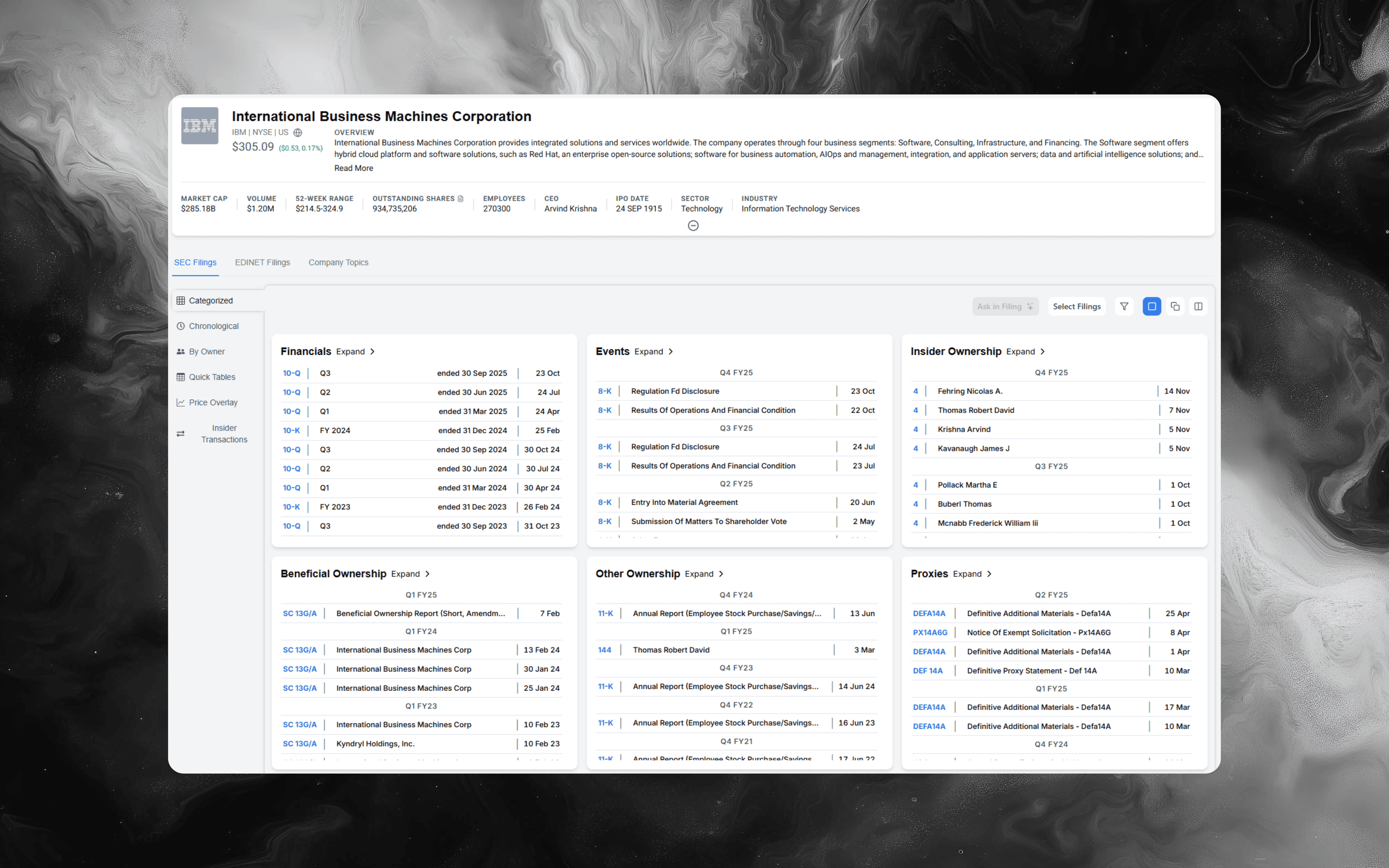
If you want the primary-source foundation (segment definitions, how IBM describes its platforms, what’s changing in disclosures, and the language management uses to explain demand), start with the filings in Alpha Analyst here: International Business Machines Corporation (IBM)
The fastest mental model: IBM sells “enterprise outcomes,” not just technology
A useful way to explain IBM to a non-specialist is:
IBM sells a combination of enterprise software and long-running services that help large organizations run, modernize, and secure critical systems—especially in hybrid cloud environments—while adding AI capabilities to workflows and applications.
Three ideas make the model click:
-
IBM is a mix of product and services economics
Parts of IBM look like classic software (high-margin, recurring subscriptions), while other parts behave like large-scale services delivery (people-intensive with different margin mechanics). -
IBM is organized around segments, but positioned around platforms
In filings, IBM describes strategic platforms (hybrid cloud and AI, including watsonx and Red Hat technologies) that connect the segments—software provides the tools, consulting implements them, and infrastructure runs them. -
Recurring revenue and installed base matter
Enterprise buyers often renew, expand, and add modules over time. The pace of renewals, backlog conversion (in services), and platform adoption can matter as much as “new logo” wins.
For a broader governance and technology perspective on AI in business platforms, see Generative AI Ethics in Business: A Practical Governance Playbook.
How IBM turns strategy into revenue (step-by-step)
Here’s a practical “operating loop” behind IBM’s income statement:
-
A client problem appears (modernization, security, cost, compliance, uptime)
The trigger is often complexity: multiple clouds, legacy applications, regulatory constraints, or the need to modernize without disrupting operations. -
IBM sells software capabilities and/or a transformation program
Some deals are primarily software (licenses/subscriptions, platform tools, security, automation). Others are transformation engagements delivered through consulting. -
Consulting implements and runs the work
Implementation, application modernization, and ongoing operations can become multi-year engagements, where execution quality and delivery capacity influence outcomes. -
Infrastructure supports mission-critical workloads
Some clients buy or refresh infrastructure and related support/services for performance, reliability, and regulated use cases. -
Contracts renew and expand
In enterprise tech, “land” is only the start. Expansion can come from additional workloads, added modules, larger usage, more geographies, or additional managed services.
Analyst takeaway: when you read IBM, try to match each quarter’s commentary to where you are in that loop (new demand, conversion, renewal, expansion, or product cycle).
What IBM sells: the four segments in one map
IBM reports four operating segments in its filings. A simple way to remember them:
-
Software: the products (and recurring subscriptions)
IBM describes this segment as providing software solutions for hybrid cloud platform needs, data and AI, automation, and security. In filings, IBM also discusses Transaction Processing software tied to IBM Z. -
Consulting: the builders and operators
Consulting delivers business transformation, technology consulting, application modernization, and application operations—often leveraging IBM platforms plus ecosystem partners. -
Infrastructure: the systems that run critical workloads
Infrastructure includes compute and storage products and lifecycle support. IBM’s filings often emphasize performance, security, resilience, and mission-critical use cases (including IBM Z). -
Financing: a smaller enabling business
Financing supports client purchases (e.g., financing receivables) and tends to be a smaller revenue contributor relative to the other segments.
A helpful framing for readers new to enterprise tech: IBM is not “one product.” It’s a portfolio where software and services are the primary engines, and infrastructure/financing can support enterprise adoption and long-lived client relationships.
For more on how natural language processing is used to analyze company filings and disclosures (such as IBM’s), explore NLP in Financial Research: Practical Use Cases and Playbook.
The revenue drivers that usually matter most for IBM
For recurring analyst work, the goal is consistency: the same questions, every quarter. These drivers tend to be repeatable:
-
Mix shift between software and services
Software typically carries different margin characteristics than consulting delivery. Even without building a full model, track whether growth is being led by higher-margin software or services-heavy activity. -
Adoption of platform-centric offerings (hybrid cloud and AI)
In IBM’s language, the platform strategy ties together Red Hat, watsonx, automation, data/AI, security, and transaction processing. Watch how management describes demand and client use cases. -
Consulting execution and backlog conversion dynamics
For services businesses, investors often care about signings/backlog and the pace at which work converts into recognized revenue, plus delivery efficiency. -
Infrastructure product cycles
Hardware and infrastructure can be sensitive to refresh cycles. Quarter-to-quarter changes may reflect cycle timing rather than a “new steady state.” -
Currency and geographic mix
IBM is global, and filings discuss currency impacts. When reported growth and constant-currency narratives diverge, the “real story” can be obscured without reading carefully.
Cost structure: where IBM’s operating leverage (or drag) tends to show up
IBM can look straightforward until you break costs into “software scale” vs “services delivery.” A practical way to read the cost mechanics:
-
Software economics: R&D and product expansion
Track the narrative on innovation, platform roadmap, and where IBM is investing (especially AI-related productization). For software, the key question is often: are they getting enough durable recurring demand to justify the investment? -
Consulting economics: utilization, mix, and productivity
Consulting margins are often driven by delivery efficiency, labor mix, and the ability to productize repeatable work. Watch for language that implies pricing pressure, project delays, or improved productivity. -
Infrastructure economics: product mix + support
Infrastructure profitability can be influenced by what’s selling (and when), plus lifecycle services and support. -
Corporate items and one-time charges
IBM’s filings can include items that affect comparability (e.g., portfolio actions, divestitures, and other corporate gains/charges). When margins move, separate structural drivers from one-offs.
A practical checklist for reading IBM filings like an analyst
Use this as a repeatable process each quarter:
-
Start with the segment definitions and any “what changed” notes
IBM periodically updates segment presentation and revenue categories. Capture changes early so your comparisons stay apples-to-apples. -
Build a segment scorecard (one page)
For each segment: revenue direction, segment profit/margin direction, and the stated drivers (mix, demand, product cycle, productivity actions, currency). -
Track platform keywords across the MD&A
Suggested recurring terms to search in Alpha Analyst: “hybrid cloud”, “Red Hat”, “OpenShift”, “watsonx”, “generative AI”, “automation”, “transaction processing”, “IBM Z”, “application modernization”, “security”, “backlog”, “product cycle”, “constant currency”.
For a realistic view of a research workflow that applies to companies like IBM, see Day in the Life of an Investment Analyst: A Realistic Playbook.
-
Read acquisitions and divestitures with a “portfolio fit” lens
Instead of asking “is it big?”, ask “does it strengthen software platform capabilities, add distribution, or expand consulting specialization?” -
Capture the risks that are actually evolving
Risk factors are long, but edits matter. Focus on what changes about client spending, competition, delivery capacity, security/regulatory pressures, and execution on platform strategy.
How to do IBM research faster in Alpha Analyst
If you cover IBM regularly, the highest ROI move is turning your analysis into reusable workflows:
-
Save your IBM keyword set once, then reuse it each filing cycle
Use advanced operators (phrases, NOT, proximity) to reduce noise, then save the search. -
Pin saved searches to a dashboard filtered to IBM
Add widgets like Recent Filings and your saved keyword searches so new disclosures surface automatically as filings arrive. -
Use AI Chat to pressure-test your thesis against filings
Ask questions like “What changed in IBM’s segment commentary quarter-over-quarter?” or “Where does IBM describe its hybrid cloud platform strategy most explicitly?” and ground answers in the documents you’re reviewing.
For a look at how AI-powered tools are transforming SEC filings research workflows, consider AI Search for SEC Filings, Rebuilt From the Ground Up.
- Keep an annotations trail for decisions and open questions
Highlight key passages (segment definition changes, new platform language, acquisition rationale) and store them in a centralized notes hub so you can audit your own thesis later.
Explore IBM filings in Alpha Analyst
To validate how IBM explains its platform-centric hybrid cloud and AI strategy, how it reports segment performance, and what management emphasizes when demand shifts, go straight to the primary-source filings: International Business Machines Corporation (IBM)
CTA: Use Alpha Analyst to search across IBM filings with advanced keyword operators, save your best IBM queries, and pin them to a dashboard so new IBM disclosures surface immediately when they’re published.
Related Posts
View all posts →
January 31, 2026
Fed Chair Nomination News: What Hassett’s Comments Signal
A practical guide to tracking Fed leadership changes, confirmation risk, and market reactions using filings, search, and dashboards

January 29, 2026
New York Fiscal Crisis: A Company Impact Playbook
How to map NYC budget stress to revenue, taxes, real estate, and credit risk across US equities

January 29, 2026
Monetary Debasement and the US Dollar: A Company Playbook
What “currency going to hell” really means, what could come next for USD, and how US businesses can defend margins, cash flows, and valuation

January 16, 2026
Amgen (AMGN) Deep Dive: Products, Pipeline, and Key Risks
A practical equity-research playbook for underwriting the next leg of growth, margin durability, and biosimilar exposure

January 16, 2026
Daikin Industries (6367): A Deep-Dive Equity Research Playbook
Business model, segment drivers, key risks, and how to build a thesis faster in Alpha Analyst
Explore More
View all posts →
February 4, 2026
Software Stocks and AI Disruption Fears: Investor Playbook
How to evaluate “AI risk” claims, pressure-test seat-based pricing, and track what matters in filings using Alpha Analyst

February 4, 2026
Enphase (ENPH) Upgrade After Earnings: What Changed
A practical investor brief on the BMO upgrade, Q4 beat, 2026 guideposts, and how to track follow-through in Alpha Analyst

February 4, 2026
Tether fundraising report: what changed and how to track it
A practical framework for monitoring stablecoin issuer valuation, liquidity, and regulatory signals with Alpha Analyst