

What Does Eli Lilly (LLY) Actually Do?
A plain-English look at Lilly’s one-segment pharma model, how drugs become revenue, and what to track in filings
By Michael Chen

Table of Contents
A simple explanation of Eli Lilly’s business model (it’s not “a weight-loss stock”)
What does Eli Lilly (LLY) actually do? Eli Lilly discovers, develops, manufactures, and markets prescription medicines, and it reports itself as a single business segment: human pharmaceutical products.
If you want the primary-source map (business description, risks, revenue mechanics, and accounting disclosures), start with Lilly’s filings in Alpha Analyst here: Eli Lilly and Company (LLY)
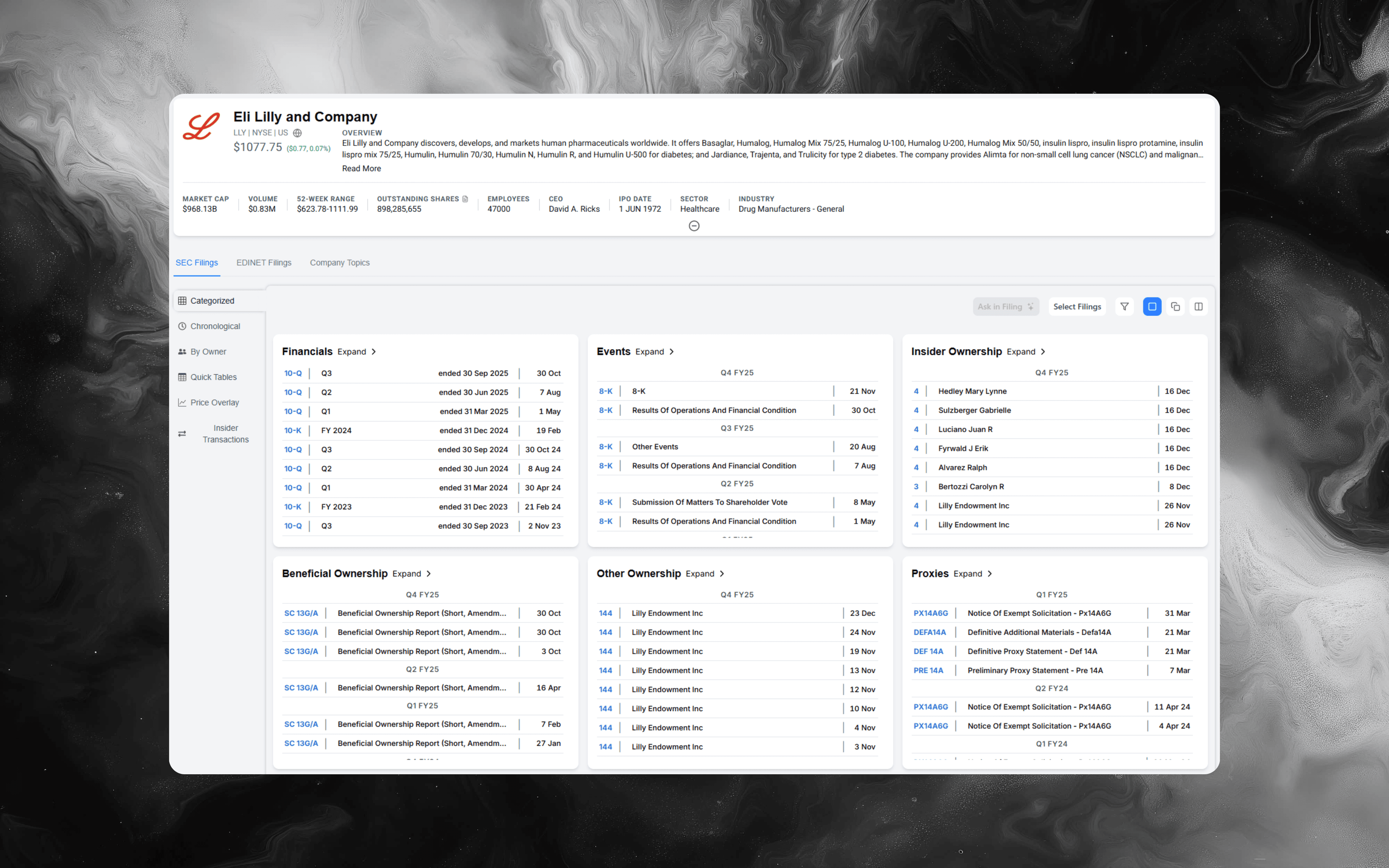
Table of contents
- The fastest mental model: Lilly monetizes medicines, not “therapeutic categories”
- Lilly’s one-segment reporting (and what replaces segments in your analysis)
- From molecule to revenue: the practical lifecycle that drives cash flows
- How Lilly sells drugs: wholesalers, payers, rebates, and access
- Where recurring revenue does (and doesn’t) exist in pharma
- A quick checklist for reading LLY filings like an analyst
- Explore LLY filings in Alpha Analyst
The fastest mental model: Lilly monetizes medicines, not “therapeutic categories”
Lilly is easiest to understand when you separate two ideas:
- What Lilly makes: branded medicines (and, in some cases, collaboration-linked products and royalties)
- How Lilly measures and manages: a portfolio of products and pipeline programs that sit inside one consolidated pharma segment
In other words, Lilly doesn’t need multiple reportable segments to have multiple “engines.” The engines are product families, indications, and pipelines that can rise or fall at different times, even though the financials roll up into a single segment.
A practical way to explain Lilly in one sentence:
Lilly is a global pharma company that earns money by bringing medicines to market, then sustaining demand through supply reliability, patient access, and ongoing evidence generation.
Lilly’s one-segment reporting (and what replaces segments in your analysis)
Some companies hand you a clean, two-segment story (hardware vs software, product vs services, etc.). Lilly is different.
In its 10-K, Lilly describes itself as operating in a single business segment (human pharmaceutical products) and notes that performance is evaluated on consolidated results. For analysts, that changes your workflow:
- You won’t get “segment margins” for oncology vs diabetes vs immunology.
- Instead, you learn the business by triangulating:
- product-level revenue tables and commentary,
- pipeline discussions,
- supply chain constraints and capacity investments,
- pricing/rebate dynamics and access shifts,
- concentration risks (a few products and a few distributors).
This is why a “what does LLY do?” explainer should focus less on segment labels and more on the portfolio mechanics that move the consolidated numbers.
For a broader look at how analysts approach segment and financial structure in their research process, you might find Day in the Life of an Investment Analyst: A Realistic Playbook helpful, especially for adapting workflows across different business models.
From molecule to revenue: the practical lifecycle that drives cash flows
Pharma revenue looks simple on an income statement (sell product, record revenue), but the business behind it is a multi-stage pipeline with several “risk gates.” A useful operating model looks like this:
-
Discover or acquire candidates
Lilly’s long-term success depends on continually discovering, developing, or acquiring new medicines. -
Prove safety and efficacy in clinical trials
Clinical programs can expand into new indications, new dosing, and new patient populations, but timelines and outcomes are uncertain. -
Get regulatory approvals market by market
Even after approval, regulators can change requirements, scrutinize manufacturing quality, or require additional data. -
Manufacture at scale (reliably)
Manufacturing in pharma is highly regulated and capacity expansion takes time. When demand runs ahead of supply (or supply disruptions occur), volume can be constrained regardless of underlying demand. -
Win access with payers and channel partners
Especially in the U.S., access is shaped by formularies, prior authorizations, tier placement, rebates, and patient affordability. -
Sustain demand post-launch
Demand durability depends on real-world experience, competitive entrants, safety updates, new clinical data, and commercial execution.
This lifecycle is the reason Lilly can look “product-concentrated” in the present while still being a diversified R&D engine underneath. The filings are where you see management describe which gates are currently the tightest.
For insight into how these business model patterns recur across the pharmaceutical sector and what key shifts are reshaping pharma, see Pharmaceutical Industry Trends 2025: 5 Shifts Reshaping Pharma.
How Lilly sells drugs: wholesalers, payers, rebates, and access
For a plain-English understanding of LLY revenue, the most important idea is this:
Lilly’s list price is not the same as Lilly’s net realized price.
A simplified channel model:
- Lilly sells most U.S. volume through a small set of large wholesalers.
- Payers and pharmacy benefit managers influence which drugs get covered and on what terms.
- Discounts and rebates are common, and net product revenue reflects those reductions.
That matters because two quarters with identical prescription demand can still show different net revenue trends if:
- mix shifts between products with different rebate intensity,
- payer coverage changes,
- patient affordability programs change,
- estimates for rebates/discounts are updated.
Lilly also describes patient access initiatives, including a direct-to-consumer digital healthcare platform (LillyDirect) intended to help patients access care and, for certain medicines, home delivery through third-party pharmacies. Operationally, initiatives like this can influence access friction, patient experience, and the commercial pathway, even though they don’t change the core truth: Lilly remains a medicines company selling through a complex healthcare ecosystem.
Where recurring revenue does (and doesn’t) exist in pharma
If you’re coming from software or payments, it’s tempting to look for classic “contracted recurring revenue.” Pharma works differently.
Here’s a more accurate recurring framework for LLY:
-
Chronic therapy persistence (behavioral recurrence)
Some medicines are used long-term. That can create repeat demand, but it’s not contractual; it depends on adherence, coverage, safety, and competition. -
Indication expansion (portfolio recurrence)
A single molecule can generate multiple revenue waves as indications expand and guidelines evolve. -
Collaboration and royalty-like revenue (contract recurrence)
Lilly has collaborations and other arrangements that can include profit shares or royalties. These can behave more like contracted cash flows, but they’re typically tied to performance and product success. -
Patent and exclusivity cliffs (the anti-recurring force)
In pharma, today’s “recurring” demand can compress quickly when exclusivity fades and generics/biosimilars enter.
A simple takeaway:
Lilly’s durability comes from medical value plus access plus supply execution across a portfolio, not from subscription contracts.
To see how these risk and recurring revenue concepts are relevant for sector-wide business model changes—including supply chain, policy, and technology impacts—review Manufacturing Trends 2025: 5 Signals to Monitor.
A quick checklist for reading LLY filings like an analyst
Use this checklist each quarter/year to keep your research consistent and to spot narrative shifts early.
-
Product concentration and “few products” risk language
Look for disclosures about reliance on a small number of products or product classes, and how management frames that risk over time. -
Net price vs volume drivers
In MD&A, track whether growth is described as primarily volume-driven, price-driven, or mix-driven, and note any mention of rebates, discounts, or access changes. -
Supply chain and capacity constraints
Scan for language on manufacturing capacity additions, third-party manufacturing, lead times, shortages, or demand/supply mismatches. -
Competitive dynamics and class effects
Pay attention to competition framing, including generics, biosimilars, and any discussion of compounded/counterfeit market risks that could affect perception or pricing. -
Regulatory and legal exposure
Track risk factor updates around regulation, quality inspections, pricing scrutiny, investigations, and litigation. -
Technology risk (including AI)
Lilly specifically flags that the use of AI and emerging technologies can introduce or exacerbate competitive, regulatory, litigation, and cybersecurity risks. Watch how that language evolves.
Practical habit: build a “standing query pack” and rerun it every filing. You want the same search inputs so changes in wording become obvious.
For more practical tips on building habits and workflows that keep your research engine consistent, Day in the Life of an Investment Analyst: A Realistic Playbook offers a realistic framework you can apply in pharma and beyond.
Explore LLY filings in Alpha Analyst
To validate how Lilly describes its single-segment structure, follow how it explains product concentration, access and rebate dynamics, supply capacity, and key risks, go straight to the primary-source filings: Eli Lilly and Company (LLY)
CTA: Use Alpha Analyst to search across LLY filings with advanced keyword operators (phrases like “single reportable segment”, “net product revenue”, “rebates and discounts”, “wholesalers”, “formulary”, “supply”, “manufacturing capacity”, “compounded”, and “risk factors”), save those searches, and add them to a dashboard so new disclosures surface as soon as they land.
Related Posts
View all posts →
January 31, 2026
Fed Chair Nomination News: What Hassett’s Comments Signal
A practical guide to tracking Fed leadership changes, confirmation risk, and market reactions using filings, search, and dashboards

January 29, 2026
New York Fiscal Crisis: A Company Impact Playbook
How to map NYC budget stress to revenue, taxes, real estate, and credit risk across US equities

January 29, 2026
Monetary Debasement and the US Dollar: A Company Playbook
What “currency going to hell” really means, what could come next for USD, and how US businesses can defend margins, cash flows, and valuation

January 16, 2026
Amgen (AMGN) Deep Dive: Products, Pipeline, and Key Risks
A practical equity-research playbook for underwriting the next leg of growth, margin durability, and biosimilar exposure

January 16, 2026
Daikin Industries (6367): A Deep-Dive Equity Research Playbook
Business model, segment drivers, key risks, and how to build a thesis faster in Alpha Analyst
Explore More
View all posts →
February 4, 2026
Software Stocks and AI Disruption Fears: Investor Playbook
How to evaluate “AI risk” claims, pressure-test seat-based pricing, and track what matters in filings using Alpha Analyst

February 4, 2026
Enphase (ENPH) Upgrade After Earnings: What Changed
A practical investor brief on the BMO upgrade, Q4 beat, 2026 guideposts, and how to track follow-through in Alpha Analyst

February 4, 2026
Tether fundraising report: what changed and how to track it
A practical framework for monitoring stablecoin issuer valuation, liquidity, and regulatory signals with Alpha Analyst