

What Does SoftBank Group (9434.T) Actually Do?
A plain-English map of SoftBank’s holding-company model, how gains and losses flow through, and what to track in filings

Table of Contents
A plain-English explanation of SoftBank Group’s business model (a portfolio holding company, not a single operating business)
What does SoftBank Group (9434.T) actually do? At a high level, SoftBank is a holding company that owns a mix of public equities, private technology investments, and operating subsidiaries, and it tries to compound capital by allocating across that portfolio over time.
That sounds simple, but the analysis gets tricky because earnings can swing based on the market value of holdings, private valuation changes, and realized gains or losses from sales.
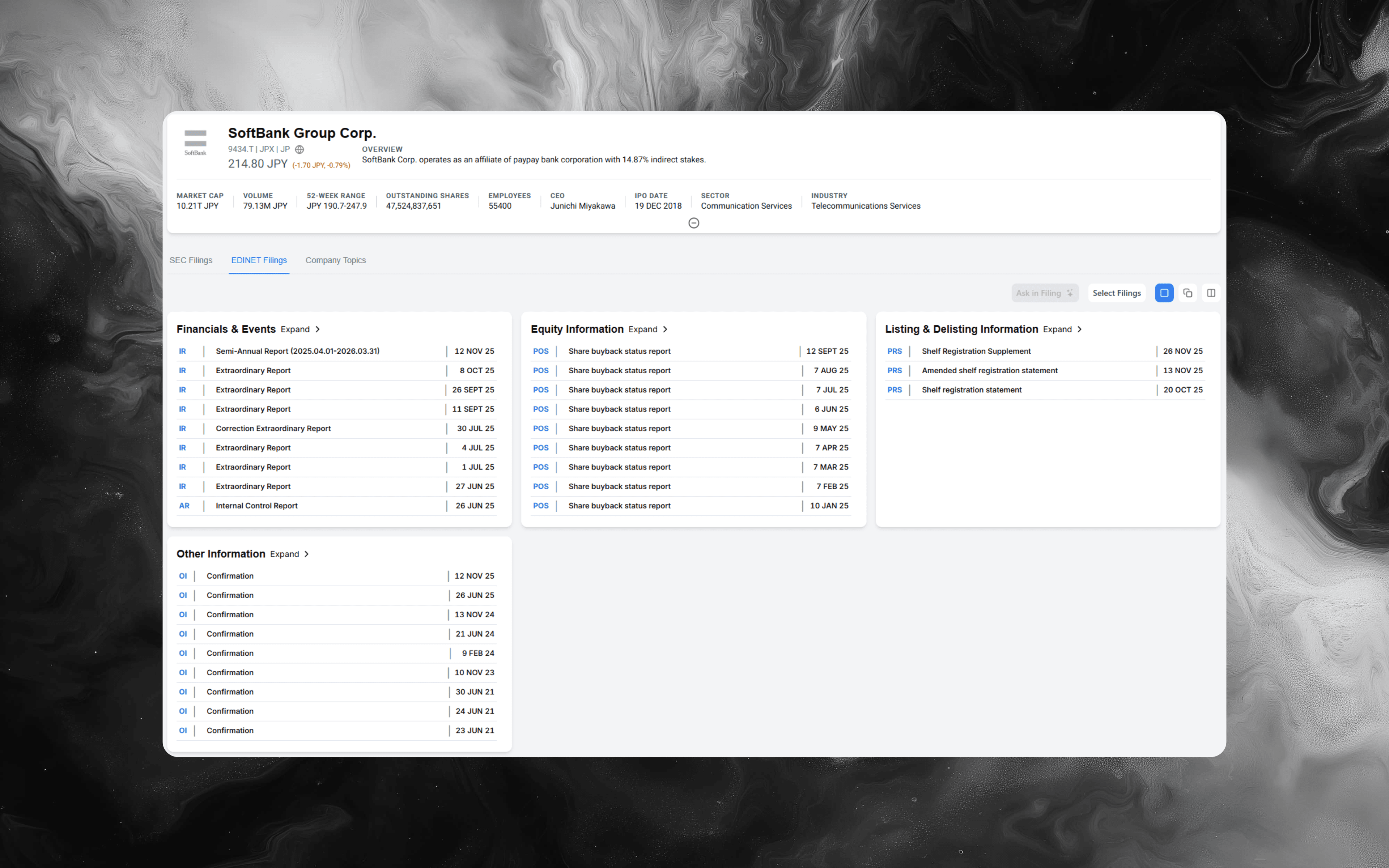
If you want to start from the source documents and see how the company describes itself, begin with the filings in Alpha Analyst here: SoftBank Group Corp. (9434.T)
The fastest mental model: a balance sheet of investments with a financing layer
A practical way to think about SoftBank is:
- Assets: stakes in portfolio companies (public and private) plus operating subsidiaries
- Liabilities: holding-company debt and other financing obligations
- Equity value: what’s left after funding costs, taxes, and volatility in asset values
For many investors, the central question becomes: what is the underlying value of the portfolio (often discussed as net asset value or NAV-like thinking) versus what the market is paying for the holding company, and how does leverage change the risk?
For a comparison with how other diversified holding companies approach valuation, portfolio risk, and market value disconnects, you might also explore What Does Berkshire Hathaway (BRK) Actually Do? (if available), or compare SoftBank’s model to What Does Wells Fargo (WFC) Actually Do? for a banking-focused holding business.
What SoftBank “sells” (and why the income statement can be misleading)
Unlike a bank or a software company, SoftBank is not primarily “selling a product” every day. Its economic engine is closer to these buckets:
-
Investment results from portfolio companies
This can include gains and losses from public holdings moving up or down, and revaluations or impairments on private investments. -
Realized monetization events
When SoftBank sells a stake (fully or partially), the realized gain or loss can materially impact results. -
Ongoing operating cash flows from subsidiaries (where applicable)
Some parts of the group may generate recurring operating revenue and cash flow, but the consolidated story can still be dominated by investment marks. -
Financing and capital allocation decisions
Issuing debt, buying back shares, selling assets, or shifting exposure between public and private holdings can matter as much as “operating performance.”
Analyst takeaway: for an investment-heavy holding company, reported profit in a given quarter can be a noisy signal. You often need a second lens focused on portfolio composition, valuation methodology, liquidity, and financing.
The step-by-step operating loop (how decisions turn into returns)
Here’s a repeatable way to connect SoftBank’s activity to outcomes:
-
Raise and manage capital
The company funds itself through a mix of equity and debt at the holding-company level (and sometimes through structures around specific assets). -
Deploy capital into concentrated positions
SoftBank has historically taken meaningful stakes rather than broad, index-like diversification. Concentration can amplify upside and downside. -
Value changes hit results (sometimes quickly, sometimes slowly)
Public holdings can move daily. Private holdings can reprice less frequently, often tied to funding rounds, comparable public multiples, or internal valuation frameworks. -
Realizations convert paper value into cash (or reduce risk)
The path from “marked value” to “cash proceeds” matters. Investors should separate unrealized marks from realized exits. -
Capital allocation feedback loop
Proceeds from sales, cash from subsidiaries, and financing capacity feed back into new investments, debt paydowns, buybacks, or reserves for volatility.
If you can map a disclosure to one of those steps, it becomes easier to judge whether it changes long-term compounding potential or is just short-term noise.
How to read SoftBank filings like an analyst (a repeatable checklist)
Use this as a standing process when new filings arrive:
-
Start with segment and portfolio framing
Identify how the company groups its activities (investment-related segments vs operating businesses). Your goal is a stable mental model that holds up quarter to quarter. -
Separate three concepts: marks, realizations, and cash
Ask:- What changed because market prices moved?
- What changed because the company sold something?
- What changed because cash actually came in or went out?
-
Track leverage and refinancing risk like it’s a core product
For a holding company, debt maturity profiles, covenants, and interest costs can influence strategy (when to sell assets, whether to do buybacks, and how much risk the portfolio can carry). -
Watch concentration and exposure drift
Even if the company looks diversified on paper, a few large positions can dominate outcomes. Track the largest holdings and how quickly that concentration is changing. -
Look for valuation policy language changes
For private assets, small changes in methodology or assumptions can move marks. Even without numbers, wording changes can be a signal that judgment is shifting. -
Treat “liquidity” as a strategic constraint
The ability to fund obligations without forced selling is often as important as long-term upside. Note disclosures about cash, committed facilities, and how assets can be monetized.
For further guidance on efficient filing review, see One-Click 10-K & 10-Q Financials to Excel and AI Search for SEC Filings, Rebuilt From the Ground Up.
Key metrics to follow each period (what usually explains the swings)
For SoftBank-style analysis, these tend to explain most headline moves:
-
Investment gains/losses and what drove them
Focus on whether changes are driven by a small set of names, broad market movement, FX, or private valuation adjustments. -
Realizations and monetization activity
What was sold, why, and what the cash was used for (debt reduction, buybacks, redeployment). -
Holding-company financial flexibility
Cash position, near-term maturities, and how management talks about funding plans. -
Portfolio mix shifts
Public vs private, region/sector exposure, and how concentrated the top holdings are.
For broader industry context, consider reading NLP in Financial Research: Practical Use Cases and Playbook, which details how modern language AI can accelerate analysis of filings and disclosures across complex portfolios.
Keywords to search in SoftBank filings (so you don’t miss what matters)
If you want a high-signal workflow, run the same searches every filing cycle and compare what changes:
- “segment” or “segment information”
- “investment” and “investment gain” / “investment loss”
- “fair value” and “valuation”
- “unrealized” and “realized”
- “impairment”
- “liquidity” and “cash and cash equivalents”
- “debt” and “maturity”
- “interest expense”
- “foreign exchange” or “FX”
- “hedge” or “derivative”
- “share repurchase” or “buyback”
In Alpha Analyst, these searches get much more precise when you use phrase matching and proximity-style operators (so you can keep “fair value” near “unlisted” or “valuation technique,” for example).
A practical Alpha Analyst workflow for covering SoftBank over time
If you follow SoftBank (or any investment-heavy holding company) across multiple filing cycles, the fastest improvement is turning your research into a repeatable system:
-
Save a “SoftBank core” search pack once
Build saved searches for valuation language, fair value hierarchy, liquidity/debt, realizations, and segment disclosures. Reuse them every filing cycle to keep your diligence consistent. -
Put monitoring on autopilot with dashboards
Create a dashboard with Recent Filings plus your saved keyword searches filtered to 9434.T, so new disclosures surface immediately when they’re published. -
Use AI Chat to turn filing language into a decision-ready summary
Examples to ask:- “What changed in SoftBank’s discussion of liquidity and funding this period?”
- “Where do they explain drivers of investment gains and losses?”
- “What did they say about valuation methodology for unlisted investments?”
Keep answers grounded by filtering the document universe to the specific filing(s) you want to analyze.
-
Annotate the few passages you’ll need next quarter
Highlight the lines that explain the biggest drivers (valuation policies, material exits, financing actions, concentration changes). Next quarter, you can jump straight back to those anchor points and see what changed.
For additional workflow systems, see Day in the Life of an Investment Analyst: A Realistic Playbook.
Explore SoftBank filings in Alpha Analyst
To validate how SoftBank describes its portfolio, how gains and losses flow through results, and where financing and liquidity constraints show up in disclosure language, go straight to the primary-source filings: SoftBank Group Corp. (9434.T)
CTA: Use Alpha Analyst to search across SoftBank filings with advanced keyword operators, save your best 9434.T queries, and pin them to a dashboard so new SoftBank disclosures surface the moment they’re published.
Related Posts
View all posts →
January 16, 2026
Amgen (AMGN) Deep Dive: Products, Pipeline, and Key Risks
A practical equity-research playbook for underwriting the next leg of growth, margin durability, and biosimilar exposure

January 16, 2026
Daikin Industries (6367): A Deep-Dive Equity Research Playbook
Business model, segment drivers, key risks, and how to build a thesis faster in Alpha Analyst

January 16, 2026
Bridgestone (5108): Deep Dive on Segments, Strategy, and Risks
A fundamentals-first breakdown of how the tire leader makes money, what’s changing in 2024–2026, and what to monitor next

January 16, 2026
Panasonic (6752) Deep Dive: Segments, Strategy, and Key Watch Items
A filing-driven look at Panasonic Holdings’ business mix, portfolio moves, and the debates that matter for investors

January 16, 2026
Gilead Sciences (GILD) Deep Dive: Business, Moats, and Key Risks
A practical investor framework for underwriting Gilead’s HIV-led cash flows, oncology optionality, and policy-driven headwinds
Explore More
View all posts →
February 4, 2026
Software Stocks and AI Disruption Fears: Investor Playbook
How to evaluate “AI risk” claims, pressure-test seat-based pricing, and track what matters in filings using Alpha Analyst

February 4, 2026
Enphase (ENPH) Upgrade After Earnings: What Changed
A practical investor brief on the BMO upgrade, Q4 beat, 2026 guideposts, and how to track follow-through in Alpha Analyst

February 4, 2026
Tether fundraising report: what changed and how to track it
A practical framework for monitoring stablecoin issuer valuation, liquidity, and regulatory signals with Alpha Analyst