

What Does Shopify (SHOP) Actually Do?
A plain-English map of Shopify’s commerce platform, how revenue is split, and what to track in SEC filings

Table of Contents
A plain-English explanation of Shopify’s business model (software platform + merchant services)
What does Shopify (SHOP) actually do? At a high level, Shopify sells a commerce platform that helps merchants run a retail business across online and offline channels, and it earns revenue in two big buckets: software subscriptions and merchant-linked services.
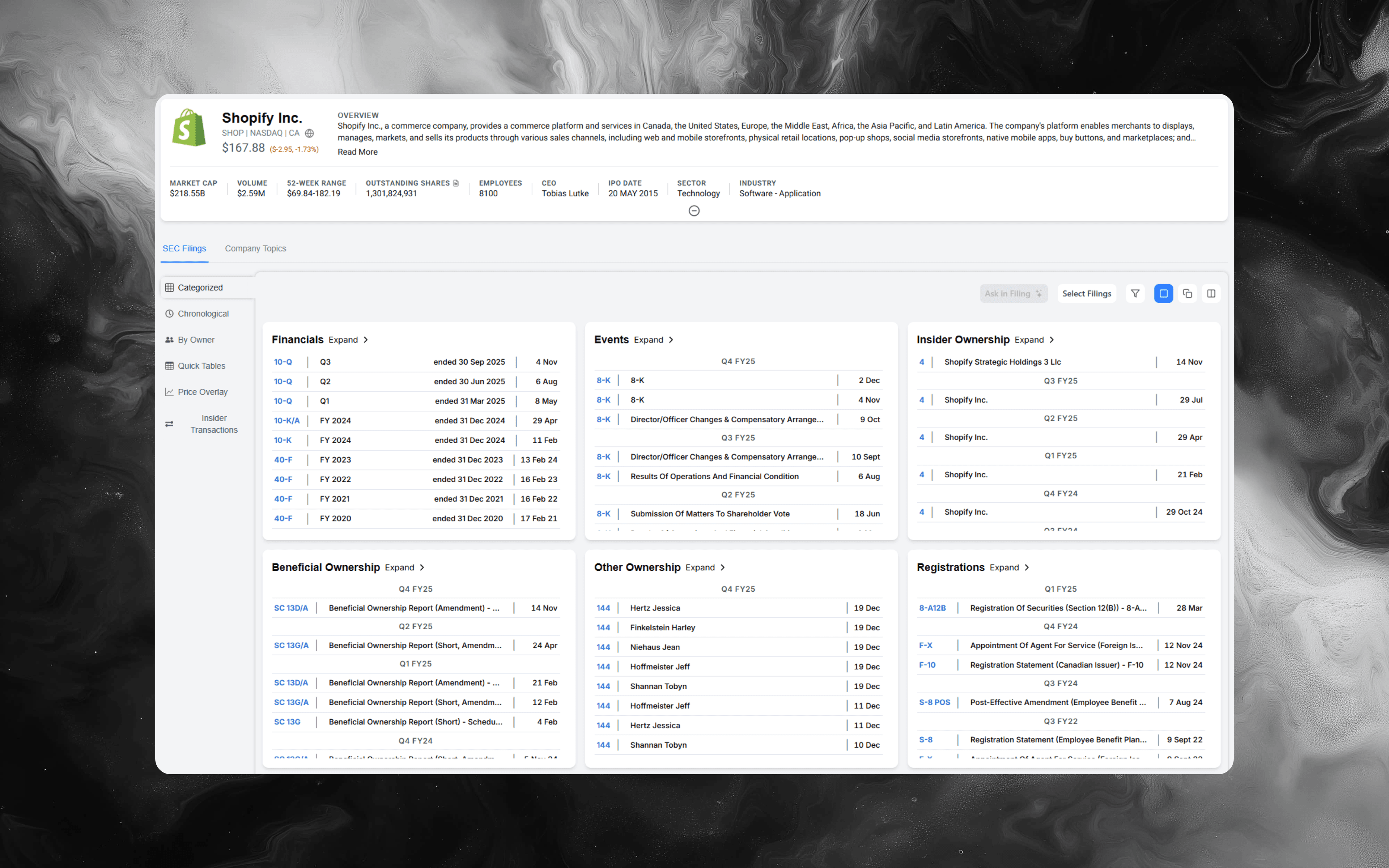
If you want the primary-source foundation (how Shopify defines its revenue categories, what products sit inside each category, and how it recognizes revenue), start with the filings in Alpha Analyst here: Shopify Inc. (SHOP)
The fastest mental model: Shopify is a two-engine model
A simple way to hold Shopify in your head is as two connected engines:
- Subscription engine: merchants pay to access the platform and tools (more predictable, plan-driven)
- Merchant services engine: Shopify earns when merchants sell and transact (more variable, activity-driven)
The strategic idea is that software gets a merchant onto the platform, and then Shopify increases revenue per merchant by attaching services that are naturally needed to run commerce.
What Shopify sells (in filing language: Subscription Solutions vs Merchant Solutions)
Shopify’s filings describe two primary revenue sources:
-
Subscription Solutions This is largely platform subscription revenue, plus related items such as POS Pro subscriptions, themes/apps, domain registration, and certain variable platform fees.
-
Merchant Solutions This bucket includes services designed to increase merchant use of the platform, including items such as Shopify Payments, Shopify Shipping, referral and transaction services, POS hardware, advertising on the Shopify App Store, Shopify Email, Shopify Capital, Shop Pay Installments, Shopify Balance, and cross-border offerings like Shopify Markets.
Analyst takeaway: when you read the income statement, don’t just ask “did revenue grow?” Ask which engine drove it: subscriptions (merchant count/plan mix/pricing) or merchant solutions (volume, payment penetration, take rate, and attach).
If you’re interested in a broader context on how analysts approach SEC filings or segment economics efficiently, see One-Click 10-K & 10-Q Financials to Excel or AI Search for SEC Filings, Rebuilt From the Ground Up.
How Shopify makes money (the step-by-step operating loop)
Here’s the practical operating loop that connects a merchant’s workflow to Shopify’s financial model:
-
A merchant starts on Shopify and pays for access The merchant chooses a plan and begins using the platform to run storefront, products, inventory, and order management.
-
The merchant sells across channels Shopify is designed to support multiple sales channels (online storefronts, marketplaces, social, and physical retail). More commerce activity expands the opportunity for merchant solutions.
-
Shopify attaches transaction and operational services When a merchant uses Shopify-linked services (payments, shipping labels, financing tools, and other transaction services), Shopify earns revenue that is tied to usage.
-
Revenue splits into two reporting lines Subscription Solutions tends to be tied to access and tooling. Merchant Solutions tends to scale with transaction volume and service adoption.
-
Costs differ by engine Merchant Solutions can carry higher direct costs (for example, payment processing and other service delivery costs), while Subscription Solutions is closer to a software cost structure.
This loop is why Shopify research often comes down to two questions: how many merchants are on the platform, and how deeply Shopify is embedded in how those merchants operate.
The key Shopify products to map to the P&L
When you read filings, it helps to translate product names into “what line does it usually pull on?”
-
Core platform subscription The foundational monthly/annual access fee for the platform.
-
POS Pro and offline enablement Shopify’s point-of-sale offering helps unify in-store and online operations. In filings, POS Pro subscriptions show up in subscription solutions; related hardware sales are part of merchant solutions.
-
Payments and checkout Shopify Payments and Shop Pay are central to the merchant solutions engine because they tie to transaction volume and payment processing economics.
-
Shipping and fulfillment-related services Shopify Shipping revenue is tied to shipping label activity and service delivery. (In filings, Shopify Shipping is discussed inside merchant solutions.)
-
Financing and merchant cash advances Shopify Capital is a financing program for eligible merchants. It’s useful to treat this as both a growth lever and a risk vector (credit/transaction and loan losses, underwriting changes, and loss rates).
-
Merchant financial tools Shopify Balance and related card services sit inside merchant solutions and can strengthen Shopify’s role in day-to-day merchant operations.
-
Cross-border selling enablement Shopify Markets is positioned as a way to help merchants sell internationally, and it can interact with other transactional services and partner economics.
For insight into how payment companies structure their platforms and monetize service layers, you might compare with What Does Mastercard (MA) Actually Do?.
The few metrics that explain most quarter-to-quarter changes
Shopify can feel noisy quarter to quarter, but a lot of variance tends to map back to a short list of drivers:
-
Subscription base health Look for signals on merchant additions, churn/retention, plan mix, and pricing/packaging changes. These factors influence Subscription Solutions.
-
Merchant Solutions attach and monetization Track how adoption changes for products like payments, shipping, and financing. The core concept is “revenue per merchant,” often driven by penetration of Shopify services.
-
Gross margin mix shift A higher share of merchant solutions can pressure or lift gross margin depending on product mix and unit economics. Always ask what changed in the mix, not only the headline margin.
-
Losses related to transactions and loans Shopify reports transaction and loan losses as an operating expense line. If Shopify Capital expands or credit performance changes, this line can become a meaningful swing factor.
How to read Shopify filings like an analyst (repeatable checklist)
Use this checklist each 10-Q/annual cycle so you don’t rely on management language alone:
-
Start with the segment bridge Build a simple two-line bridge:
- Subscription Solutions: what changed (merchant base, pricing, mix)?
- Merchant Solutions: what changed (volume, attach, take rate, product adoption)?
-
Translate “product news” into financial statement impact Every product update should map to one of these:
- subscription expansion (higher ARPU, better retention)
- higher merchant services penetration (more attach)
- changes in costs or risk (processing costs, credit losses)
-
Watch accounting signals inside revenue recognition disclosures Shopify’s filings describe how different products recognize revenue (over time vs point in time) and, in some areas, whether revenue is recorded gross or net depending on principal-versus-agent conclusions. Those details can matter when you’re modeling the “true” economics of certain services.
-
Track risk using the “where can losses show up?” lens For Shopify, that often means:
- merchant receivables/credit exposure (Shopify Capital)
- transaction disputes/fraud/chargebacks (payments ecosystem dynamics)
- partner dependencies and changing economics in services delivered via third parties
-
Force a unit-economics sanity check Even if you don’t have every KPI, you can still ask:
- which engine grew faster?
- did margins move in the same direction as mix would suggest?
- did transaction and loan losses move with the financing program’s footprint?
Keywords to search in Shopify filings (to catch the signal fast)
Run these searches each quarter and compare how language changes over time:
- “Subscription Solutions” and “Merchant Solutions”
- “Shopify Payments” and “payment processing”
- “Shop Pay” and “Shop Pay Installments”
- “Shopify Capital” and “merchant cash advances”
- “Shopify Shipping” and “shipping labels”
- “Shopify Balance” and “card services”
- “Shopify Markets” and “cross-border”
- “transaction and loan losses”
- “principal versus agent”
- “deferred revenue” and “variable platform fees”
In Alpha Analyst, these are especially effective when you use phrase matching, AND/OR logic, and proximity-style operators to keep results focused on the exact disclosure you care about.
For more on incorporating AI and workflow efficiency when parsing filings, see NLP in Financial Research: Practical Use Cases and Playbook.
How to do Shopify research faster in Alpha Analyst
If you cover Shopify (or commerce software names more broadly) repeatedly, the speed upgrade is turning your recurring diligence into reusable building blocks:
-
Save a “SHOP core” search pack once Create saved searches for the revenue split, payments, shipping, capital/credit, and principal-versus-agent language. Reuse them every quarter so you’re always comparing like-for-like.
-
Pin your saved searches to a monitoring dashboard Build a dashboard with Recent Filings plus your saved keyword searches filtered to SHOP, so new disclosures surface automatically as soon as they’re filed.
-
Use AI Chat to translate dense accounting and product language into decision-ready takeaways Example prompts:
- “Summarize what Shopify includes in Merchant Solutions and what changed this period.”
- “Where do they discuss Shopify Capital economics and credit risk this cycle?”
- “What disclosures explain changes in gross margin mix between Subscription Solutions and Merchant Solutions?”
-
Annotate the 10–15 passages that actually move your model Highlight the definitions, the “what changed” commentary, and any revisions to product scope or revenue recognition language. Next quarter, your prior notes become an instant baseline.
If you’re interested in professional analyst routines for speed and auditability, see Day in the Life of an Investment Analyst: A Realistic Playbook.
Explore Shopify filings in Alpha Analyst
To validate how Shopify describes its operating model, what sits inside Subscription Solutions vs Merchant Solutions, and what is changing in the disclosures over time, go straight to the primary-source filings: Shopify Inc. (SHOP)
CTA: Use Alpha Analyst to search across Shopify filings with advanced keyword operators, save your best SHOP queries, and pin them to a dashboard so new Shopify disclosures surface immediately when they’re published.
Related Posts
View all posts →
January 31, 2026
Fed Chair Nomination News: What Hassett’s Comments Signal
A practical guide to tracking Fed leadership changes, confirmation risk, and market reactions using filings, search, and dashboards

January 29, 2026
New York Fiscal Crisis: A Company Impact Playbook
How to map NYC budget stress to revenue, taxes, real estate, and credit risk across US equities

January 29, 2026
Monetary Debasement and the US Dollar: A Company Playbook
What “currency going to hell” really means, what could come next for USD, and how US businesses can defend margins, cash flows, and valuation

January 16, 2026
Amgen (AMGN) Deep Dive: Products, Pipeline, and Key Risks
A practical equity-research playbook for underwriting the next leg of growth, margin durability, and biosimilar exposure

January 16, 2026
Daikin Industries (6367): A Deep-Dive Equity Research Playbook
Business model, segment drivers, key risks, and how to build a thesis faster in Alpha Analyst
Explore More
View all posts →
February 4, 2026
Software Stocks and AI Disruption Fears: Investor Playbook
How to evaluate “AI risk” claims, pressure-test seat-based pricing, and track what matters in filings using Alpha Analyst

February 4, 2026
Enphase (ENPH) Upgrade After Earnings: What Changed
A practical investor brief on the BMO upgrade, Q4 beat, 2026 guideposts, and how to track follow-through in Alpha Analyst

February 4, 2026
Tether fundraising report: what changed and how to track it
A practical framework for monitoring stablecoin issuer valuation, liquidity, and regulatory signals with Alpha Analyst