

What Does Mastercard (MA) Actually Do?
A plain-English map of the payment network, who pays the fees, and why “net revenues” show up in five key buckets
By Michael Chen

Table of Contents
A simple explanation of Mastercard’s business model (it’s more “toll road” than “bank”)
What does Mastercard (MA) actually do? Mastercard runs a global payments network that connects consumers, banks, and merchants so electronic payments can be authorized, cleared, and settled. In many cases, Mastercard is not the lender and it generally does not take the credit risk on the cardholder’s balance. Instead, it earns fees for enabling transactions and for related services.
If you want the primary-source foundation (business description, risk factors, accounting policies, and how the company breaks down net revenues), start with the filings in Alpha Analyst here: Mastercard Incorporated (MA)
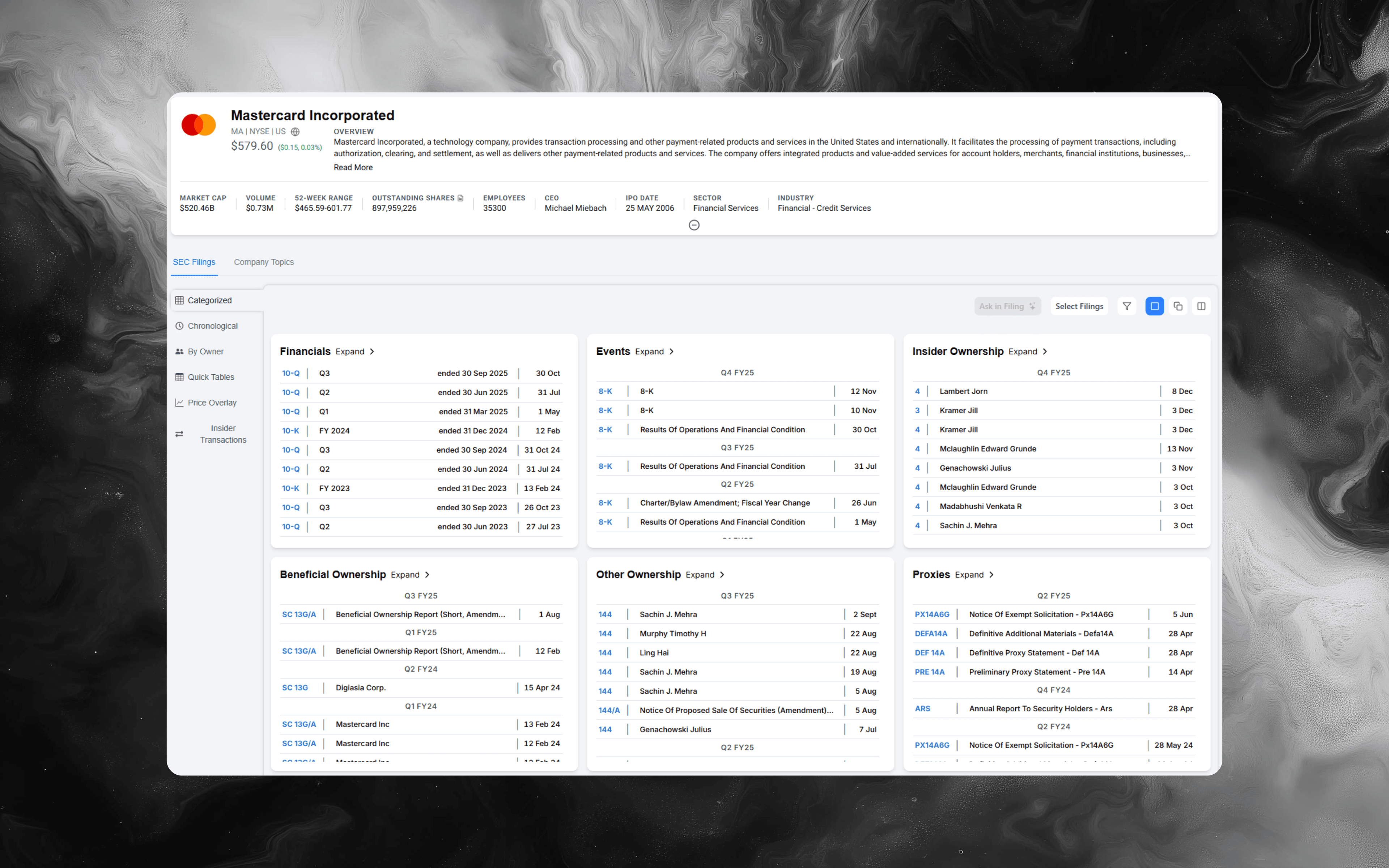
Table of contents
- The fastest mental model: Mastercard is the network behind the swipe/tap
- The four-participant system that makes a card payment work
- What Mastercard sells (network services plus value-added services)
- The five net revenue categories to know (and what drives each)
- Where recurring revenue tends to come from (and where it doesn’t)
- A quick checklist for reading MA filings like an analyst
- Explore Mastercard filings in Alpha Analyst
The fastest mental model: Mastercard is the network behind the swipe/tap
A clean way to explain Mastercard to a non-specialist is:
Mastercard operates the rails, rules, and processing that allow banks and merchants to complete electronic payments at scale.
Think “network utility”:
- When more payments run over the network, fee revenue tends to grow with activity (dollar volume and transaction count).
- When commerce shifts from domestic to cross-border, the economics can change because cross-border activity has its own fee bucket.
- As the network relationship deepens, Mastercard can sell additional services around security, authentication, analytics, and acceptance.
This mental model helps avoid a common mistake: treating Mastercard like a consumer lender. Banks (issuers) typically provide the credit; Mastercard provides the network and services.
For a broader playbook on how language AI is being embedded into financial research—including in payments and transaction data—read NLP in Financial Research: Practical Use Cases and Playbook.
The four-participant system that makes a card payment work
Mastercard’s filings describe a core network with four participants in addition to Mastercard:
- Account holders: the person or business using the card (or payment credential)
- Issuers: the bank (or financial institution) that issues the card to the account holder
- Merchants: the business accepting the payment
- Acquirers: the merchant’s bank (or payment institution) that routes transactions for the merchant
Why this matters for investors: it clarifies who Mastercard’s direct “customers” are for many fees (often issuers and acquirers), even though the brand is most visible to consumers at the point of sale.
What Mastercard sells (network services plus value-added services)
At a practical level, Mastercard monetizes two big activity streams:
-
Network fees tied to payment activity Mastercard earns fees based on payment volumes (gross dollar volume) and transaction processing (the count and type of transactions).
-
“Attach” services sold alongside the core network The company also earns revenue from other payment-related products and services that are often integrated and sold with payment offerings. These can include areas like security, data/insights, fraud tools, and other capabilities that help issuers, acquirers, and merchants run safer and more efficient payments.
A useful way to say it in one sentence:
Mastercard earns money when payments flow through its network, and it can earn more per relationship when customers adopt additional services around those payment flows.
The five net revenue categories to know (and what drives each)
Mastercard’s filings classify net revenues into five categories:
-
Domestic assessments Fees generally linked to payment volume within a country or domestic region. A simple driver to watch is domestic consumer spending and overall electronic payment penetration.
-
Cross-border volume fees Fees generally linked to cross-border payment activity. Travel trends, e-commerce imports, FX-related commerce, and geographic mix can all influence this bucket.
-
Transaction processing Fees tied more directly to the number and type of transactions processed. This bucket is often connected to payment frequency and shifts in transaction mix (for example, more small-ticket tap-to-pay usage typically increases transaction count).
-
Other revenues A catch-all bucket for other payment-related products and services, often including value-added services. This is where you’ll often find signals about expansion beyond the “core swipe.”
-
Rebates and incentives (contra-revenue) Payments networks commonly provide incentives to customers (for example, to support volume growth, acceptance expansion, or partnership economics). These reduce net revenues and can materially affect net revenue yield, especially when competition intensifies.
When you see investors talk about “pricing,” “take rate,” or “yield,” it often comes down to changes in mix across these buckets and changes in incentives relative to gross activity.
For sector-specific changes that can impact payments—like policy, automation, and digital trends—see Manufacturing Trends 2025: 5 Signals to Monitor.
Where recurring revenue tends to come from (and where it doesn’t)
Mastercard can look “recurring,” but it’s not subscription recurring in the classic SaaS sense. A better framing is activity recurring.
Places where revenue can feel recurring:
-
Everyday payments volume A large portion of spend (groceries, fuel, bills, commerce) repeats continuously, which can create a steady baseline of network activity.
-
Embedded network relationships Issuers and acquirers don’t typically change networks lightly because it affects card programs, merchant acceptance, processing flows, and customer experience.
-
Value-added services that renew or expand Many add-on services (security, data, analytics, risk tools) can become ongoing operating tools for customers, supporting renew-and-expand behavior even when payment growth slows.
Places where revenue is more variable:
-
Cross-border activity Travel cycles, macro conditions, and geopolitical friction can swing cross-border volume more than domestic spend.
-
Incentives Rebates and incentives can rise or fall as customer negotiations change, creating periods where “net revenues” grow differently than underlying gross activity.
A simple summary:
Mastercard’s economics often behave like a scaled network business whose revenue follows payment activity, with incentives and mix determining how much of that activity turns into net revenue.
A quick checklist for reading MA filings like an analyst
Use this checklist to keep your Mastercard review consistent quarter to quarter:
-
Start with the net revenue bridge Track what management says about domestic assessments, cross-border fees, transaction processing, other revenues, and incentives. Mix changes can matter as much as growth.
-
Look for changes in competitive language Watch for shifts in how incentives are discussed, especially if the narrative suggests higher cost to win or retain volumes.
-
Follow the activity drivers Pay attention to volume language (gross dollar volume), processed transactions, geographic mix, and cross-border commentary. These are the mechanical levers behind the model.
-
Scan for product expansion signals In business sections and MD&A, look for mentions of additional services being integrated with payment offerings, which can indicate deeper customer relationships.
-
Watch risk factor updates that touch regulation and network rules Payments networks operate inside complex regulatory and competitive environments. Changes here can signal future pricing, incentives, or product constraints.
A practical habit: keep a saved keyword list (for example: “cross-border volume”, “transaction processing”, “rebates and incentives”, “net revenues”, “gross dollar volume”) so you can quickly spot what changed in language, not just the numbers.
For a hands-on guide to analyst routines, playbook strategies, and sector monitoring, see Day in the Life of an Investment Analyst: A Realistic Playbook.
Explore Mastercard filings in Alpha Analyst
To validate how Mastercard describes its network, monitor the five net revenue categories, and surface the disclosures most likely to move your thesis, go straight to the primary-source filings: Mastercard Incorporated (MA)
CTA: Use Alpha Analyst to search across MA filings with advanced keyword operators, save your best queries, and pin them to a dashboard filtered by your watchlist so new Mastercard disclosures surface the moment they land.
Related Posts
View all posts →
January 31, 2026
Fed Chair Nomination News: What Hassett’s Comments Signal
A practical guide to tracking Fed leadership changes, confirmation risk, and market reactions using filings, search, and dashboards

January 29, 2026
New York Fiscal Crisis: A Company Impact Playbook
How to map NYC budget stress to revenue, taxes, real estate, and credit risk across US equities

January 29, 2026
Monetary Debasement and the US Dollar: A Company Playbook
What “currency going to hell” really means, what could come next for USD, and how US businesses can defend margins, cash flows, and valuation

January 16, 2026
Amgen (AMGN) Deep Dive: Products, Pipeline, and Key Risks
A practical equity-research playbook for underwriting the next leg of growth, margin durability, and biosimilar exposure

January 16, 2026
Daikin Industries (6367): A Deep-Dive Equity Research Playbook
Business model, segment drivers, key risks, and how to build a thesis faster in Alpha Analyst
Explore More
View all posts →
February 4, 2026
Software Stocks and AI Disruption Fears: Investor Playbook
How to evaluate “AI risk” claims, pressure-test seat-based pricing, and track what matters in filings using Alpha Analyst

February 4, 2026
Enphase (ENPH) Upgrade After Earnings: What Changed
A practical investor brief on the BMO upgrade, Q4 beat, 2026 guideposts, and how to track follow-through in Alpha Analyst

February 4, 2026
Tether fundraising report: what changed and how to track it
A practical framework for monitoring stablecoin issuer valuation, liquidity, and regulatory signals with Alpha Analyst