

What Does Coca-Cola (KO) Actually Do?
A plain-English view of the concentrate model, bottler system, and what to monitor in Coca-Cola’s SEC filings
By Michael Chen

Table of Contents
A plain-English explanation of Coca-Cola’s business model (brands + concentrate system + route-to-market)
What does Coca-Cola (KO) actually do? At its core, Coca-Cola is a beverage company that makes money by building drink brands and scaling them through a global route-to-market system that includes company-owned operations and a large network of bottling partners.
If you want the primary-source foundation for how management describes the model, its segments, and what it counts as “concentrate” vs “finished beverages,” start with the filings in Alpha Analyst here: The Coca-Cola Company (KO)
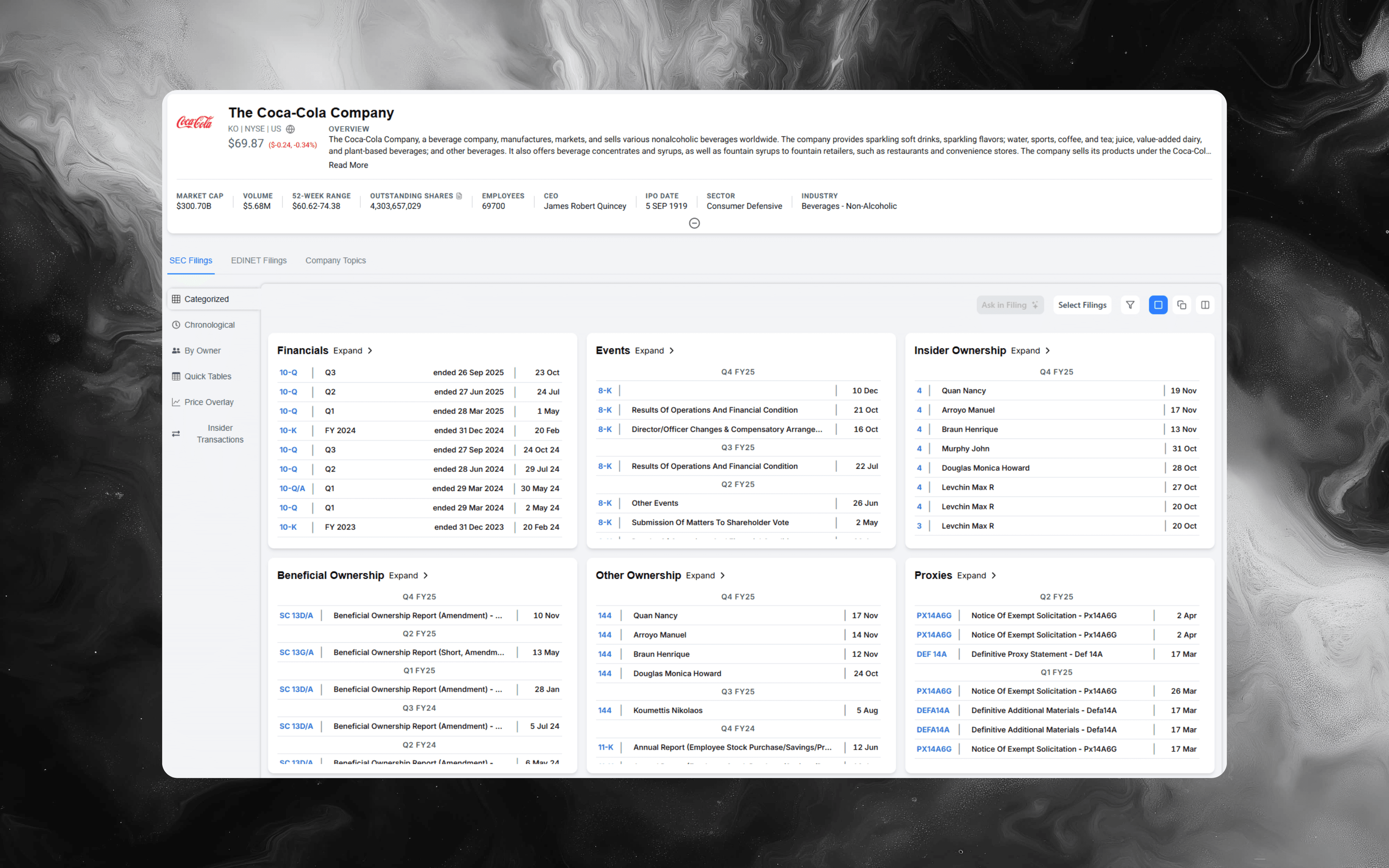
The fastest mental model: Coca-Cola sells brand demand, not just beverages
A quick way to explain Coca-Cola to a non-specialist is that the company monetizes “permission to pour” and “permission to stock.” That sounds abstract, but it maps to how the engine works:
-
Brands create pull
Marketing, trademarks, and product innovation drive consumer demand so retailers and restaurants want the portfolio. -
The system does the push
Bottlers and distributors handle a lot of the physical work: packaging, trucks, merchandising, coolers, local execution. -
Coca-Cola earns through a mix of economics
Depending on the market and product, the company may earn revenue by selling concentrates/syrups and ingredients, selling finished products, or earning results through equity stakes and other arrangements with bottlers.
Analyst takeaway: when KO commentary sounds “too marketing-heavy,” remember the marketing is the product. If brands lose relevance, the whole system’s economics compress.
How the Coca-Cola system turns a sip into revenue (step-by-step)
Here’s a practical operating loop you can map to the income statement:
-
A consumer chooses a brand
The decision happens in a store aisle, a convenience cooler, a vending machine, or a restaurant fountain. -
Route-to-market creates availability
Availability is a competitive moat in beverages: placement, cold equipment, fountain access, and reliable replenishment often matter as much as the liquid itself. -
KO monetizes through what it sells into the system
In many cases, Coca-Cola sells beverage bases and other inputs. In some businesses/markets, it may also sell packaged finished beverages directly. -
Price/mix and package architecture do a lot of work
A big portion of performance can come from what consumers buy (smaller packs, premium offerings, immediate consumption channels) and where they buy it (away-from-home vs at-home). -
The flywheel repeats
Strong brands fund marketing and innovation, which supports volume and mix, which funds more marketing and execution.
When you read a quarter, it helps to translate management language into one question: is the company winning on demand (brands) or winning on execution (availability), or both?
What Coca-Cola actually sells (and what it generally does not)
Coca-Cola’s everyday products are the beverages you recognize. But from an analyst lens, it helps to separate the offering into “consumer-facing” and “system-facing” components:
-
Consumer-facing: the beverage portfolio
Sparkling soft drinks, water, sports drinks, juices, teas, coffees, and other ready-to-drink categories depending on geography and brand lineup. -
System-facing: the engine that scales beverages
Formulas and ingredients, packaging and channel strategy, marketing programs, cold-drink equipment strategies, and customer relationships with retailers and away-from-home operators. -
What Coca-Cola generally is not
It is not a pure “own all the factories and trucks everywhere” packaged-goods company. Much of the physical bottling and last-mile execution can sit with bottling partners, which changes how to interpret margins, capex, and working capital.
For a broader context on how major consumer-facing companies segment their operations and create value, you can compare Coca-Cola’s system to retailers covered in What Does Walmart (WMT) Actually Do? or category specialists discussed in What Does Costco (COST) Actually Do?.
A useful split for analysis: concentrate economics vs bottling economics
Even if you do not have perfect disclosure symmetry market-by-market, you can build a clear internal model by treating Coca-Cola as two overlapping business types:
-
Concentrate-style economics
Typically more brand and formula-driven. Analysts often focus on volume, price/mix, and marketing efficiency because unit costs can be relatively lighter than full manufacturing and delivery. -
Bottling-style economics
More operationally intensive: packaging, labor, freight, and capex matter more. Execution risk (availability, service levels, input costs) can show up quickly.
Why this matters: two quarters can show similar “revenue growth,” but with very different underlying quality depending on whether growth is coming from concentrate economics, bottling economics, or pricing without volume support.
How Coca-Cola reports the business: what to look for in segments and geographies
For Coca-Cola, segment reporting tends to be a big part of the story because beverage economics and channel mix can vary widely by region. When you review filings, look for:
-
How management defines segments and what changed
Segment definitions can be stable for years, then shift after reorganizations. Capture those changes early to keep your trend analysis consistent. -
Organic vs reported performance
Currency can materially affect reported results for a global business. Keep a separate mental track of operational performance vs translation effects. -
“Price/mix” vs volume
Beverages can post strong revenue growth even with weak volume if pricing and mix are doing the heavy lifting. That can be sustainable in some periods, fragile in others.
The key revenue drivers to track each quarter for KO
If you cover KO regularly, consistency beats cleverness. Use the same scorecard every quarter:
-
Unit case volume and where it is moving
Identify which geographies and channels are expanding vs contracting. -
Price/mix and package architecture
Track whether growth is coming from pricing, from consumers trading up, or from channel shifts (for example, more immediate consumption). -
Concentrate sales vs finished product exposure
When the mix shifts between concentrate-style and bottling-style revenue, margins and cash dynamics can move even if demand is stable. -
Away-from-home vs at-home demand signals
Restaurants, travel, entertainment, and convenience formats often behave differently than grocery and club channels. -
Marketing spend and timing
In consumer brands, spend levels and spend timing matter. In filings, you want to understand whether changes are strategic, cyclical, or one-off.
For more direction on repeatable analyst process, see Day in the Life of an Investment Analyst: A Realistic Playbook.
Cost structure: where margins expand (and where they get squeezed)
Coca-Cola’s cost story often becomes clearer when you bucket the levers into “brand economics” and “physical economics”:
-
Brand economics levers
Marketing efficiency, portfolio mix (premium vs value), and innovation success can expand gross margin and operating margin without needing massive volume. -
Physical economics levers
Packaging inputs, sweeteners, freight, labor, and capex intensity matter more in bottling-heavy parts of the system. -
FX and hedging complexity
Global operations can create meaningful currency effects and derivative activity. Rather than trying to memorize every line item, focus on what management says is structural vs what is timing or translation. -
Bottler relationships and structural changes
Changes in bottling footprint, ownership stakes, or partner economics can reshape comparability. When KO talks about “system” evolution, treat it as potentially margin-relevant, not just narrative.
A practical checklist for reading Coca-Cola filings like an analyst
Use this process to make each quarter faster and more repeatable:
-
Start with “what changed” in definitions
Look for shifts in how KO discusses volume metrics, segment composition, or performance measures. -
Build a one-page operating dashboard
Track: volume trend, price/mix trend, organic revenue trend, margin direction, and the stated drivers. Keep the template constant. -
Run the same keyword searches every cycle
Suggested recurring terms to search in Alpha Analyst: “price/mix”, “unit case volume”, “concentrate”, “bottler”, “marketing”, “innovation”, “packaging”, “sweetener”, “currency”, “hedging”, “refranchising”, “productivity”. -
Read risk factor edits, not just the risk section
The strongest signal is what changed: commodity exposure, water/sustainability language, regulation (including sugar-related), geopolitics, and brand/reputation topics.
How to research KO faster in Alpha Analyst
If Coca-Cola is on your coverage list, the productivity unlock is turning recurring questions into reusable searches and monitoring views:
-
Save your KO search queries
Use phrase and proximity-style operators to catch consistent disclosures while filtering noise, then save those searches for reuse. -
Put KO on a dashboard
Add widgets like Recent Filings and your saved keyword searches, filtered to KO, so new disclosures show up automatically without re-running the same work. -
Use AI Chat to synthesize across filings
Examples: “Where did Coca-Cola explain changes in price/mix this quarter?” or “What parts of the business are most exposed to packaging cost inflation?” Keep the analysis grounded in the filings you selected. -
Capture an audit trail with annotations
Highlight key passages on segment performance, volume/pricing commentary, and cost drivers. Centralized notes make it easier to remember why you changed a model assumption later.
For a broader workflow and research upgrade, explore AI Search for SEC Filings, Rebuilt From the Ground Up.
Explore Coca-Cola filings in Alpha Analyst
To validate how Coca-Cola describes its operating system, how it thinks about pricing vs volume, and what is changing in its disclosures over time, go straight to the primary-source filings: The Coca-Cola Company (KO)
CTA: Use Alpha Analyst to search across Coca-Cola filings with advanced keyword operators, save your best KO queries, and pin them to a dashboard so new Coca-Cola disclosures surface immediately when they’re published.
Related Posts
View all posts →
January 31, 2026
Fed Chair Nomination News: What Hassett’s Comments Signal
A practical guide to tracking Fed leadership changes, confirmation risk, and market reactions using filings, search, and dashboards

January 29, 2026
New York Fiscal Crisis: A Company Impact Playbook
How to map NYC budget stress to revenue, taxes, real estate, and credit risk across US equities

January 29, 2026
Monetary Debasement and the US Dollar: A Company Playbook
What “currency going to hell” really means, what could come next for USD, and how US businesses can defend margins, cash flows, and valuation

January 16, 2026
Amgen (AMGN) Deep Dive: Products, Pipeline, and Key Risks
A practical equity-research playbook for underwriting the next leg of growth, margin durability, and biosimilar exposure

January 16, 2026
Daikin Industries (6367): A Deep-Dive Equity Research Playbook
Business model, segment drivers, key risks, and how to build a thesis faster in Alpha Analyst
Explore More
View all posts →
February 4, 2026
Software Stocks and AI Disruption Fears: Investor Playbook
How to evaluate “AI risk” claims, pressure-test seat-based pricing, and track what matters in filings using Alpha Analyst

February 4, 2026
Enphase (ENPH) Upgrade After Earnings: What Changed
A practical investor brief on the BMO upgrade, Q4 beat, 2026 guideposts, and how to track follow-through in Alpha Analyst

February 4, 2026
Tether fundraising report: what changed and how to track it
A practical framework for monitoring stablecoin issuer valuation, liquidity, and regulatory signals with Alpha Analyst