

What Does Walmart (WMT) Actually Do?
A plain-English map of Walmart’s three segments and the omni-channel engines behind retail, membership, and advertising
By Michael Chen

Table of Contents
Walmart in one sentence (the simplest mental model)
What does Walmart (WMT) actually do? Walmart is a global, technology-enabled retailer that sells everyday goods through a massive store footprint and eCommerce, while also monetizing traffic through membership and advertising.
For the primary-source version (business description, segment reporting, risks, and financial statements), start with Walmart’s filings in Alpha Analyst: Walmart Inc. (WMT)
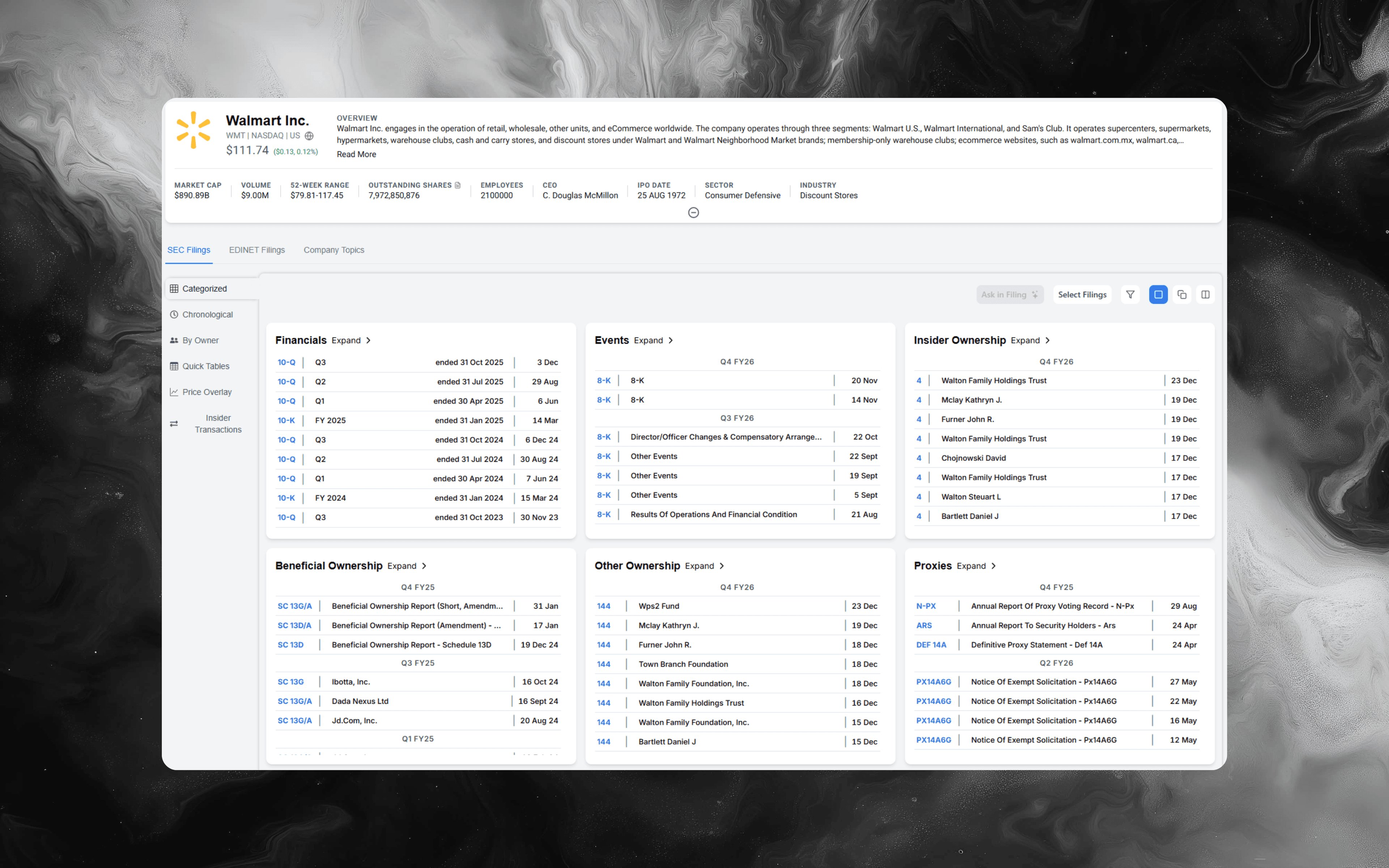
Table of contents
- The fastest mental model: Walmart sells “value + convenience at scale”
- The three segments Walmart reports (and why they matter)
- Walmart U.S.: the core engine (stores + walmart.com)
- Walmart International: local retail ecosystems outside the U.S.
- Sam’s Club U.S.: membership warehouse economics
- Where “recurring” shows up at Walmart (and where it doesn’t)
- A quick checklist for reading WMT filings like an analyst
- Explore Walmart filings in Alpha Analyst
The fastest mental model: Walmart sells “value + convenience at scale”
If you only think of Walmart as big-box stores, you miss the operating logic that shows up in the filings:
- Traffic flywheel: low prices and breadth drive frequent trips (in-store and online)
- Fulfillment machine: stores double as customer destinations and local fulfillment nodes
- Monetization layers: membership programs and advertising services monetize repeat engagement
In plain English: Walmart’s product is not just merchandise; it’s a system for moving goods efficiently and showing up where customers want to shop (store, pickup, delivery, and digital).
The three segments Walmart reports (and why they matter)
In its 10-K, Walmart describes three reportable segments:
- Walmart U.S.
- Walmart International
- Sam’s Club U.S.
This structure matters because each segment tends to have different demand drivers and different “profit levers”:
- A U.S. mass merchant can be driven by mix (grocery vs general merchandise), store productivity, and fulfillment costs
- International results can be shaped by market-specific competition, format strategy, and currency
- A membership club model can behave differently because fees and renewal-like behavior influence unit economics
When you explain WMT to a non-specialist, segment framing prevents you from mixing up “U.S. grocery trip frequency” with “international currency swings” or “club membership economics.”
For more perspective on segment reporting structure and why it matters in equity research, see Day in the Life of an Investment Analyst: A Realistic Playbook.
Walmart U.S.: the core engine (stores + walmart.com)
Walmart U.S. is the company’s largest segment and includes its mass merchandising operations in the United States, including eCommerce (walmart.com).
A helpful way to explain Walmart U.S. is as an omni-channel consumption business:
- Stores remain the traffic anchor: customers still shop in physical locations for routine needs
- eCommerce extends the basket: broader assortment, delivery, and pickup options capture more occasions
- Convenience features reduce friction: services like pickup, delivery, and faster delivery windows are designed to turn Walmart into a default weekly destination
In Walmart’s segment disclosures, omni-channel initiatives are not a side project; they’re part of how the segment is defined and described operationally.
Walmart International: local retail ecosystems outside the U.S.
Walmart International includes the company’s operations outside of the United States, along with eCommerce and omni-channel initiatives in those markets.
The simplest way to frame the International segment:
- Same mission, different playbooks: formats, competition, and customer behavior vary by country
- Operating complexity is real: logistics, labor, regulation, and currency can all affect results
- eCommerce isn’t “one thing”: market structure determines whether online growth is marketplace-led, store-led, delivery-led, or some combination
For many investors, International is where narrative and numbers can diverge most. Filings are the best place to track which markets management is emphasizing and why.
Sam’s Club U.S.: membership warehouse economics
Sam’s Club U.S. covers Walmart’s warehouse membership clubs in the United States, including eCommerce (samsclub.com) and omni-channel initiatives.
A plain-English way to explain Sam’s Club:
- Customers pay for access: membership creates a relationship that can renew over time
- Value perception is central: large pack sizes, strong price-to-quality, and a curated assortment can build loyalty
- Clubs have a different operating rhythm: basket size, trip frequency, and merchandising strategy often differ from mass retail
Sam’s Club can be easier to misunderstand than Walmart U.S. because the membership component changes how you think about customer lifetime value and repeat behavior.
Where “recurring” shows up at Walmart (and where it doesn’t)
Retail revenue is mostly transactional: customers buy items, and revenue is recognized when those goods are sold. But Walmart also has meaningful “repeat and renew” style economics in specific layers of the business.
A practical way to bucket the business model:
-
Merchandise sales (high volume, transactional)
- The bulk of revenue is net sales from everyday items sold through stores and online
- Results can be influenced by category mix, price investment, and inventory discipline
-
Membership programs (more recurring in nature)
- Walmart U.S. includes Walmart+ as part of its omni-channel offering
- Sam’s Club includes a membership model by design
- These can behave more like “retain and expand” than one-time transactions
-
Advertising services (monetization of traffic)
- Walmart’s segment disclosures describe advertising services as part of the Walmart U.S. segment
- The intuition: if Walmart can drive traffic, it can also sell high-intent visibility to brands
-
Services that ride on the retail relationship
- Fulfillment, delivery capabilities, and other digital features can strengthen retention even when the revenue is still largely tied to product sales
The key takeaway: Walmart is mostly a transactional retailer, but it increasingly has layered monetization that looks more recurring than a traditional “sell a product once” model.
For more on how recurring and transactional revenue streams shape sector leaders and supply chains, Manufacturing Trends 2025: 5 Signals to Monitor offers a practical industry lens.
A quick checklist for reading WMT filings like an analyst
If you want to understand Walmart beyond headlines, track a consistent set of disclosure themes each quarter/year:
-
Segment definitions and what’s included Look for wording changes around what each segment includes (especially eCommerce, omni-channel, and advertising services).
-
Omni-channel economics signals Watch for discussion that implies shifts in pickup/delivery adoption, fulfillment efficiency, or changes in how stores support eCommerce.
-
Mix and category language Pay attention to commentary that hints at trade-down/trade-up behavior, grocery vs general merchandise momentum, and margin implications.
-
Membership momentum and value proposition Scan for how management describes member benefits, convenience features, and engagement.
-
International complexity and currency sensitivity Track market count, strategic focus, and any recurring themes in risks and results drivers.
A practical habit: build a short keyword list once and reuse it every period so you catch narrative drift early.
Example keyword set:
- “reportable segments”
- “omni-channel”
- “advertising services”
- “membership”
- “supply chain”
- “eCommerce”
For systematic strategies you can adapt for reading Walmart (and similar large caps), the Day in the Life of an Investment Analyst: A Realistic Playbook covers research and tracking workflows you can put into action.
Explore Walmart filings in Alpha Analyst
If you want to validate how Walmart defines its three segments, understand what is included in Walmart U.S. versus Sam’s Club, and track how the omni-channel strategy evolves over time, go straight to the primary-source filings: Walmart Inc. (WMT)
CTA: Use Alpha Analyst to search across WMT filings with advanced keyword operators (phrases like “reportable segments”, “omni-channel initiatives”, “advertising services”, and “membership”), save those searches, and place them on a dashboard filtered to your watchlist so new disclosures surface immediately when filings land.
Related Posts
View all posts →
January 31, 2026
Fed Chair Nomination News: What Hassett’s Comments Signal
A practical guide to tracking Fed leadership changes, confirmation risk, and market reactions using filings, search, and dashboards

January 29, 2026
New York Fiscal Crisis: A Company Impact Playbook
How to map NYC budget stress to revenue, taxes, real estate, and credit risk across US equities

January 29, 2026
Monetary Debasement and the US Dollar: A Company Playbook
What “currency going to hell” really means, what could come next for USD, and how US businesses can defend margins, cash flows, and valuation

January 16, 2026
Amgen (AMGN) Deep Dive: Products, Pipeline, and Key Risks
A practical equity-research playbook for underwriting the next leg of growth, margin durability, and biosimilar exposure

January 16, 2026
Daikin Industries (6367): A Deep-Dive Equity Research Playbook
Business model, segment drivers, key risks, and how to build a thesis faster in Alpha Analyst
Explore More
View all posts →
February 4, 2026
Software Stocks and AI Disruption Fears: Investor Playbook
How to evaluate “AI risk” claims, pressure-test seat-based pricing, and track what matters in filings using Alpha Analyst

February 4, 2026
Enphase (ENPH) Upgrade After Earnings: What Changed
A practical investor brief on the BMO upgrade, Q4 beat, 2026 guideposts, and how to track follow-through in Alpha Analyst

February 4, 2026
Tether fundraising report: what changed and how to track it
A practical framework for monitoring stablecoin issuer valuation, liquidity, and regulatory signals with Alpha Analyst