

What Does Costco (COST) Actually Do?
A plain-English breakdown of the membership warehouse model, where profits come from, and the operating metrics investors should track
By Michael Chen

Table of Contents
A simple explanation of Costco’s business model (it’s a membership engine disguised as retail)
What does Costco (COST) actually do? Costco operates membership-based warehouse clubs that sell a curated assortment of merchandise at low prices, aiming to drive high volume and fast inventory turns. The key twist is that Costco’s economics are built to make the membership relationship unusually valuable: membership fees can provide a meaningful, steadier profit stream relative to the razor-thin margins of selling goods.
If you want the primary-source foundation (business overview, risk factors, segment notes, and the company’s definitions for membership metrics and comparable sales), start with Costco’s filings in Alpha Analyst here: Costco Wholesale Corporation (COST)
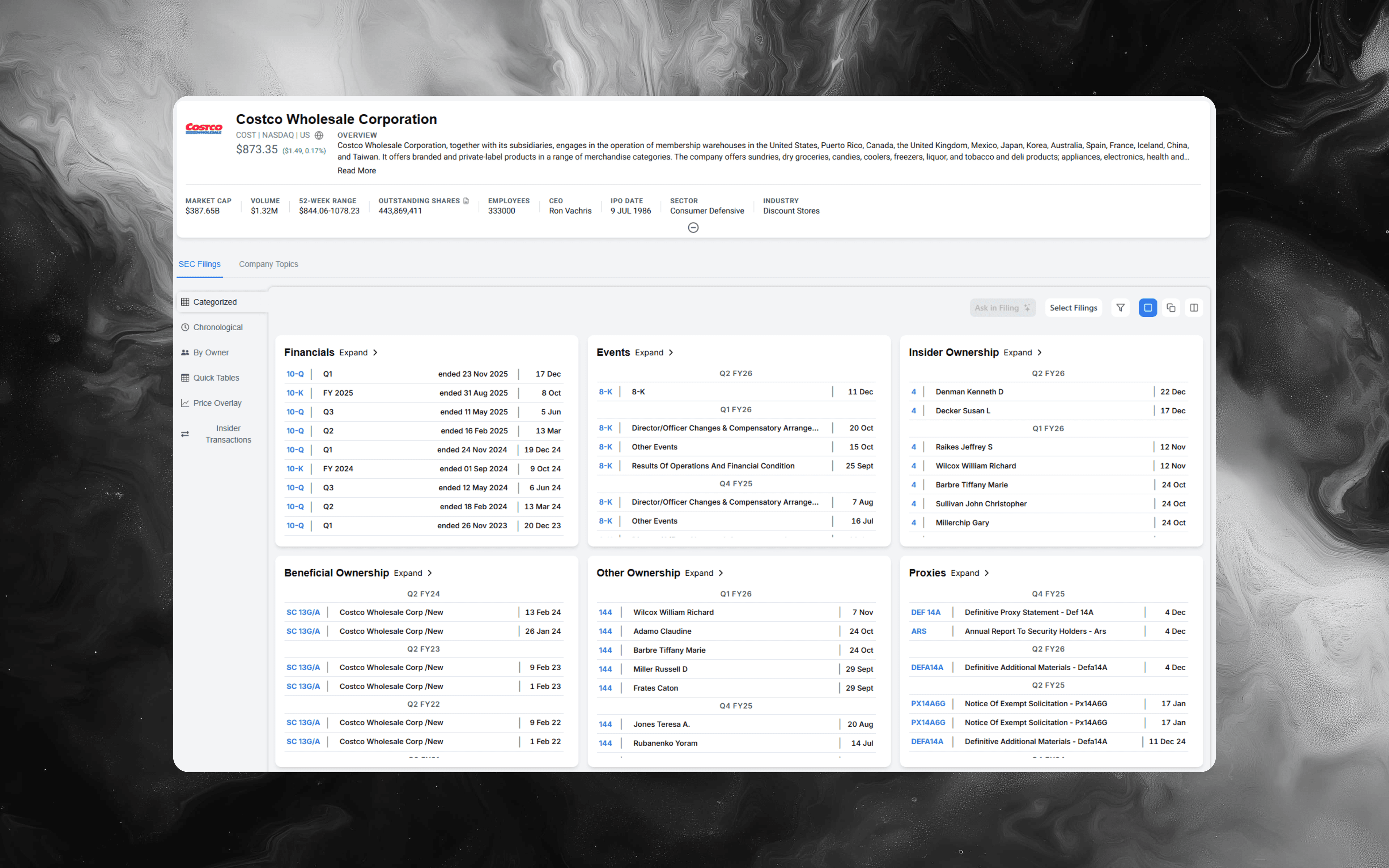
Table of contents
- The fastest mental model: Costco is a paid membership flywheel
- How a Costco warehouse makes money (two income streams)
- Why low prices are strategic, not charitable
- The operating dashboard investors watch (comps, traffic, ticket, renewal)
- The real levers behind margin (mix, shrink, freight, and efficiency)
- A quick checklist for reading COST filings like an analyst
- Explore Costco in Alpha Analyst
The fastest mental model: Costco is a paid membership flywheel
A clean way to explain Costco to a non-specialist is:
Costco uses low prices and a limited, high-turn assortment to earn customer trust, then converts that trust into paid memberships that keep shoppers coming back.
That framing matters because it prevents a common mistake: analyzing Costco like a traditional retailer that tries to maximize merchandise margin. Costco’s model is more about maximizing member value, which tends to show up as:
- high renewal behavior (a loyalty indicator, not just a marketing metric)
- frequent trips and large basket sizes
- scale advantages in procurement, logistics, and private label sourcing
In short: the membership relationship is the product, and the warehouse is the delivery system.
For another practical map of a membership- and network-driven business model, see What Does Mastercard (MA) Actually Do?.
How a Costco warehouse makes money (two income streams)
At a practical level, Costco’s economics come from two broad sources:
-
Merchandise sales (high volume, low margin) Costco sells groceries, consumables, discretionary items, and seasonal “treasure hunt” products. The goal is to drive unit volume and inventory productivity rather than maximize per-item markup.
-
Membership fees (a loyalty-linked profit pool) Members pay an annual fee for the right to shop. For many investors, this is the simplest way to understand why Costco can keep prices low while still generating attractive overall profitability.
A useful one-sentence summary:
Costco can afford to price merchandise aggressively because it doesn’t rely on merchandise markup alone to fund the business.
Why low prices are strategic, not charitable
Costco’s “low prices” aren’t just positioning; they’re a mechanism that supports the whole system:
-
Trust creation If shoppers believe the warehouse consistently offers value, they are more willing to pay for membership and renew it.
-
Trip frequency and basket expansion Value on essentials pulls members in; once in-store, the curated assortment and rotating items can increase basket size.
-
Vendor leverage and cost advantages Scale can translate into purchasing leverage, improved terms, and better supply chain utilization, which can feed back into pricing.
-
Operational simplicity Fewer SKUs than a typical big-box retailer can make merchandising and replenishment more efficient, supporting high inventory turns.
This is why analysts often talk about Costco as a flywheel: price supports trust, trust supports membership, membership supports traffic, traffic supports scale, and scale supports price again.
For broader patterns in retail supply chain strategy and key industrial cost drivers, Manufacturing Trends 2025: 5 Signals to Monitor outlines macro shifts to watch in areas like trade policy, labor, and automation.
The operating dashboard investors watch (comps, traffic, ticket, renewal)
If you want to track Costco quarter to quarter without getting lost, focus on a small set of repeatable indicators. Even when accounting lines move around due to fuel price swings or foreign exchange, these metrics usually tell you what’s happening on the ground.
Core metrics and what they signal:
-
Comparable sales (comps) A single read on demand, execution, and (sometimes) pricing environment. When comps are strong, the model is usually working.
-
Traffic and average ticket Comps are often the combination of how many transactions happen (traffic) and how much members spend per trip (ticket). When comps slow, investors try to diagnose which component is weakening.
-
Membership renewal rate A proxy for customer satisfaction and perceived value. If renewal trends soften, it can indicate pressure on the member value proposition, changes in sign-up mix, or macro-driven trade-offs.
-
Membership fee growth Influenced by member counts, renewal, and mix of membership tiers. It can be a cleaner read than merchandise sales in periods where fuel or price inflation distort top-line comparisons.
-
Warehouse expansion and productivity Store openings matter, but what often matters more is how productive the existing base is and how quickly newer locations ramp.
A practical habit: build a “Costco operating page” in your notes that you update every quarter with these five bullets. Over time, you’ll see the patterns.
For a realistic walkthrough of how analysts actually monitor and update these operating dashboards each quarter (for both retailers and payment networks), see Day in the Life of an Investment Analyst: A Realistic Playbook.
The real levers behind margin (mix, shrink, freight, and efficiency)
Costco is famous for thin merchandise margins, so small operational shifts can matter a lot. When you read filings and earnings commentary, look for margin drivers that are easy to miss in a quick skim:
-
Product mix Grocery vs. discretionary, private label vs. branded, and big-ticket categories vs. staples can move gross margin.
-
Shrink and inventory discipline In retail, controlling shrink and maintaining tight inventory management can materially affect profitability, especially when margins are slim.
-
Freight, supply chain, and distribution efficiency Changes in transportation costs, port congestion, or distribution productivity can show up as margin tailwinds or headwinds.
-
Labor and wage investment Costco is known for investing in employees. The investor question is typically not “do they pay well,” but “does wage investment translate into productivity, retention, service levels, and throughput that protect the model?”
-
Ancillary businesses Many warehouse retailers have add-on businesses (think fuel, pharmacy, optical, food court, services). These can influence traffic, loyalty, and profitability mix in ways that don’t look obvious from the merchandise assortment alone.
The goal isn’t to memorize every line item. It’s to know which operational dials can explain changes in profitability when the top line looks stable.
A quick checklist for reading COST filings like an analyst
Use this checklist to keep your Costco review consistent year over year:
-
Start with the business description Confirm how Costco describes its member value proposition, merchandising approach, and warehouse operations.
-
Identify the two-engine structure Separate your thinking into merchandise economics and membership economics. If you mix them, you’ll misread the model.
-
Track the operating metric definitions Make sure you know how the company defines comps, renewal rate, and membership counts in that period. Minor definition changes can break your model.
-
Look for “what changed” language Focus on new risk factor emphasis, supply chain updates, shrink commentary, or shifts in mix (especially discretionary vs. consumables).
-
Tie the narrative back to repeatable drivers For every big statement (growth, margins, headwinds), force yourself to map it to one of: comps, traffic, ticket, renewal, mix, or efficiency.
Explore Costco in Alpha Analyst
To validate how Costco explains its membership flywheel, monitor disclosure changes, and build a repeatable quarterly review, go straight to the primary-source filings: Costco Wholesale Corporation (COST)
CTA: Use Alpha Analyst to search across COST filings with advanced keyword operators, save your best queries (like “membership renewal,” “comparable sales,” “shrink,” and “freight”), and pin those searches to a dashboard so new Costco disclosures surface as soon as they’re filed.
Related Posts
View all posts →
January 31, 2026
Fed Chair Nomination News: What Hassett’s Comments Signal
A practical guide to tracking Fed leadership changes, confirmation risk, and market reactions using filings, search, and dashboards

January 29, 2026
New York Fiscal Crisis: A Company Impact Playbook
How to map NYC budget stress to revenue, taxes, real estate, and credit risk across US equities

January 29, 2026
Monetary Debasement and the US Dollar: A Company Playbook
What “currency going to hell” really means, what could come next for USD, and how US businesses can defend margins, cash flows, and valuation

January 16, 2026
Amgen (AMGN) Deep Dive: Products, Pipeline, and Key Risks
A practical equity-research playbook for underwriting the next leg of growth, margin durability, and biosimilar exposure

January 16, 2026
Daikin Industries (6367): A Deep-Dive Equity Research Playbook
Business model, segment drivers, key risks, and how to build a thesis faster in Alpha Analyst
Explore More
View all posts →
February 4, 2026
Software Stocks and AI Disruption Fears: Investor Playbook
How to evaluate “AI risk” claims, pressure-test seat-based pricing, and track what matters in filings using Alpha Analyst

February 4, 2026
Enphase (ENPH) Upgrade After Earnings: What Changed
A practical investor brief on the BMO upgrade, Q4 beat, 2026 guideposts, and how to track follow-through in Alpha Analyst

February 4, 2026
Tether fundraising report: what changed and how to track it
A practical framework for monitoring stablecoin issuer valuation, liquidity, and regulatory signals with Alpha Analyst