

What Does McDonald’s (MCD) Actually Do?
A plain-English map of McDonald’s franchising + real estate model, where earnings come from, and what to track in SEC filings

Table of Contents
A plain-English explanation of McDonald’s business model (a franchisor with a real estate engine)
What does McDonald’s (MCD) actually do? McDonald’s is best understood as a global restaurant brand that primarily makes money as a franchisor, with a meaningful economic layer tied to restaurant real estate. The company operates some restaurants directly, but a large majority are franchised, and much of the value creation comes from fees that scale with franchisee sales.
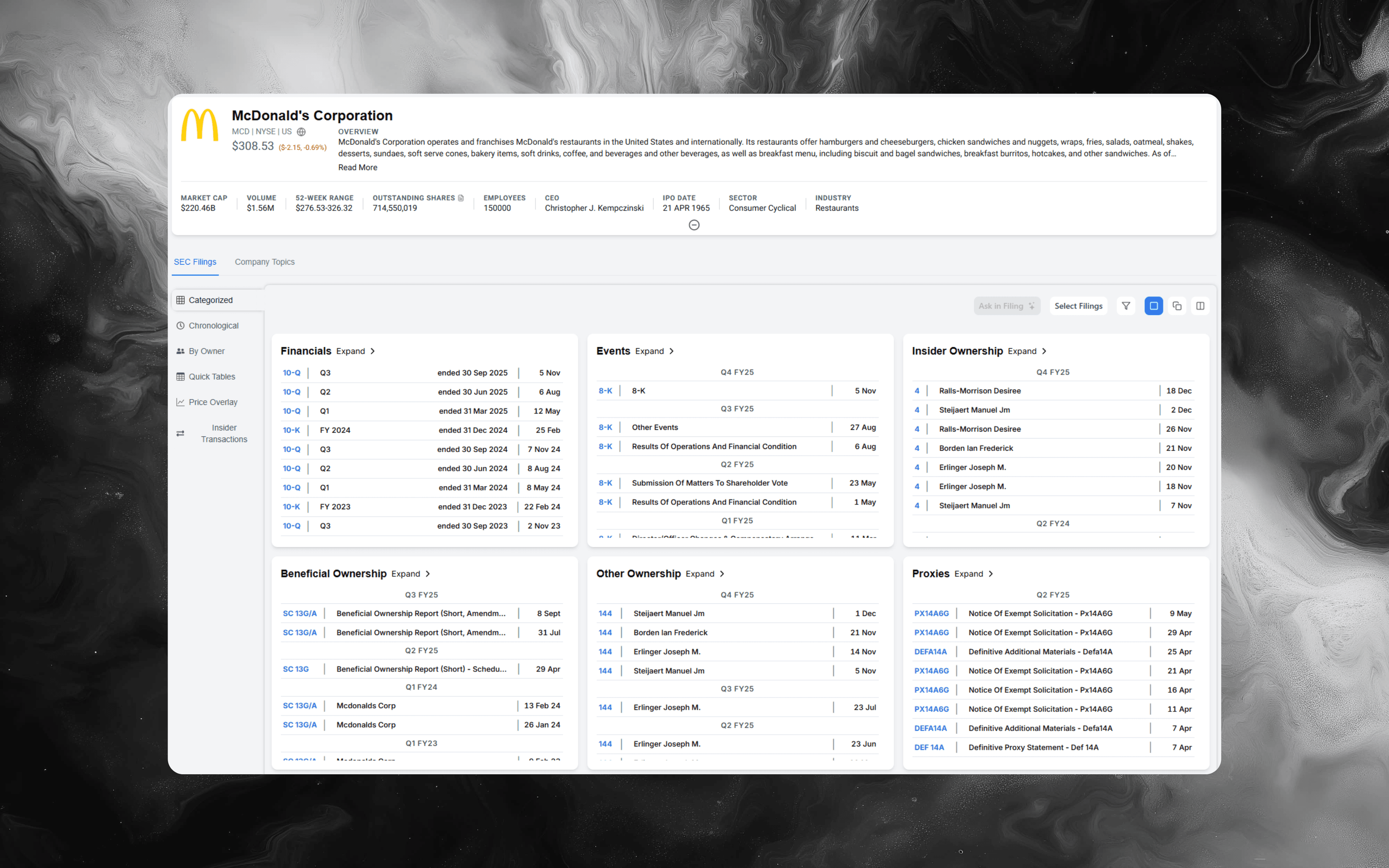
If you want the primary-source foundation (how McDonald’s describes franchising structures, what “rent and royalties” mean in their P&L, and what risks management flags), start with the filings in Alpha Analyst here: McDonald’s Corporation (MCD)
The fastest mental model: brand + operators + a fee stream that scales with sales
A simple way to hold McDonald’s in your head:
- The company provides the brand, menu playbook, standards, marketing engine, and operating system
- Franchisees (and licensees in some markets) run day-to-day restaurants and employ the staff
- Customers generate sales at the restaurant level (systemwide sales)
- McDonald’s earns revenue mainly through franchised fees tied to restaurant sales (including rent and royalties), plus some company-operated sales
- The core analyst question becomes: what changes systemwide sales, and how does that flow through to McDonald’s fee economics and margins?
In its filings, McDonald’s describes itself as “primarily a franchisor,” with the majority of restaurants franchised and revenues consisting of company-operated sales plus fees from restaurants run by franchisees.
How McDonald’s makes money (the operating loop)
Here’s the step-by-step loop that connects a burger sale to McDonald’s reported earnings:
-
Demand shows up as systemwide sales
Systemwide sales include sales at all restaurants, whether operated by McDonald’s or by franchisees. Even though franchised sales aren’t recorded as McDonald’s revenue, they matter because they are the base for calculating franchised fees. -
Company-operated restaurants generate “restaurant sales” revenue (and also restaurant-level costs)
This looks like a classic restaurant P&L: sales, food/paper, labor, occupancy, other operating costs. -
Franchised restaurants generate fees (often higher-margin revenue)
In a conventional franchise arrangement described in filings, franchisees contribute to McDonald’s revenue primarily via rent and royalties based on a percent of sales (with minimum rent payments), plus initial fees tied to new openings or franchise terms. -
In licensed structures, the company earns royalties (and usually invests less capital)
McDonald’s disclosures distinguish conventional franchises from developmental license / affiliate arrangements, where the licensee provides capital (often including real estate interest) and the company typically receives a royalty based on a percent of sales (plus initial fees in many cases). -
The ownership mix matters for the reported revenue line
A key nuance McDonald’s flags: refranchising can reduce consolidated revenues because company-operated sales are replaced by franchised revenue streams (rent/royalties). This is why you should track revenue with the business model in mind, not just as “up or down.”
Analyst takeaway: for McDonald’s, the “top line” doesn’t tell the whole story unless you separate (1) company-operated restaurant sales and (2) franchised fees and how the mix is shifting.
What McDonald’s actually sells (in analyst language)
If you’re building an analyst-friendly map, think in “economic products,” not menu items:
-
A branded operating system
Standards, menu architecture, marketing cadence, technology and operations playbooks, supplier ecosystem, and training. -
A franchising package
The right to operate under the brand with ongoing requirements (quality, service, consistency), in exchange for ongoing fees tied to sales and other contractual payments. -
In many conventional franchise cases, a real estate/occupancy economics layer
Filings describe how McDonald’s may own or secure long-term control of the land/building and then franchisees pay rent (including minimum rent payments and variable rent tied to sales in some contexts), plus royalties. -
A smaller, but strategically important, company-operated restaurant base
Management describes directly operating some restaurants as a way to remain a “credible franchisor,” test ideas, train operations talent, and refine standards.
The three “MCD variables” that explain most quarter-to-quarter changes
For a heavily franchised restaurant system, most earnings narratives can be decomposed into three buckets:
-
Systemwide sales drivers
Comparable sales, guest counts/traffic, average check (pricing and mix), and the timing/impact of promotions or menu changes. This is the demand engine that franchisees feel first and McDonald’s captures through fees. -
Ownership mix and franchised fee mechanics
What portion of the system is franchised vs company-operated, what the fee structure implies (rent, royalties, initial fees), and how refranchising affects the shape of the income statement. -
Cost and reinvestment pressures
Even for a franchisor, operating costs still matter (technology, corporate spend, marketing/brand initiatives, and company-operated restaurant margins). Macro variables like labor availability/cost, commodities, and FX can also show up differently across segments.
How to read McDonald’s filings like an analyst (repeatable checklist)
Use this checklist each 10-Q and 10-K cycle to stay consistent:
-
Start by separating restaurant economics from franchisor economics
Build a quick bridge with two buckets:- sales by company-operated restaurants, and
- fees from franchised restaurants (rent, royalties, initial fees).
-
Treat systemwide sales as the “upstream KPI”
If systemwide sales are accelerating or decelerating, ask: is it traffic, pricing, or mix? Then ask how that should flow into franchised revenue. -
Watch for ownership mix and refranchising commentary
McDonald’s explicitly notes that refranchising can reduce consolidated revenues because of the accounting change in what gets recorded as “revenue.” So look for disclosures that explain mix shifts and strategy changes. -
Read franchisee alignment language as a leading indicator
Because franchisees run their businesses independently, changes in tone around franchisee willingness/ability to invest (remodels, technology, staffing) can matter as much as a single quarter’s comp. -
Scan the risk factors with a “system health” lens
For a heavily franchised system, risks often compound: if franchisee sales growth slows, fee revenue can slow; if franchisee economics weaken, reinvestment can lag; if operations become inconsistent, the brand can take a hit.
Keywords to search in McDonald’s filings (so you don’t miss the signal)
If you want a repeatable workflow, run the same search set each quarter and compare what changed:
- “systemwide sales”
- “comparable sales” and “guest counts”
- “franchised restaurants” and “company-operated restaurants”
- “rent” and “minimum rent”
- “royalties” and “percent of sales”
- “initial fees”
- “refranchising”
- “developmental license” and “affiliate”
- “margin” and “restaurant margins”
- “labor” and “wage”
- “commodity” and “supply chain”
In Alpha Analyst, these become higher-signal when you use phrase matching and proximity-style operators so you’re not wading through generic mentions.
If you want to compare McDonald’s business model to other large consumer-facing companies, What Does Walmart (WMT) Actually Do? provides a plain-English breakdown of the retail engine, and What Does Starbucks (SBUX) Actually Do? (if available) covers the branded franchise and licensing structure.
How to do McDonald’s research faster in Alpha Analyst
If you cover MCD repeatedly, the goal is to turn your diligence into reusable building blocks:
-
Save your recurring MCD search pack once
Create a set for systemwide sales/comp drivers, franchising economics (rent/royalties/initial fees), refranchising, and key risks (labor, supply chain, franchisee investment). Reuse it every filing cycle to keep your process consistent. -
Pin those saved searches to a dashboard
Build a monitoring workspace with Recent Filings and your saved keyword widgets filtered to MCD, so new disclosures surface immediately when filings land. -
Use AI Chat to convert dense disclosures into decision-ready answers
Example prompts:- “Summarize how McDonald’s describes franchised revenue (rent, royalties, initial fees) in this filing.”
- “What changed in the discussion of systemwide sales drivers and comparable sales?”
- “Where do they discuss refranchising and how it affects reported revenue?”
-
Annotate the few passages that explain the quarter
Highlight the specific sentences that connect comps → systemwide sales → franchised fees, and any changes in franchisee alignment or reinvestment expectations. Next quarter, your notes become your shortcut.
For broader workflow strategies used by professional analysts, see Day in the Life of an Investment Analyst: A Realistic Playbook.
Explore McDonald’s filings in Alpha Analyst
To validate how McDonald’s describes its franchising structures, how rent and royalties tie to sales, and what management says is changing in the system, go straight to the primary-source filings: McDonald’s Corporation (MCD)
CTA: Use Alpha Analyst to search across McDonald’s filings with advanced keyword operators, save your best MCD queries, and pin them to a dashboard so new McDonald’s disclosures surface immediately when they’re published.
Related Posts
View all posts →
January 31, 2026
Fed Chair Nomination News: What Hassett’s Comments Signal
A practical guide to tracking Fed leadership changes, confirmation risk, and market reactions using filings, search, and dashboards

January 29, 2026
New York Fiscal Crisis: A Company Impact Playbook
How to map NYC budget stress to revenue, taxes, real estate, and credit risk across US equities

January 29, 2026
Monetary Debasement and the US Dollar: A Company Playbook
What “currency going to hell” really means, what could come next for USD, and how US businesses can defend margins, cash flows, and valuation

January 16, 2026
Amgen (AMGN) Deep Dive: Products, Pipeline, and Key Risks
A practical equity-research playbook for underwriting the next leg of growth, margin durability, and biosimilar exposure

January 16, 2026
Daikin Industries (6367): A Deep-Dive Equity Research Playbook
Business model, segment drivers, key risks, and how to build a thesis faster in Alpha Analyst
Explore More
View all posts →
February 4, 2026
Software Stocks and AI Disruption Fears: Investor Playbook
How to evaluate “AI risk” claims, pressure-test seat-based pricing, and track what matters in filings using Alpha Analyst

February 4, 2026
Enphase (ENPH) Upgrade After Earnings: What Changed
A practical investor brief on the BMO upgrade, Q4 beat, 2026 guideposts, and how to track follow-through in Alpha Analyst

February 4, 2026
Tether fundraising report: what changed and how to track it
A practical framework for monitoring stablecoin issuer valuation, liquidity, and regulatory signals with Alpha Analyst