

What Does Lam Research (LRCX) Actually Do?
A plain-English map of Lam’s wafer-fab equipment business, how revenue splits between systems and services, and what to track in SEC filings

Table of Contents
A plain-English explanation of Lam Research’s business model (tools + installed-base support)
What does Lam Research (LRCX) actually do? Lam builds and services wafer processing equipment used by semiconductor manufacturers to make chips. In plain English: Lam sells sophisticated tools that help customers deposit materials onto wafers, remove materials with etching, and run related cleaning/processing steps—then it keeps those tools running and upgraded over many years.
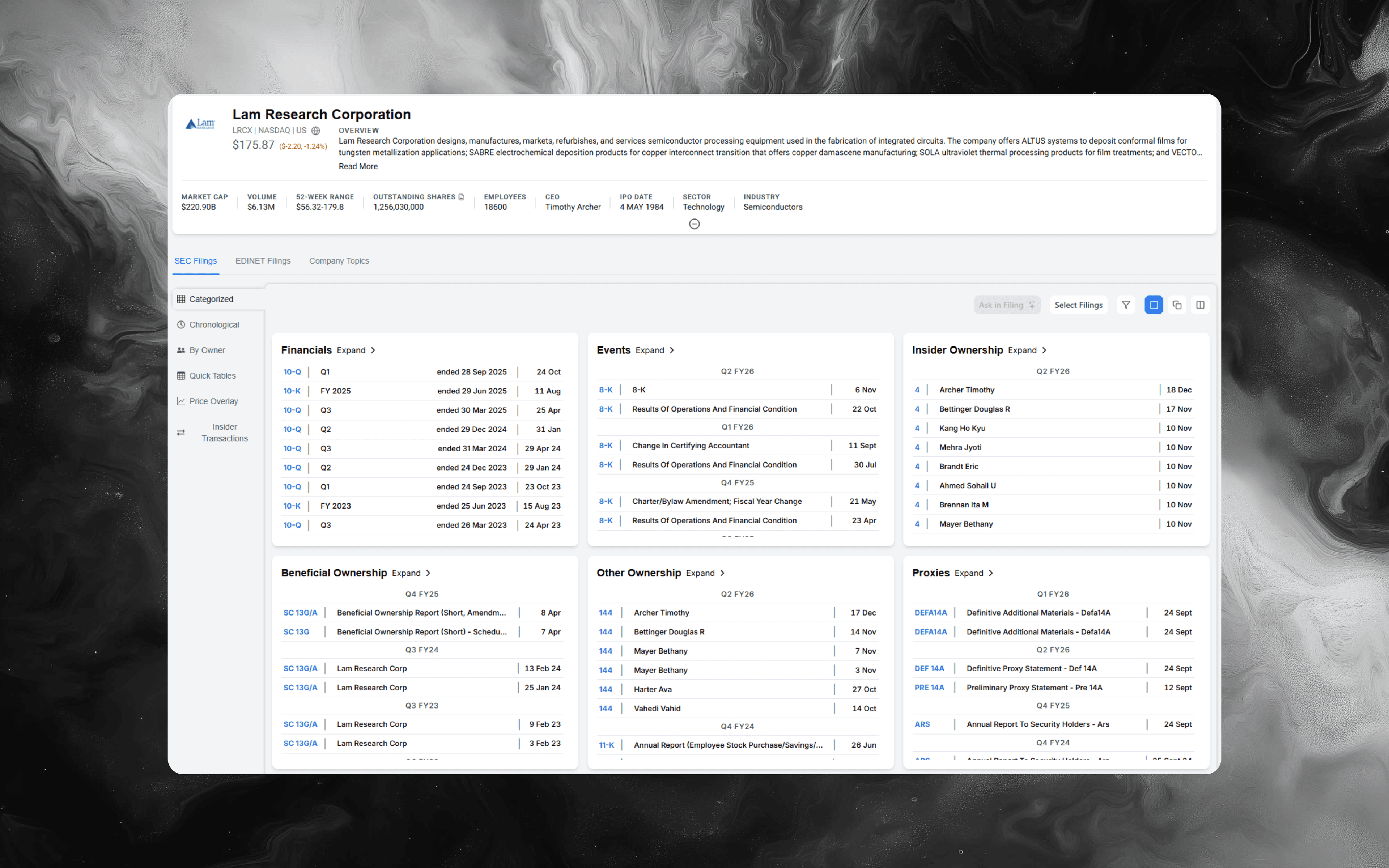
If you want the primary-source foundation for how the company defines its revenue streams and end markets, start with the filings in Alpha Analyst here: Lam Research Corporation (LRCX)
The fastest mental model: a two-engine model with a cycle overlay
A useful way to think about Lam is:
-
Engine 1: Systems revenue
New equipment shipped into semiconductor fabs (capital equipment spending). -
Engine 2: Customer support-related revenue
Service, spares, upgrades, and non-leading-edge equipment (including Lam’s Reliant product line).
Then layer on the cycle: chipmakers increase or reduce capital spending based on end-demand, technology transitions, capacity utilization, and their own cash flow priorities. That cycle tends to drive Systems volatility, while the installed base tends to support a steadier service/spares layer.
What Lam sells (in analyst language)
Lam’s filings describe the company as operating in one reportable business segment focused on manufacturing and servicing wafer processing semiconductor manufacturing equipment. Practically, most product-level thinking can be grouped into:
-
Deposition tools
Equipment that applies thin films/material layers onto the wafer as part of building device structures. -
Etch tools
Equipment that selectively removes material to form patterns and features. -
Clean and other wafer fabrication markets
Adjacent steps that support yield, reliability, and process control. -
Reliant (non-leading-edge) and upgrades
A product family and upgrade pathways aimed at mature nodes and cost-effective capacity, alongside modernizations of existing tools.
Analyst takeaway: even if you don’t model every tool family, you can stay oriented by tracking how Lam talks about deposition, etch, and clean demand, and then separately tracking the installed-base support story.
For a look at how another semiconductor equipment company’s business model is structured, see What Does Applied Materials (AMAT) Actually Do? (note: the link references AMD, which is a chip company, but covers similar value chain themes).
How Lam makes money (the operating loop)
Here’s the step-by-step loop that connects customers to earnings:
-
Customers plan fab expansions and technology roadmaps
Spending plans are influenced by end-market demand (PC, mobile, data center, auto, industrial), plus node transitions and yield/complexity challenges. -
Lam competes for “tool of record” positions
Winning a step in the process flow can create repeat buys across multiple tools, multiple fabs, and multiple technology generations. -
Systems ship, install, and qualify
Systems revenue is tied to shipments and customer acceptance dynamics. Quarter-to-quarter results can move on customer timing, supply chain constraints, and project sequencing. -
The installed base creates recurring monetization
Once tools are in the fab, customers buy spares, services, and upgrades to keep uptime high and extend tool capability. This layer can be a stabilizer when new systems demand softens. -
Mix and cost structure drive margins
Mix shifts between systems and support, between different product lines, and across geographies can matter as much as headline revenue growth.
The key split to track in filings: systems vs customer support-related revenue
Lam’s filings disaggregate revenue into two high-signal buckets:
-
Systems revenue
Described as sales of new leading-edge equipment across deposition, etch, clean, and other wafer fabrication markets. -
Customer support-related revenue and other
Described as customer service, spares, upgrades, and non-leading-edge equipment (including the Reliant product line).
Why this matters: it’s one of the cleanest ways to separate “new capex cycle” exposure from “installed base” exposure. When investors debate whether results are “cycle” or “franchise,” this split is often the first place to look.
The three end markets: memory, foundry, and logic/IDM
Lam’s filings also frame demand through three primary markets:
- Memory
- Foundry
- Logic/integrated device manufacturing (IDM)
A practical use: when a quarter looks unusually strong or weak, try to force an explanation using only these levers:
- which end market is driving demand,
- whether the change is mostly systems or support, and
- whether it’s concentrated in specific geographies.
You don’t need perfect precision to build a good read; you need a repeatable structure.
A repeatable checklist for reading Lam’s 10-Q and 10-K
Use this workflow each filing cycle:
-
Start with revenue disaggregation tables
Anchor your read in systems vs customer support-related revenue, then move to geographic and end-market commentary. -
Ask “what changed in demand” before “what changed in EPS”
Focus on whether management is describing: technology-driven spend, capacity adds, customer pauses, or timing/acceptance effects. -
Separate short-cycle from structural signals
Short-cycle: quarter timing, customer build schedules, supply chain constraints.
Structural: installed base expansion, product transitions, competitive position in key steps. -
Scan for concentration and sensitivity
Look for disclosures that help you understand whether results are broadly distributed across customers/regions or dependent on a narrow set of decisions. -
Treat definitions as part of the model
When a company clearly defines what is in “systems” versus “support,” reuse those definitions in your own notes so your quarter-to-quarter comparisons stay consistent.
For broader workflow context on how analysts approach SEC filings efficiently, see One-Click 10-K & 10-Q Financials to Excel and AI Search for SEC Filings, Rebuilt From the Ground Up.
Keywords to search in Lam filings (so you don’t miss the signal)
If you cover LRCX repeatedly, run the same keyword set every quarter and compare what changes:
- “systems revenue”
- “customer support-related revenue”
- “spares” and “upgrades”
- “Reliant”
- “deposition” and “etch”
- “clean”
- “memory” “foundry” “logic”
- “geographic region” (and region names that matter to your coverage)
- “deferred revenue” (and related contract/revenue recognition language)
- “supply chain” and “lead times”
- “export” “regulation” “restricted” (for policy sensitivity monitoring)
In Alpha Analyst, these become higher-signal when you use phrase matching and proximity-style operators to reduce noise.
How to do Lam Research diligence faster in Alpha Analyst
Here’s a practical setup that makes each new filing cycle faster:
-
Save a “Lam core” search pack once
Create saved searches for systems vs support, Reliant, deposition/etch/clean, memory/foundry/logic, and any policy/regulatory terms you monitor. Reuse the same pack every quarter. -
Turn those saved searches into a monitoring dashboard
Build a dashboard that includes Recent Filings plus your saved keyword searches filtered to LRCX, so new disclosures surface without manual digging. -
Use AI Chat to translate filings into an analyst-ready answer
Examples:- “Summarize what changed in systems revenue vs customer support-related revenue this quarter, and why.”
- “Where do they discuss demand across memory, foundry, and logic/IDM in this filing?”
- “What language changed around Reliant, upgrades, or mature-node demand?”
Keep responses grounded by restricting the document universe to the specific 10-Q/10-K you’re reviewing.
-
Annotate the few passages you’ll want next quarter
Highlight the lines that explain mix shifts, end-market commentary, and any definitional changes. Centralized notes make it easier to audit your thesis across multiple quarters.
For workflow tips used by professional analysts, see Day in the Life of an Investment Analyst: A Realistic Playbook.
Explore Lam Research filings in Alpha Analyst
If you want to validate how Lam describes its revenue split, the role of installed-base support, and the end-market/geographic drivers that management emphasizes, go straight to the primary-source filings: Lam Research Corporation (LRCX)
CTA: Use Alpha Analyst to search across Lam Research filings with advanced keyword operators, save your highest-signal LRCX queries, and pin them to a dashboard so new Lam disclosures surface immediately when they’re published.
Related Posts
View all posts →
January 31, 2026
Fed Chair Nomination News: What Hassett’s Comments Signal
A practical guide to tracking Fed leadership changes, confirmation risk, and market reactions using filings, search, and dashboards

January 29, 2026
New York Fiscal Crisis: A Company Impact Playbook
How to map NYC budget stress to revenue, taxes, real estate, and credit risk across US equities

January 29, 2026
Monetary Debasement and the US Dollar: A Company Playbook
What “currency going to hell” really means, what could come next for USD, and how US businesses can defend margins, cash flows, and valuation

January 16, 2026
Amgen (AMGN) Deep Dive: Products, Pipeline, and Key Risks
A practical equity-research playbook for underwriting the next leg of growth, margin durability, and biosimilar exposure

January 16, 2026
Daikin Industries (6367): A Deep-Dive Equity Research Playbook
Business model, segment drivers, key risks, and how to build a thesis faster in Alpha Analyst
Explore More
View all posts →
February 4, 2026
Software Stocks and AI Disruption Fears: Investor Playbook
How to evaluate “AI risk” claims, pressure-test seat-based pricing, and track what matters in filings using Alpha Analyst

February 4, 2026
Enphase (ENPH) Upgrade After Earnings: What Changed
A practical investor brief on the BMO upgrade, Q4 beat, 2026 guideposts, and how to track follow-through in Alpha Analyst

February 4, 2026
Tether fundraising report: what changed and how to track it
A practical framework for monitoring stablecoin issuer valuation, liquidity, and regulatory signals with Alpha Analyst