

What Does Chevron (CVX) Actually Do?
A plain-English map of Chevron’s Upstream vs. Downstream, how cash flow is made, and what to watch in filings each quarter
By Michael Chen

Table of Contents
A plain-English explanation of Chevron’s business model (finding molecules, moving them, and monetizing margin cycles)
What does Chevron (CVX) actually do? Chevron is a global energy company that makes money by producing oil and natural gas, then refining, manufacturing, transporting, and marketing fuels and related products. In Chevron’s SEC reporting, the company groups its business into two reportable segments: Upstream and Downstream (with corporate and other items captured in “All Other”).
If you want the most reliable foundation for how Chevron defines each segment, what management says is changing, and what risks are getting updated, start with the filings in Alpha Analyst here: Chevron Corporation (CVX)
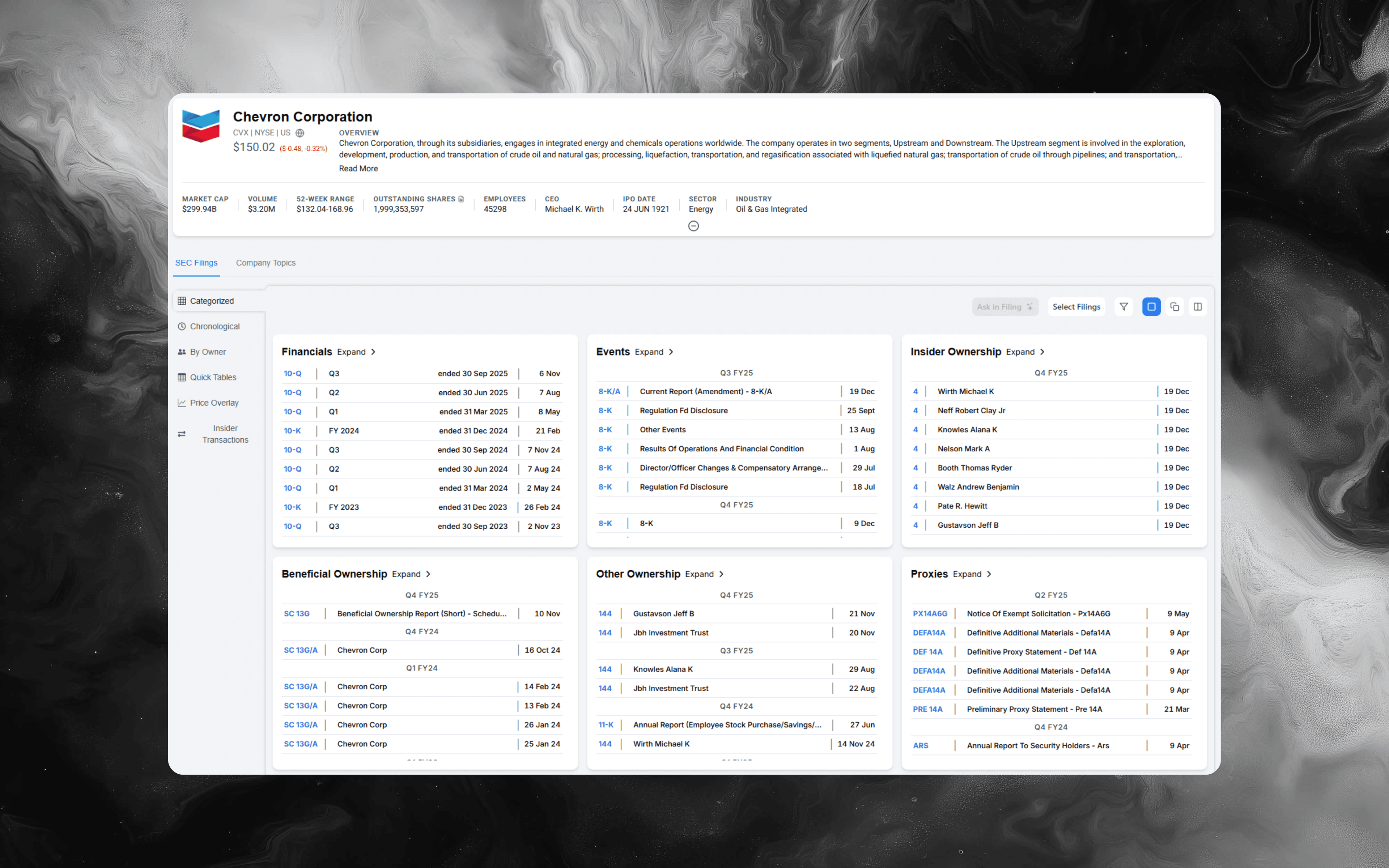
For a broader industry perspective, you might also want to review What Does Exxon Mobil (XOM) Actually Do?, which outlines another leading global integrated oil company’s segment structure, margin drivers, and reporting nuances.
The fastest mental model: Chevron runs a two-engine system
A simple way to explain Chevron to a non-specialist:
Chevron has an extraction engine (Upstream) and a conversion-and-distribution engine (Downstream). The two engines respond differently to commodity prices and industry conditions, which is why results can look “choppy” even when the underlying asset base is stable.
Three ideas that make the model click:
-
Upstream is mostly price realization and production volume
When crude and natural gas prices rise (or realizations improve), Upstream earnings usually respond quickly. When prices fall, the reverse is true. -
Downstream is mostly margin management and reliability
Downstream performance tends to be driven by refined product margins, chemical margins, utilization, planned maintenance timing, and unplanned outages. -
Corporate and financing choices matter, but don’t define the core business
Chevron’s “All Other” captures items like corporate administrative functions and financing activities. It can move reported net income, but the main business debate typically lives in Upstream and Downstream.
What Chevron sells (and who buys it)
Chevron ultimately sells energy and energy-derived products into global and regional markets. In plain language, that includes:
- Crude oil and natural gas (and related liquids)
- LNG-related activities (where applicable in the business mix)
- Transportation and trading/supply activities that move molecules and balance systems
- Fuels such as gasoline, diesel, and jet fuel
- Lubricants and additives
- Petrochemical-related products (the filing language references commodity petrochemicals, plastics for industrial uses, and additives within Downstream activities)
Analyst takeaway: for Chevron, “product” is less about branded SKUs and more about exposure to market pricing, differentials, and the company’s ability to run large, complex assets reliably.
How Chevron turns strategy into revenue (the operating loop)
Here’s a practical operating loop you can map to the income statement and segment tables:
-
Acquire and develop resource positions
Chevron invests capital in exploration and development, then builds projects that can produce for years (often decades). -
Produce and transport oil and gas
Production volumes and operating efficiency become critical, but price realizations often dominate earnings swings. -
Sell into global/regional markets
Prices are set by market forces largely outside company control; geography, quality, and logistics influence differentials and realizations. -
Convert crude into refined products and chemicals
Downstream takes crude/feedstocks and turns them into higher-value products, where profitability depends heavily on market margins and operational uptime. -
Distribute and market products
Marketing, supply, and distribution can amplify (or compress) profitability depending on regional demand, logistics constraints, and inventory dynamics. -
Allocate cash flow
The long-run story is capital discipline: how much is reinvested (capex), what is returned to shareholders, and what is used for portfolio actions.
Chevron’s segments in one map: Upstream, Downstream, and “All Other”
Chevron reports two business segments that management treats as the core operating engines:
-
Upstream: the production engine
Upstream primarily includes exploring for, developing, producing, and transporting crude oil and natural gas, plus related activities such as processing, transporting, storage, and marketing of natural gas and other integrated gas/LNG-related components described in filings. -
Downstream: the conversion and commercialization engine
Downstream primarily includes refining crude into petroleum products; marketing crude oil, refined products, and lubricants; manufacturing and marketing renewable fuels; transporting crude and refined products; and manufacturing/marketing commodity petrochemicals, industrial plastics, and fuel/lubricant additives (as described in segment disclosures). -
All Other: corporate and non-core buckets
“All Other” generally includes items like worldwide cash management, debt financing, corporate administrative functions, insurance operations, real estate activities, and technology companies.
Practical point: when you see a headline earnings move, split your explanation into (1) upstream realizations/volumes, (2) downstream margins/utilization, and (3) corporate/other noise.
For a broader survey of how manufacturing trends—like supply chain shifts or policy shocks—impact sectors with heavy upstream and downstream dynamics, see Manufacturing Trends 2025: 5 Signals to Monitor.
The drivers that usually matter most for Chevron (repeatable quarter after quarter)
If you want a consistent analyst workflow, keep the questions stable and let the answers change each quarter:
-
Commodity price realizations and differentials
Look for commentary on crude price realizations, natural gas realizations, and regional effects that can diverge from benchmark headlines. -
Production volumes and mix
Track oil-equivalent production and the mix of liquids vs. gas. Volume changes can be organic, acquisition-driven, or maintenance-driven. -
Refining and product margins
Downstream results tend to follow refined product margins and chemical margins, plus operational reliability. -
Reliability, turnarounds, and unplanned downtime
Maintenance timing can shift reported profitability between quarters. Unplanned outages can be a major short-term driver. -
Cost structure and inflation/energy inputs
Chevron’s filings discuss operating expenses and cost pressures as part of performance explanation; this can matter especially when prices are flat. -
Portfolio actions (acquisitions, dispositions, restructurings)
Large companies constantly optimize asset portfolios. The key is whether actions improve long-run cash generation and resilience.
Cost structure: where operating leverage (or drag) tends to show up
Chevron can look straightforward until you separate “what you can control” from “what markets control.”
-
What markets control (mostly)
Commodity prices and industry margins. These drive big swings in segment earnings, especially in Upstream. -
What Chevron controls (where execution shows up)
Operating efficiency, uptime, project execution, and how well capital is allocated across opportunities. -
What can distort comparability
One-time items, impairments, tax impacts, and timing effects (maintenance schedules, lifting/sales timing, inventory impacts).
A useful habit: when net income moves, identify which bucket explains it before you overfit a narrative.
A filings checklist for reading Chevron like an analyst
Use this as a quarterly ritual:
-
Start with segment definitions and any disclosure changes
Confirm what’s in Upstream vs. Downstream vs. All Other, and whether anything about reporting presentation changed. -
Build a one-page segment scorecard
For each segment: earnings direction, the stated drivers, and whether the driver is market (price/margin) or execution (volume, uptime, costs). -
Search the MD&A with a stable keyword set
Suggested recurring terms to track in Alpha Analyst: “realizations”, “margins”, “turnaround”, “utilization”, “maintenance”, “differentials”, “impairment”, “capital expenditures”, “production”, “LNG”, “renewable fuels”, “petrochemicals”, “logistics”, “OPEC”. -
Read risk factor edits, not just the risk factor length
Focus on what changed about commodity sensitivity, regulatory/environmental constraints, operational risks, geopolitical exposure, and litigation/contingencies. -
Sanity-check the narrative against the tables
If management says “lower realizations,” tie it back to segment earnings and the quantitative indicators disclosed in the filing.
For more on analyst workflow efficiency and repeatable research routines—including for energy sector majors—see Day in the Life of an Investment Analyst: A Realistic Playbook.
How to research Chevron faster in Alpha Analyst (without losing rigor)
If you cover Chevron regularly, the productivity win is converting your routine into saved, repeatable workflows:
-
Save your Chevron keyword searches and reuse them every filing cycle
Use phrase search, exclusions (NOT), and proximity operators (NEAR) to reduce noise and isolate the paragraphs that actually move. -
Pin your best saved searches to a dashboard filtered to Chevron
Pair widgets like Recent Filings with your saved keyword searches so you see what changed as soon as new filings land. -
Use AI Chat to summarize what changed, then verify in context
Examples:- “What changed in Chevron’s Upstream discussion versus last quarter?”
- “Where does Chevron explain the main drivers of Downstream margins this period?”
- “List the key risk factor edits related to operations or regulation.”
-
Keep an annotation trail for your thesis and open questions
Highlight the exact passages that explain the quarter (realizations, margins, outages, capex shifts) so you can audit your own conclusions later.
For more on applying AI-powered tools to scan SEC filings, streamline search, and track disclosure or risk factor evolution, see AI Search for SEC Filings, Rebuilt From the Ground Up.
Explore Chevron filings in Alpha Analyst
For a primary-source view of how Chevron defines Upstream and Downstream, what is driving earnings, and what the company is emphasizing as conditions change, go straight to: Chevron Corporation (CVX)
CTA: Use Alpha Analyst to search across Chevron filings with advanced keyword operators, save your best CVX queries, and pin them to a dashboard so new Chevron disclosures surface immediately when they’re published.
Related Posts
View all posts →
January 31, 2026
Fed Chair Nomination News: What Hassett’s Comments Signal
A practical guide to tracking Fed leadership changes, confirmation risk, and market reactions using filings, search, and dashboards

January 29, 2026
New York Fiscal Crisis: A Company Impact Playbook
How to map NYC budget stress to revenue, taxes, real estate, and credit risk across US equities

January 29, 2026
Monetary Debasement and the US Dollar: A Company Playbook
What “currency going to hell” really means, what could come next for USD, and how US businesses can defend margins, cash flows, and valuation

January 16, 2026
Amgen (AMGN) Deep Dive: Products, Pipeline, and Key Risks
A practical equity-research playbook for underwriting the next leg of growth, margin durability, and biosimilar exposure

January 16, 2026
Daikin Industries (6367): A Deep-Dive Equity Research Playbook
Business model, segment drivers, key risks, and how to build a thesis faster in Alpha Analyst
Explore More
View all posts →
February 4, 2026
Software Stocks and AI Disruption Fears: Investor Playbook
How to evaluate “AI risk” claims, pressure-test seat-based pricing, and track what matters in filings using Alpha Analyst

February 4, 2026
Enphase (ENPH) Upgrade After Earnings: What Changed
A practical investor brief on the BMO upgrade, Q4 beat, 2026 guideposts, and how to track follow-through in Alpha Analyst

February 4, 2026
Tether fundraising report: what changed and how to track it
A practical framework for monitoring stablecoin issuer valuation, liquidity, and regulatory signals with Alpha Analyst