

What Does Bank of America (BAC) Actually Do?
A plain-English map of how a large U.S. bank earns money, what the major business lines are, and which disclosures usually move the stock
By Michael Chen

Table of Contents
A simple explanation of Bank of America’s business model (it’s a balance sheet plus a fee platform)
What does Bank of America (BAC) actually do? At its core, Bank of America is a diversified financial institution that gathers deposits, makes loans, provides payment and cash-management services, and runs capital markets and wealth businesses. Unlike a card network, a bank is built around a balance sheet: it earns spread income when it funds assets (loans and securities) with liabilities (deposits and other funding), and it earns fee income from services.
If you want the primary-source foundation (business description, segment discussion, risk factors, accounting policies, and MD&A), start with the filings in Alpha Analyst here: Bank of America Corporation (BAC)
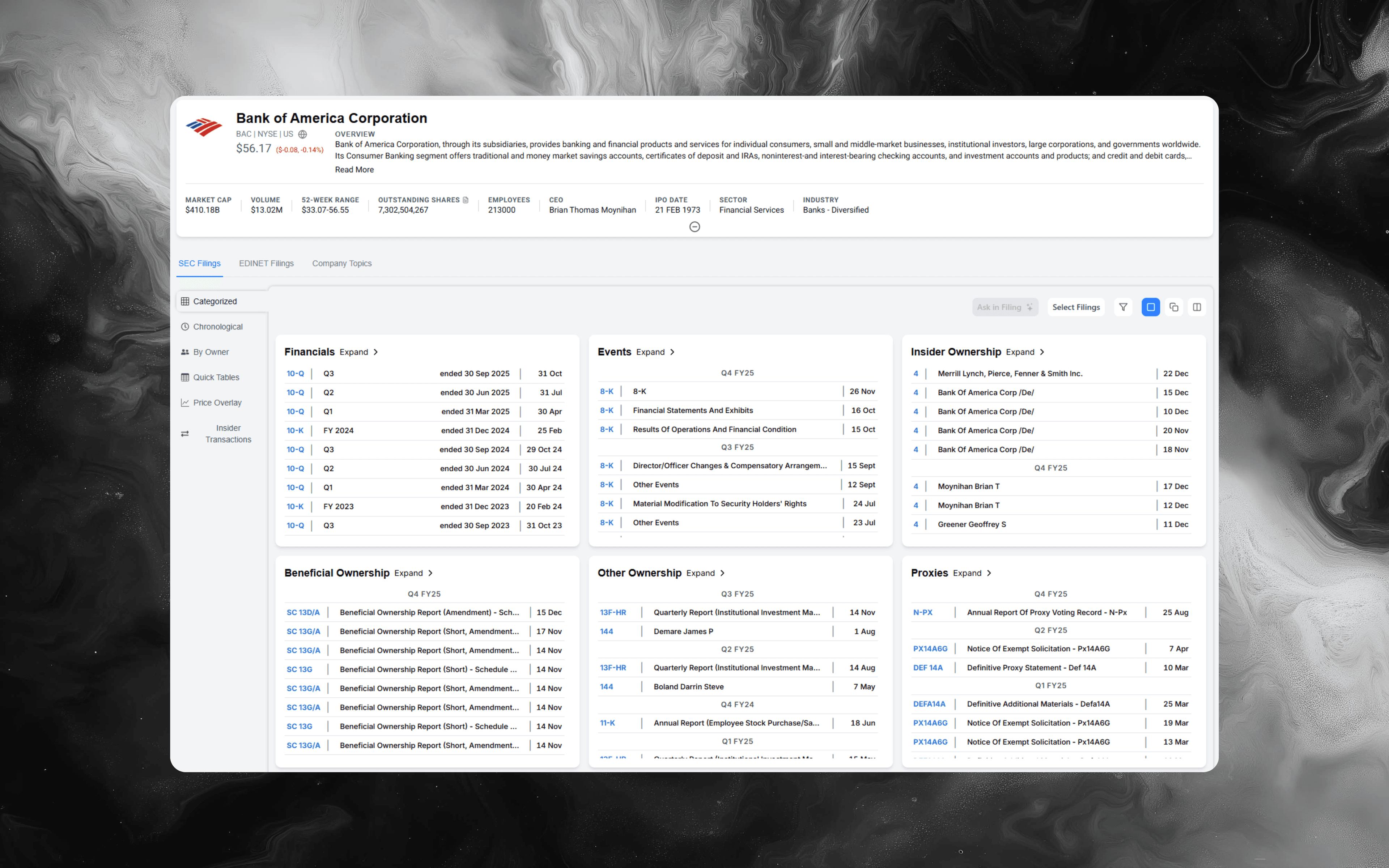
Table of contents
- The fastest mental model: BAC is a deposit franchise with multiple fee engines
- The five big “moving parts” inside a large bank
- What Bank of America sells (products and relationships, not just loans)
- The revenue lines that matter most (and why banks say “net interest income”)
- The credit cycle: where losses show up and what to scan for
- Interest-rate sensitivity: the hidden lever behind quarterly swings
- A quick checklist for reading BAC filings like an analyst
- Explore Bank of America filings in Alpha Analyst
The fastest mental model: BAC is a deposit franchise with multiple fee engines
A clean way to explain Bank of America to a non-specialist is:
Bank of America collects low-cost funding (primarily deposits), uses it to fund interest-earning assets (loans and securities), and layers on fee-based businesses like wealth management and investment banking.
Why that framing helps:
- It clarifies why deposit mix and funding costs can matter as much as loan growth.
- It explains why rate changes can move earnings even if “customers didn’t change.”
- It prevents a common mistake: viewing a large bank as only a consumer lender or only an investment bank.
For a sector research perspective on how language AI is transforming research workflows for banking and payments data, see NLP in Financial Research: Practical Use Cases and Playbook.
The five big “moving parts” inside a large bank
Even though the organization can be complex, you can usually map a large U.S. bank into a few repeatable buckets:
-
Consumer and small business banking Checking and savings accounts, credit cards, consumer loans (like mortgages and auto), and the day-to-day financial relationship.
-
Wealth management Advisory and brokerage, managed portfolios, and client cash and lending tied to wealthy households.
-
Commercial and corporate banking Loans, underwriting support, and cash-management services for middle-market and large corporate clients.
-
Markets and trading Client-driven activity in rates, FX, credit, and equities, plus market-making and risk management.
-
“All other” and corporate functions Items that don’t fit neatly into the above, including certain legacy positions, corporate treasury activity, and overhead.
You don’t need to memorize every sub-product. The objective is to know which activities are spread-driven (balance-sheet) vs fee-driven (service and activity).
For a broader look at the habits and routines of buy-side researchers navigating large, complex institutions, read Day in the Life of an Investment Analyst: A Realistic Playbook.
What Bank of America sells (products and relationships, not just loans)
Thinking in “products” alone can miss the point. Banks are relationship businesses. Bank of America typically monetizes relationships across multiple touchpoints:
-
Primary operating accounts Deposits are not just funding; they are sticky relationships that can lead to cards, mortgage, small business services, and wealth referrals.
-
Credit and liquidity Lending includes consumer credit, commercial loans, corporate revolvers, and other facilities. For businesses, credit often anchors broader fee opportunities.
-
Payments and transaction services Card fees, service charges, merchant-related capabilities through partners, and treasury services (cash management, payment rails, receivables).
-
Advice and distribution Wealth advisory, brokerage, managed investing, plus capital markets underwriting and M&A advisory for corporate clients.
A helpful one-sentence summary:
BAC tends to earn money when it is the customer’s primary bank, because “primary” creates multiple revenue streams that reinforce each other.
The revenue lines that matter most (and why banks say “net interest income”)
For a bank, “revenue” can be split into two big families:
-
Net interest income (NII) This is the difference between interest earned on assets and interest paid on liabilities. NII is driven by:
- Asset yields (loan pricing, securities yields, mix shift)
- Funding costs (deposit rates, wholesale funding, mix shift)
- Balance growth (how big the earning-asset base is)
- The yield curve and rate environment
-
Noninterest income (fees) This includes various categories depending on the bank, but conceptually it tends to come from:
- Service charges and account-related fees
- Card-related fees
- Wealth and asset management fees
- Investment banking fees
- Trading and market-related income
- Other service and transactional fees tied to client activity
A practical investor takeaway:
- If you expect rates to fall, you usually focus more on NII sensitivity and deposit beta dynamics.
- If you expect markets and corporate activity to rebound, you focus more on investment banking, trading, and wealth flows.
- If you expect credit stress, you focus less on “headline revenue” and more on provisions and net charge-offs.
For company-specific earnings call research practices, and how 10-K/10-Q data can be turned into actionable metrics and Excel-ready tables, see One-Click 10-K & 10-Q Financials to Excel.
The credit cycle: where losses show up and what to scan for
Credit risk is a defining difference between banks and payment networks. Even if revenue looks stable, credit can change the earnings picture quickly.
Three places to pay attention in filings:
-
Provision for credit losses This is where the bank builds or releases reserves based on expected losses. It can move meaningfully with macro assumptions and portfolio trends.
-
Net charge-offs These are realized losses, often discussed by portfolio (cards, consumer real estate, commercial, etc.). This is where the cycle becomes visible in the income statement over time.
-
Credit quality indicators Look for delinquency trends, criticized/classified commercial exposures (for commercial portfolios), and any notable concentration commentary.
A common pitfall: Analysts sometimes anchor on current charge-offs and miss that reserve builds can move first when management updates forward-looking expectations.
For insight into how risks and governance issues are discussed in SEC filings—and how to track them with AI—see Tesla Governance Red Flags: 10-K Risks & Lawsuits (2024).
Interest-rate sensitivity: the hidden lever behind quarterly swings
Banks often publish interest-rate sensitivity discussions because small rate moves can create big earnings changes at scale.
What to watch in a large bank’s narrative:
-
Deposit betas How quickly deposit rates reprice upward or downward relative to market rates.
-
Mix shift in deposits Customers can move from noninterest-bearing deposits into interest-bearing products or leave for higher-yield alternatives, changing funding cost even if total deposits are flat.
-
Asset repricing speed Fixed-rate vs variable-rate loan mix, and how quickly new originations reprice.
-
Securities portfolio dynamics The securities book can affect yield and capital; pay attention to how management discusses positioning, liquidity, and risk management.
You don’t need to build a full model to benefit from this section. The goal is to translate rate talk into a simple question: does a changing rate environment widen or compress the bank’s spread, and how fast?
For macro and sector context that can move banks and adjacent verticals—including policy, automation, and AI shifts—see Manufacturing Trends 2025: 5 Signals to Monitor.
A quick checklist for reading BAC filings like an analyst
Use this checklist to keep your BAC review consistent quarter to quarter:
-
Start with the “what changed” paragraph in MD&A Identify whether the driver is rates, volumes, fees/activity, or credit.
-
Separate NII from fees Don’t let strong fee quarters hide NII pressure (or vice versa). Treat them as different engines.
-
Track deposit and loan mix, not just totals Mix shifts can be more informative than growth rates.
-
Read the credit sections like a trend report Focus on directionality: early-stage delinquencies, reserve builds, and portfolio callouts.
-
Look for segment-level narrative When management shifts emphasis between consumer, wealth, commercial, and markets, it can signal where they see momentum or risk.
-
Save a keyword set for fast comparisons Example terms to reuse in Alpha Analyst search: net interest income, net interest yield, deposits, deposit costs, provision for credit losses, net charge-offs, delinquency, wealth management fees, investment banking, trading results.
Explore Bank of America filings in Alpha Analyst
To validate how Bank of America describes its business lines, identify what’s driving net interest income and fees, and catch changes in credit or rate sensitivity language before consensus fully adjusts, go straight to the filings: Bank of America Corporation (BAC)
CTA: Use Alpha Analyst to search across BAC filings with advanced keyword operators, save your highest-signal queries, and pin them to a dashboard filtered by your watchlist so new disclosures surface as soon as they’re filed.
Related Posts
View all posts →
January 31, 2026
Fed Chair Nomination News: What Hassett’s Comments Signal
A practical guide to tracking Fed leadership changes, confirmation risk, and market reactions using filings, search, and dashboards

January 29, 2026
New York Fiscal Crisis: A Company Impact Playbook
How to map NYC budget stress to revenue, taxes, real estate, and credit risk across US equities

January 29, 2026
Monetary Debasement and the US Dollar: A Company Playbook
What “currency going to hell” really means, what could come next for USD, and how US businesses can defend margins, cash flows, and valuation

January 16, 2026
Amgen (AMGN) Deep Dive: Products, Pipeline, and Key Risks
A practical equity-research playbook for underwriting the next leg of growth, margin durability, and biosimilar exposure

January 16, 2026
Daikin Industries (6367): A Deep-Dive Equity Research Playbook
Business model, segment drivers, key risks, and how to build a thesis faster in Alpha Analyst
Explore More
View all posts →
February 4, 2026
Software Stocks and AI Disruption Fears: Investor Playbook
How to evaluate “AI risk” claims, pressure-test seat-based pricing, and track what matters in filings using Alpha Analyst

February 4, 2026
Enphase (ENPH) Upgrade After Earnings: What Changed
A practical investor brief on the BMO upgrade, Q4 beat, 2026 guideposts, and how to track follow-through in Alpha Analyst

February 4, 2026
Tether fundraising report: what changed and how to track it
A practical framework for monitoring stablecoin issuer valuation, liquidity, and regulatory signals with Alpha Analyst