

What Does Tesla (TSLA) Actually Do?
A plain-English map of Tesla’s two reportable segments and the revenue streams that sit behind “cars + energy”
By Michael Chen

Table of Contents
A simple explanation of Tesla’s business model (it’s more than selling cars)
What does Tesla (TSLA) actually do? In plain English, Tesla builds and sells electric vehicles, and it also sells energy products like batteries and solar. Around those two cores, Tesla layers software, charging, and services that can expand revenue per customer over time.
In Tesla’s filings, the company describes two operating and reportable segments: (i) automotive and (ii) energy generation and storage. If you want the primary-source map (business description, segment reporting, risks, and financial statements), start with Tesla’s filings in Alpha Analyst here: Tesla, Inc. (TSLA)
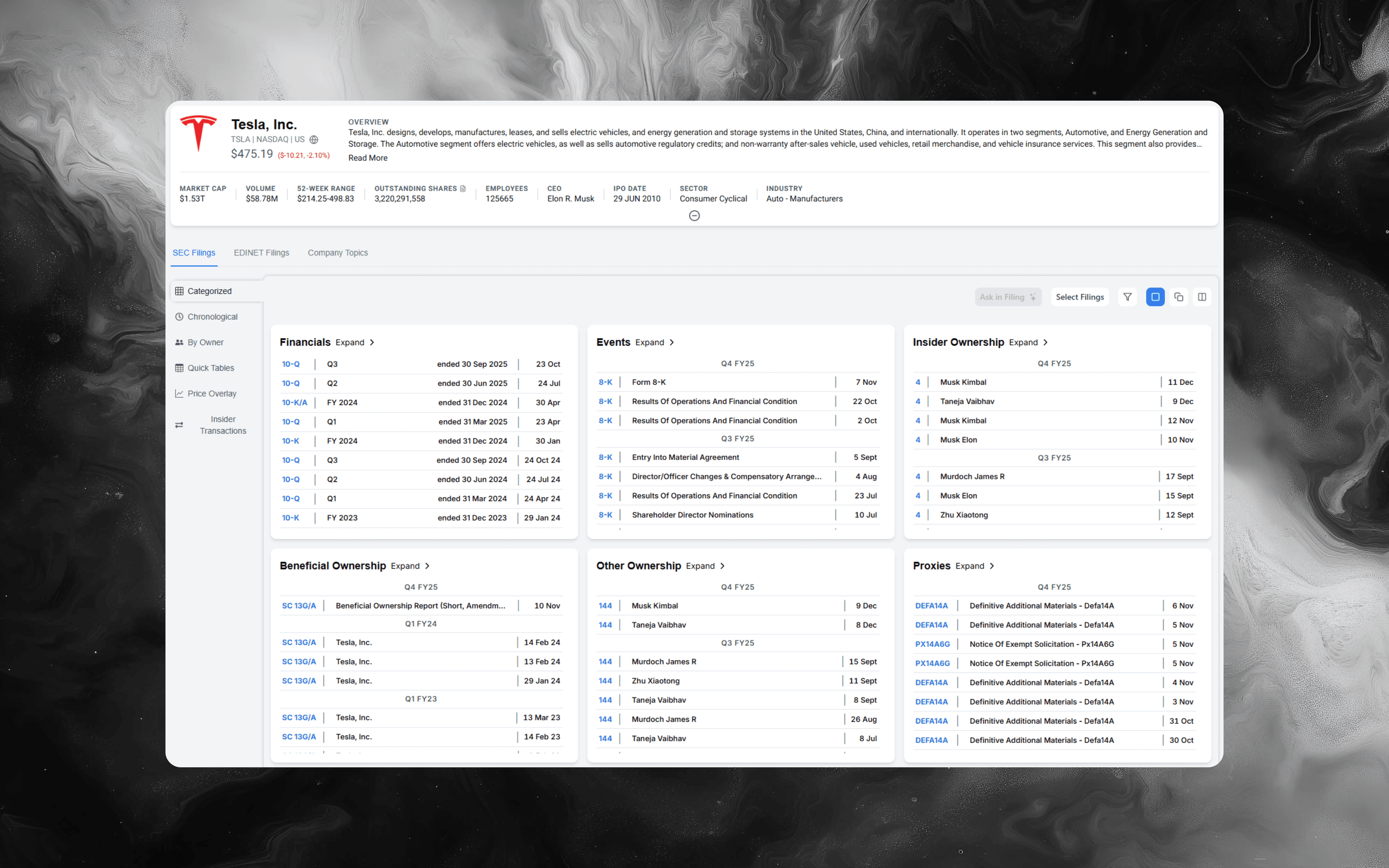
Table of contents
- The fastest mental model: Tesla sells electrification “systems,” not just products
- The two segments Tesla reports (and what sits inside each)
- Automotive segment: vehicles plus credits, software, charging, and services
- Energy generation and storage: batteries and solar as an infrastructure business
- Where recurring revenue can show up in TSLA (and what is still cyclical)
- A quick checklist for reading TSLA filings like an analyst
- Explore Tesla filings in Alpha Analyst
The fastest mental model: Tesla sells electrification “systems,” not just products
Tesla is easiest to understand if you picture it as a company trying to deliver an end-to-end electrification stack:
- Transportation stack: EVs plus the ecosystem that makes EV ownership work (delivery, service, parts, charging, software updates).
- Energy stack: battery storage and solar products that help homes and grids generate, store, and use electricity.
This matters because a “systems” business tends to create more than one way to earn revenue from the same customer relationship. The vehicle sale may be the headline, but the economics can also be influenced by the add-ons and services that follow the installed base.
For a broader look at how manufacturing, automation, and supply chain trends are impacting companies like Tesla, see Manufacturing Trends 2025: 5 Signals to Monitor.
The two segments Tesla reports (and what sits inside each)
Tesla’s segment framing is simple on paper: two segments.
But within that simplicity, filings show a more detailed revenue map that’s useful for investors, especially when you’re trying to reconcile big narratives (EV demand, autonomy, energy storage growth) with how the company actually reports results.
High-level view:
- Automotive segment: includes the design, development, manufacturing, sales and leasing of electric vehicles, plus automotive regulatory credits; it also includes “services and other” items such as used vehicles, non-warranty maintenance and collision, parts, paid Supercharging, insurance services revenue, and retail merchandise sales.
- Energy generation and storage segment: includes solar energy generation and energy storage products (sold or leased), related services, and certain solar energy systems incentives.
One practical takeaway: many things people talk about as separate “business lines” are financially nested inside the automotive segment (especially services and other), so you have to read footnotes and revenue tables carefully to avoid mixing categories.
For analysts who want practical habits and playbooks for segment analysis, Day in the Life of an Investment Analyst: A Realistic Playbook covers techniques that translate well to tracking Tesla.
Automotive segment: vehicles plus credits, software, charging, and services
Most investors start (and sometimes stop) at “Tesla sells cars.” The filings paint a broader picture: Tesla sells and leases vehicles, earns and sells regulatory credits, and operates customer-facing infrastructure that supports the fleet.
A clean, plain-English breakdown:
- New vehicle sales: revenue from delivering new vehicles.
- Leasing: Tesla has vehicle leasing activity (and filings discuss how certain leasing programs are structured).
- Automotive regulatory credits: Tesla earns tradable credits under various emissions and fuel economy regulations and sells them to other regulated entities.
- Services and other: a catch-all bucket that includes multiple post-sale and fleet-driven revenue streams (used vehicles, non-warranty service and collision, parts, paid Supercharging, insurance services, and merchandise).
Why this segment can be misunderstood:
- Some revenue is tied to unit volumes and pricing (vehicle sales), which can behave cyclically.
- Some revenue can be more market-structure-driven (regulatory credits), which can be meaningful but can also change quickly based on regulation and industry demand.
- Some revenue scales with the installed base (service, parts, charging), which can act differently than new vehicle deliveries.
A useful one-sentence explanation: Tesla’s automotive segment is a vehicle manufacturing and distribution engine, with additional monetization from credits, charging, and the growing global fleet’s service needs.
For a close-up look at recent financials—including assets, liabilities, and cash trends—see Tesla Balance Sheet Analysis 2025: Latest Assets, Liabilities, Cash Position & Debt Trends.
Energy generation and storage: batteries and solar as an infrastructure business
Tesla’s second segment, energy generation and storage, is the piece that many people “know exists” but can’t describe confidently.
In simple terms, this segment sells:
- Energy storage products (grid-scale and customer-scale storage)
- Solar energy generation products
- Related services, and certain incentives linked to solar energy systems
What makes this segment distinct from automotive:
- The buyer is often a utility, developer, commercial customer, or homeowner optimizing for project economics, reliability, and installation timelines, not “brand preference.”
- Delivery cadence can be project-based (especially for larger deployments), which can affect quarterly lumpiness.
- The drivers are tied to grid investment cycles, electricity pricing, renewable integration, and reliability needs, not the car market.
A useful one-sentence explanation: Tesla’s energy segment provides hardware and services that help customers store energy and, in some cases, generate it, positioning the business closer to electrical infrastructure than consumer electronics.
Where recurring revenue can show up in TSLA (and what is still cyclical)
If you’re explaining TSLA’s business model to someone who’s not deep in the name, it helps to separate “repeatable” from “recurring.”
Repeatable means Tesla can sell more of it each year if demand holds. Recurring means the same customer relationship can generate revenue again without a new vehicle purchase.
A practical lens:
-
New vehicle sales (repeatable, not inherently recurring) Vehicle deliveries can scale, but each purchase is a discrete event and is typically sensitive to pricing, competition, and macro factors.
-
Regulatory credits (opportunistic and policy-shaped) Credits can be high-margin, but the durability depends on regulation and other manufacturers’ compliance needs. This is a revenue line analysts often monitor with a cautious mindset.
-
Post-sale services tied to the installed base (often more recurring) As the fleet grows, categories like paid charging, parts, non-warranty service/collision, and other service-like items can become more structurally repeatable.
-
Software-enabled revenue elements (timing and accounting matter) Filings discuss software features and ongoing maintenance and describe deferred revenue related to items bundled with vehicle sales. The key analytical point is to watch how product packaging and feature releases can change revenue timing.
-
Energy deployments (repeatable, sometimes project-lumpy) Energy storage and solar can scale over time, but project cycles and customer mix can shape quarterly patterns.
A simple summary sentence: Tesla blends a high-profile product sales engine (vehicles) with additional revenue layers (credits, charging, services, software elements) and a separate energy infrastructure segment that follows different demand cycles.
You can also see how Tesla compares to other innovation-led manufacturers by reviewing Electric Vehicle Trends 2025: What to Watch Next.
A quick checklist for reading TSLA filings like an analyst
If you want to track Tesla without getting pulled into headlines, use a consistent checklist each quarter:
-
Segment narrative vs. segment numbers Do management’s explanations match the automotive vs. energy mix changes?
-
Automotive revenue composition Scan how Tesla breaks out automotive sales, regulatory credits, leasing, and services and other. Shifts here often explain the “why” behind margin commentary.
-
Regulatory credits: direction and drivers Look for changes in language around credit demand, regulatory frameworks, and how proactively credits are monetized.
-
Services and other: what’s actually growing Because this line bundles multiple activities, look for commentary on what is driving increases (charging, insurance, used vehicles, service).
-
Deferred revenue and performance obligations language Monitor disclosures that explain how and when revenue is recognized for bundled items and longer-duration obligations.
-
Energy segment operational signals Track deployment commentary, pricing/mix language, and how incentives or policy changes affect the business.
Pro tip: keep a saved search list of the same phrases (for example, “reportable segments”, “services and other”, “automotive regulatory credits”, “deferred revenue”, “energy generation and storage”) so you can compare disclosure shifts quarter-to-quarter.
For more on governance, risks, and legal challenges found in Tesla output, see Tesla Governance Red Flags: 10-K Risks & Lawsuits (2024).
Explore Tesla filings in Alpha Analyst
To validate how Tesla defines its segments, see what management says is driving automotive versus energy performance, and quickly surface the disclosures that can move the TSLA narrative, go straight to the filings: Tesla, Inc. (TSLA)
CTA: Use Alpha Analyst to search across TSLA filings with advanced keyword operators, save those searches, and add them to a dashboard filtered by your watchlist so new disclosures surface as soon as they land.
Related Posts
View all posts →
January 31, 2026
Fed Chair Nomination News: What Hassett’s Comments Signal
A practical guide to tracking Fed leadership changes, confirmation risk, and market reactions using filings, search, and dashboards

January 29, 2026
New York Fiscal Crisis: A Company Impact Playbook
How to map NYC budget stress to revenue, taxes, real estate, and credit risk across US equities

January 29, 2026
Monetary Debasement and the US Dollar: A Company Playbook
What “currency going to hell” really means, what could come next for USD, and how US businesses can defend margins, cash flows, and valuation

January 16, 2026
Amgen (AMGN) Deep Dive: Products, Pipeline, and Key Risks
A practical equity-research playbook for underwriting the next leg of growth, margin durability, and biosimilar exposure

January 16, 2026
Daikin Industries (6367): A Deep-Dive Equity Research Playbook
Business model, segment drivers, key risks, and how to build a thesis faster in Alpha Analyst
Explore More
View all posts →
February 4, 2026
Software Stocks and AI Disruption Fears: Investor Playbook
How to evaluate “AI risk” claims, pressure-test seat-based pricing, and track what matters in filings using Alpha Analyst

February 4, 2026
Enphase (ENPH) Upgrade After Earnings: What Changed
A practical investor brief on the BMO upgrade, Q4 beat, 2026 guideposts, and how to track follow-through in Alpha Analyst

February 4, 2026
Tether fundraising report: what changed and how to track it
A practical framework for monitoring stablecoin issuer valuation, liquidity, and regulatory signals with Alpha Analyst