

What Does Palantir (PLTR) Actually Do?

Table of Contents
A clear explanation of Palantir’s platforms and revenue model
What does Palantir (PLTR) actually do? Palantir builds enterprise software that helps organizations integrate data, turn it into decisions, and run day-to-day operations at scale.
In Palantir’s own words from its latest annual filing: it “build[s] software that empowers organizations to effectively integrate their data, decisions, and operations at scale.” It started in 2003 serving the U.S. intelligence community and later expanded into commercial enterprises facing similar data and operational complexity.
Palantir’s business is easiest to understand as “operational data + AI + deployment anywhere” packaged into four core platforms:
- Gotham (government-focused analytics and operations)
- Foundry (enterprise data operating system for commercial and government)
- Apollo (deployment and continuous delivery control layer)
- AIP (Artificial Intelligence Platform that brings generative AI and LLMs into Gotham/Foundry workflows)
For primary-source context (business description, segments, risk factors, and financial statements), you can pull up Palantir’s standardized filings inside Alpha Analyst here: Palantir Technologies Inc. (PLTR)
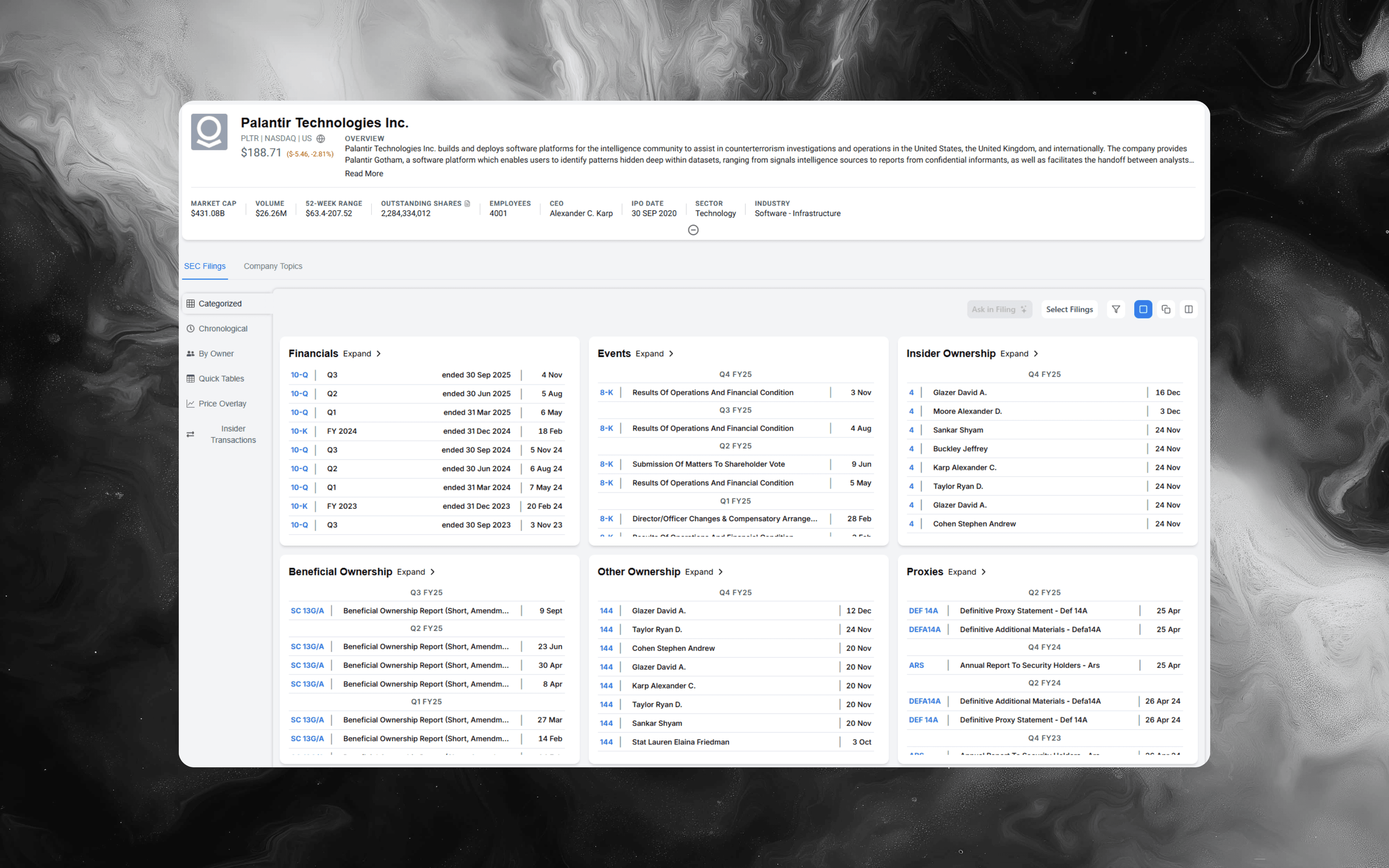
Table of contents
- What does Palantir sell (in practical terms)?
- Palantir Foundry: the enterprise data operating system
- Palantir Gotham: government analytics into operations
- Palantir AIP: operationalizing generative AI on enterprise data
- Palantir Apollo: “deploy anywhere” and keep it updated
- Who uses Palantir (and why)?
- How Palantir makes money: commercial vs government
- The bottom line: what Palantir actually does
- Explore Palantir filings in Alpha Analyst
What does Palantir sell (in practical terms)?
If you ignore product names and focus on the buyer’s problem, Palantir is selling a way to:
- connect scattered data sources into a trusted “operational picture”
- embed analytics and AI into real workflows (not just dashboards)
- deploy securely across cloud, on-prem, and constrained environments
- enforce access controls, auditability, and governance end-to-end
This framing matters because Palantir says it primarily competes with customers’ internal software development efforts (the build-it-yourself route), plus a mix of enterprise software vendors, government contractors, and system integrators.
To see how other companies are using AI-powered analytics, you might explore NLP in Financial Research: Practical Use Cases and Playbook.
Palantir Foundry: the enterprise data operating system
Foundry is Palantir’s platform aimed at transforming how organizations operate by creating a central operating system for their data.
A helpful mental model:
- Data engineering: bring data in, integrate sources, build pipelines
- Governance and traceability: understand what data means and where it came from
- Analytics and operations: allow business users to do daily work using that data foundation
- Scale: expand from a single use case into many functions and teams
Palantir highlights one sticky feature: pipelines that are trackable and reproducible, designed to reduce the “it worked once, but no one can explain it” failure mode common in data projects. It also notes that Foundry’s interface helps users trace what rows and columns represent and why they exist.
For a broader overview of how operational data integration and AI are reshaping enterprise software, see Generative AI Ethics in Business: A Practical Governance Playbook.
Palantir Gotham: from intelligence analysis to real-world action
Gotham is positioned around high-stakes government use cases. Palantir describes Gotham as enabling users to identify patterns hidden deep within datasets (including sensitive sources) and then facilitate a hand-off from analysis to operational users.
In other words, it’s not only about finding insights; it’s about helping teams plan and execute responses based on what the platform surfaces. Palantir says Gotham is used broadly across government functions, and it cites long-standing use across defense agencies, the intelligence community, and disaster relief organizations.
Palantir AIP: operationalizing generative AI on enterprise data
AIP (Artificial Intelligence Platform) is Palantir’s newer layer that brings generative AI into decision workflows inside Gotham and/or Foundry.
Based on Palantir’s description, AIP is designed to:
- connect LLMs and other AI to enterprise data and operations
- support multiple model options (open-source, self-hosted, commercial)
- turn actions and processes into tools that humans and AI agents can use
- include security, audit controls, and human review checkpoints so AI can be used in environments with strict legal, ethical, and security constraints
A simple way to explain the value proposition:
AIP is meant to make AI usable in the messy reality of enterprise data and governance, rather than as a standalone chatbot.
Palantir also emphasizes “bundling”: AIP is described as seamlessly bundled with Foundry, Gotham, and Apollo, so it’s not a separate island.
Palantir Apollo: “deploy anywhere” and keep it running
Apollo is Palantir’s control layer for deployment and continuous delivery. Palantir describes Apollo as cloud-agnostic and built to coordinate delivery of new features, security updates, and platform configurations.
What that means in practical terms:
- customers can run Palantir in multiple environments (cloud, on-prem, or more rugged/disconnected settings)
- the software can be updated and operated continuously without breaking critical systems
- Apollo can also help customers deploy their own software in many environments, using a single control layer
This “run it anywhere” angle is important because many of Palantir’s target customers (especially in government and regulated industries) have constraints that prevent a simple “everything in one public cloud” approach.
Who uses Palantir (and why)?
Palantir reports that, as of December 31, 2024, it had 711 customers and that its software is used across approximately 90 industries worldwide.
It also provides examples of the types of users and settings where its platforms show up, including:
- utility operations analysts
- automotive manufacturing workers
- oil and gas technicians and operators
- pharmaceutical researchers
- supply-chain managers
- public health administrators
- special forces personnel and military officials
In plain terms, Palantir is going after organizations where:
- data is fragmented across many systems
- decisions need to be made quickly and defensibly
- governance, access controls, and audit logs are not optional
- “time to value” matters because long implementation timelines are not acceptable
Palantir explicitly argues that customers are increasingly adopting software that can be “ready in days,” rather than internal development efforts that can take months or years.
For a look at how these challenges play out in data-driven investment jobs, the Day in the Life of an Investment Analyst: A Realistic Playbook offers a useful perspective.
How Palantir makes money: commercial vs government
Palantir’s revenue is commonly discussed through the lens of two customer groups:
- Government segment
- Commercial segment
In 2024, Palantir reported total revenue of $2.9 billion, with 55% coming from government customers and 45% from commercial customers. It also reported geographic mix: 66% of revenue from the United States and 34% from abroad.
A few other customer economics signals Palantir calls out:
- The average revenue for its top twenty customers (trailing twelve months ended Dec 31, 2024) was $64.6 million, up from $54.6 million for the comparable period ended Dec 31, 2023.
- It emphasizes account expansion strategies (adding divisions, use cases, and user groups) once it earns trust by solving difficult, high-priority problems first.
Palantir also describes sales and go-to-market mechanisms that help it expand, including:
- AIP bootcamps introduced in 2023 (to deliver workflows on actual customer data in days)
- Developer Tier introduced in 2024 (limited access to Foundry and AIP in the U.S. and select countries)
- cloud partnerships and potential channel relationships
- industry operating systems and partnerships in sectors like airline, insurance, healthcare, automotive, and government
The bottom line: what Palantir actually does
Palantir is an enterprise software company focused on operational decision-making at scale.
Its core idea is to integrate data, analytics, and AI into live workflows (not just reporting), and then deploy that capability wherever the customer needs it (cloud, on-prem, hybrid, or edge).
If you only remember one sentence: Palantir sells platforms that connect data to decisions to operations, with governance and deployment built in.
Explore Palantir filings inside Alpha Analyst
If you want to validate product descriptions, understand customer concentration and contract terms, or map the narrative to segment-level numbers, the fastest path is to read the primary-source filings in a searchable format: Palantir Technologies Inc. (PLTR)
CTA: If you’re building an investment memo or monitoring a name like PLTR over time, use Alpha Analyst to search across filings, save keyword queries, and track new disclosures as they land.
Related Posts
View all posts →
January 31, 2026
Fed Chair Nomination News: What Hassett’s Comments Signal
A practical guide to tracking Fed leadership changes, confirmation risk, and market reactions using filings, search, and dashboards

January 29, 2026
New York Fiscal Crisis: A Company Impact Playbook
How to map NYC budget stress to revenue, taxes, real estate, and credit risk across US equities

January 29, 2026
Monetary Debasement and the US Dollar: A Company Playbook
What “currency going to hell” really means, what could come next for USD, and how US businesses can defend margins, cash flows, and valuation

January 16, 2026
Amgen (AMGN) Deep Dive: Products, Pipeline, and Key Risks
A practical equity-research playbook for underwriting the next leg of growth, margin durability, and biosimilar exposure

January 16, 2026
Daikin Industries (6367): A Deep-Dive Equity Research Playbook
Business model, segment drivers, key risks, and how to build a thesis faster in Alpha Analyst
Explore More
View all posts →
February 4, 2026
Software Stocks and AI Disruption Fears: Investor Playbook
How to evaluate “AI risk” claims, pressure-test seat-based pricing, and track what matters in filings using Alpha Analyst

February 4, 2026
Enphase (ENPH) Upgrade After Earnings: What Changed
A practical investor brief on the BMO upgrade, Q4 beat, 2026 guideposts, and how to track follow-through in Alpha Analyst

February 4, 2026
Tether fundraising report: what changed and how to track it
A practical framework for monitoring stablecoin issuer valuation, liquidity, and regulatory signals with Alpha Analyst