

What Does Microsoft (MSFT) Actually Do?
A plain-English map of Microsoft’s three segments and the recurring revenue engines behind them
By Michael Chen

Table of Contents
A simple explanation of Microsoft’s business model (beyond “it sells Windows”)
What does Microsoft (MSFT) actually do? In plain terms, Microsoft sells software and cloud services that companies and consumers use every day, then compounds revenue over time through subscriptions, long-term contracts, usage-based cloud consumption, and add-on security/AI capabilities.
Microsoft’s filings describe the business through three reportable segments: Productivity and Business Processes, Intelligent Cloud, and More Personal Computing. If you want the primary-source map (business description, segment reporting, risks, and financial statements), start with Microsoft’s filings in Alpha Analyst here: Microsoft Corporation (MSFT)
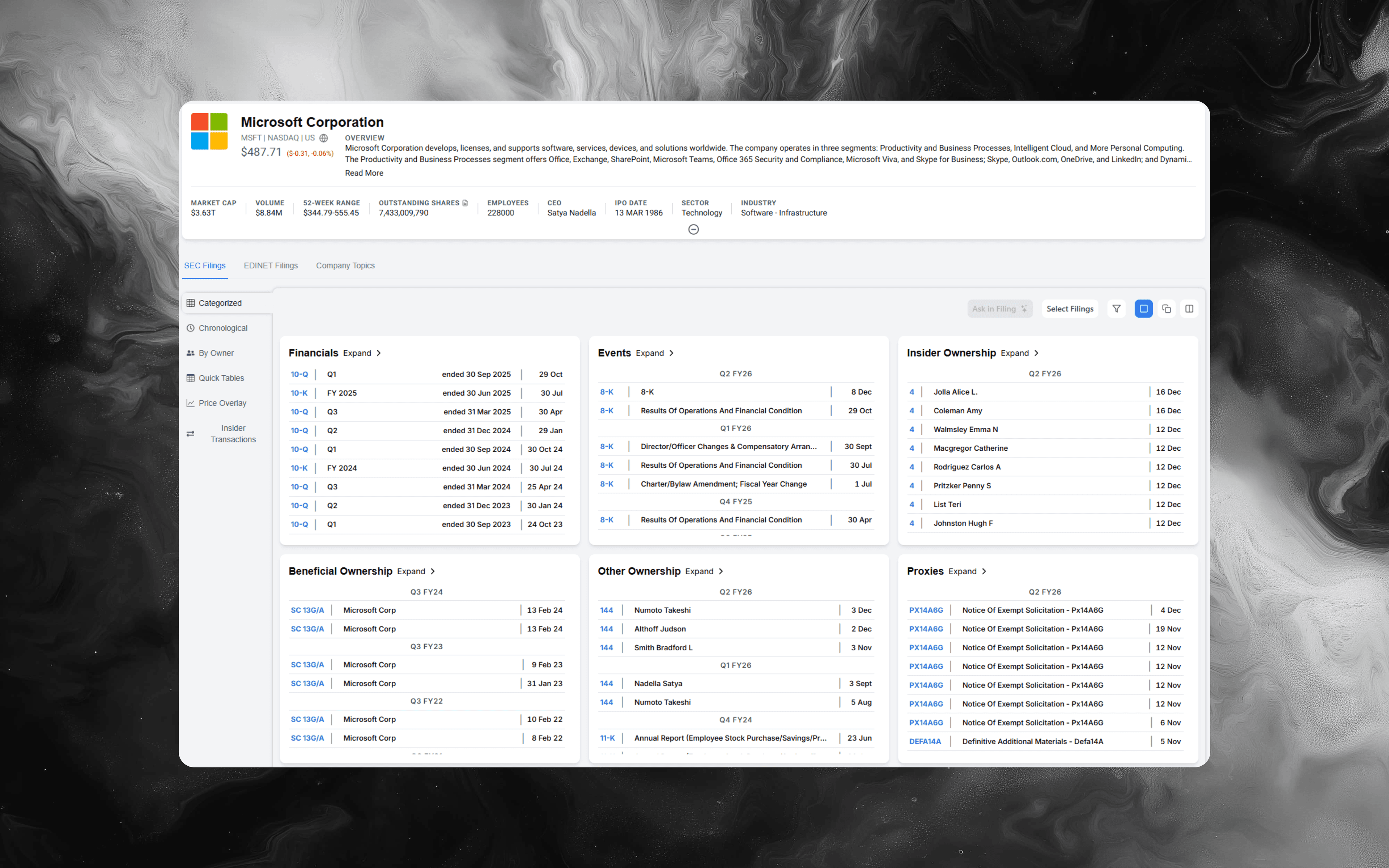
Table of contents
- The fastest mental model: Microsoft sells platforms, not one-off products
- The three segments Microsoft reports (and why that matters)
- Productivity and Business Processes: subscriptions that sit inside daily work
- Intelligent Cloud: Azure consumption + server products + cloud services
- More Personal Computing: Windows, devices, gaming, and advertising
- Where Microsoft’s recurring revenue really comes from
- A quick checklist for reading MSFT filings like an analyst
- Explore Microsoft filings in Alpha Analyst
The fastest mental model: Microsoft sells platforms, not one-off products
Microsoft is easier to understand if you stop thinking in individual product names and start thinking in “platform attachment.”
A practical way to picture the business is a loop:
- Start with a core entry point (Microsoft 365 for knowledge work, Windows on PCs, Azure for cloud infrastructure, GitHub for developers, Dynamics for business apps, Xbox for gaming)
- Become embedded in daily workflows or mission-critical IT
- Expand within the same customer via more seats, more workloads, and more services
- Add higher-value layers like security, compliance, management, and AI copilots/agents
- Renew contracts and subscriptions (and, for cloud, keep consuming compute/storage over time)
This is why Microsoft can look “diversified” on the surface while still operating like an integrated stack: productivity + cloud + identity/security + developer tooling + endpoints.
For a closer look at enterprise technology business models and their platform expansion strategies, NLP in Financial Research: Practical Use Cases and Playbook outlines how language AI tools now attach to core software suites, much like Microsoft's approach with AI and workflow integration.
The three segments Microsoft reports (and why that matters)
Microsoft reports financial performance in three segments:
- Productivity and Business Processes
- Intelligent Cloud
- More Personal Computing
This segmentation matters for two reasons:
- It tells you how leadership manages the business internally (how resources are allocated and performance is evaluated).
- It gives you a clean framework for separating demand drivers (seat-based subscriptions vs cloud consumption vs consumer device cycles).
When you read quarterly updates or the annual report, segment mix is often the simplest way to see what is actually accelerating (or decelerating), even when product headlines are noisy.
Analyzing similar reporting frameworks in other technology companies is discussed in What Does Oracle (ORCL) Actually Do?, which provides another lens on multi-segment financial disclosures.
Productivity and Business Processes: subscriptions that sit inside daily work
Think of this segment as “work runs here.”
In Microsoft’s filings, Productivity and Business Processes spans products and services that help people communicate, collaborate, create, and run business processes across devices and platforms. In practice, it’s anchored by:
- Microsoft 365 commercial offerings (and related services)
- Collaboration and communication tools (for example, Teams as part of the suite)
- Business applications (Dynamics family)
- LinkedIn (a distinct business with hiring, marketing, and subscriptions)
Business-model intuition:
- A large portion of this segment is subscription-driven.
- Expansion often shows up as more paid users (seats), higher-value bundles, and add-ons (notably security/compliance and AI features).
- Switching costs can be meaningful because the products become the “default layer” for documents, meetings, messaging, identity, and organizational workflow.
If you’re trying to explain Microsoft to a non-technical reader, this segment is the “software rent” that many organizations pay to run everyday work.
Intelligent Cloud: Azure consumption + server products + cloud services
Think of Intelligent Cloud as “digital infrastructure and developer plumbing.”
This segment generally includes:
- Azure and other cloud services (often usage-based, scaling with customer workloads)
- Server products and cloud services (including hybrid and on-premises server software plus cloud counterparts)
- Developer and data/AI-related tooling that supports building and operating software at scale
Business-model intuition:
- Cloud infrastructure is often consumption-driven: as customers run more workloads, usage rises.
- Cloud economics are shaped by scale (datacenters, utilization, and multi-tenant operations), and filings often discuss the cost structure tied to cloud growth.
- Attach opportunities matter: customers running workloads in Azure frequently add security, identity, management, data services, and AI capabilities.
For analysis, the two most common pitfalls are:
- Treating “cloud” as a single product rather than a bundle of consumption, platform services, and enterprise agreements
- Ignoring cost dynamics when infrastructure demand ramps (capacity, hardware cycles, and efficiency gains)
To dive deeper into the competitive landscape shaping cloud and AI infrastructure trends, AI Data Center Optics Stocks: COHR, LITE, MRVL + More breaks down some of the underlying technologies powering hyperscale platforms like Azure.
More Personal Computing: Windows, devices, gaming, and advertising
This segment is “consumer and PC ecosystem,” but it’s not just PCs.
More Personal Computing typically includes:
- Windows (including OEM channels and commercial components, as applicable)
- Devices (for example, Surface-related hardware where relevant)
- Gaming (Xbox content/services and subscriptions)
- Search and news advertising (often discussed as advertising revenue net of traffic acquisition costs in certain contexts)
Business-model intuition:
- Some parts can be cyclical (PC market conditions and device refresh cycles).
- Gaming blends one-time purchases with recurring subscriptions and ongoing content/service monetization.
- Advertising can be more sensitive to macro ad spend trends, but the strategic tie-in is engagement across products and services.
This segment helps explain why Microsoft can show consumer-like dynamics in one area while the rest of the company behaves like enterprise software and infrastructure.
Broader trends impacting the hardware and device ecosystem are discussed in Manufacturing Trends 2025: 5 Signals to Monitor, which can provide a useful backdrop when thinking about device-driven cycles in this segment.
Where Microsoft’s recurring revenue really comes from
If you need a plain-English revenue map for Microsoft, these buckets are usually enough:
-
Seat-based subscriptions
Organizations pay per user for productivity and collaboration suites, often with multi-year agreements. -
Usage-based cloud consumption
Customers pay for the compute/storage/networking they use, plus managed services on top. -
Ongoing support and enterprise agreements
Large customers often buy via structured contracts that renew and expand over time. -
Add-ons and “higher layers”
Security, compliance, identity, management, and AI features can increase revenue per user or per workload. -
Subscriptions beyond the enterprise suite
Gaming subscriptions and other consumer subscriptions can add recurring revenue on the consumer side as well.
A useful way to phrase it in one sentence:
Microsoft is a compounder because many customers start with one Microsoft product, then gradually pay more as they add users, move more workloads to cloud, and adopt higher-value layers like security and AI.
For perspective on how recurring revenue models drive compounding growth in adjacent sectors, Electric Vehicle Trends 2025: What to Watch Next discusses how platform expansion and revenue innovation work beyond software.
A quick checklist for reading MSFT filings like an analyst
When you’re monitoring Microsoft, these are high-signal areas to track in filings:
- Segment mix and segment growth drivers (what is actually moving results)
- Cloud commentary on capacity, efficiency, and gross margin dynamics
- Any language about changes in segment composition or internal reporting (it can affect comparability)
- Unearned revenue and remaining performance obligations language (helps frame the forward revenue pipeline conceptually)
- Product metrics discussion (when disclosed) that hints at seat growth, usage intensity, or engagement
- Risk factors that evolve (competition, platform shifts, security incidents, regulatory and tax matters, supply chain or hardware constraints)
If you keep a consistent checklist across quarters, you can spot narrative changes early, not just performance changes.
For practical tips on surfacing risk and opportunity in filings-based research, AI Search for SEC Filings, Rebuilt From the Ground Up offers guidance on using modern tools to identify high-signal disclosures in real time.
Explore Microsoft filings in Alpha Analyst
If you want to validate how Microsoft describes each segment, track what management emphasizes about cloud scale and cost structure, or quickly find the few disclosures that actually move your thesis, go straight to the primary-source filings in a searchable format: Microsoft Corporation (MSFT)
CTA: If you’re monitoring MSFT over time, use Alpha Analyst to search across filings with advanced keyword operators (for example, “Azure”, “Microsoft Cloud gross margin”, “unearned revenue”, “remaining performance obligations”, “segment changes”), save those searches, and add them to a dashboard filtered by your watchlist so new disclosures surface as soon as they land.
Related Posts
View all posts →
January 31, 2026
Fed Chair Nomination News: What Hassett’s Comments Signal
A practical guide to tracking Fed leadership changes, confirmation risk, and market reactions using filings, search, and dashboards

January 29, 2026
New York Fiscal Crisis: A Company Impact Playbook
How to map NYC budget stress to revenue, taxes, real estate, and credit risk across US equities

January 29, 2026
Monetary Debasement and the US Dollar: A Company Playbook
What “currency going to hell” really means, what could come next for USD, and how US businesses can defend margins, cash flows, and valuation

January 16, 2026
Amgen (AMGN) Deep Dive: Products, Pipeline, and Key Risks
A practical equity-research playbook for underwriting the next leg of growth, margin durability, and biosimilar exposure

January 16, 2026
Daikin Industries (6367): A Deep-Dive Equity Research Playbook
Business model, segment drivers, key risks, and how to build a thesis faster in Alpha Analyst
Explore More
View all posts →
February 4, 2026
Software Stocks and AI Disruption Fears: Investor Playbook
How to evaluate “AI risk” claims, pressure-test seat-based pricing, and track what matters in filings using Alpha Analyst

February 4, 2026
Enphase (ENPH) Upgrade After Earnings: What Changed
A practical investor brief on the BMO upgrade, Q4 beat, 2026 guideposts, and how to track follow-through in Alpha Analyst

February 4, 2026
Tether fundraising report: what changed and how to track it
A practical framework for monitoring stablecoin issuer valuation, liquidity, and regulatory signals with Alpha Analyst