

What Does Meta (META) Actually Do?
A plain-English map of Meta’s two segments and how ads fund long-term bets in AI, wearables, and mixed reality

Table of Contents
A simple explanation of Meta’s business model (it’s more than “social media”)
What does Meta (META) actually do? Meta Platforms, Inc. operates a family of consumer apps that monetize primarily through advertising, and it runs a separate business building virtual, augmented, and mixed reality products. In filings, those show up as two reportable segments: Family of Apps and Reality Labs.
If you want the primary-source map (business description, segment reporting, risks, and financial statements), start with Meta’s filings in Alpha Analyst here: Meta Platforms, Inc. (META)
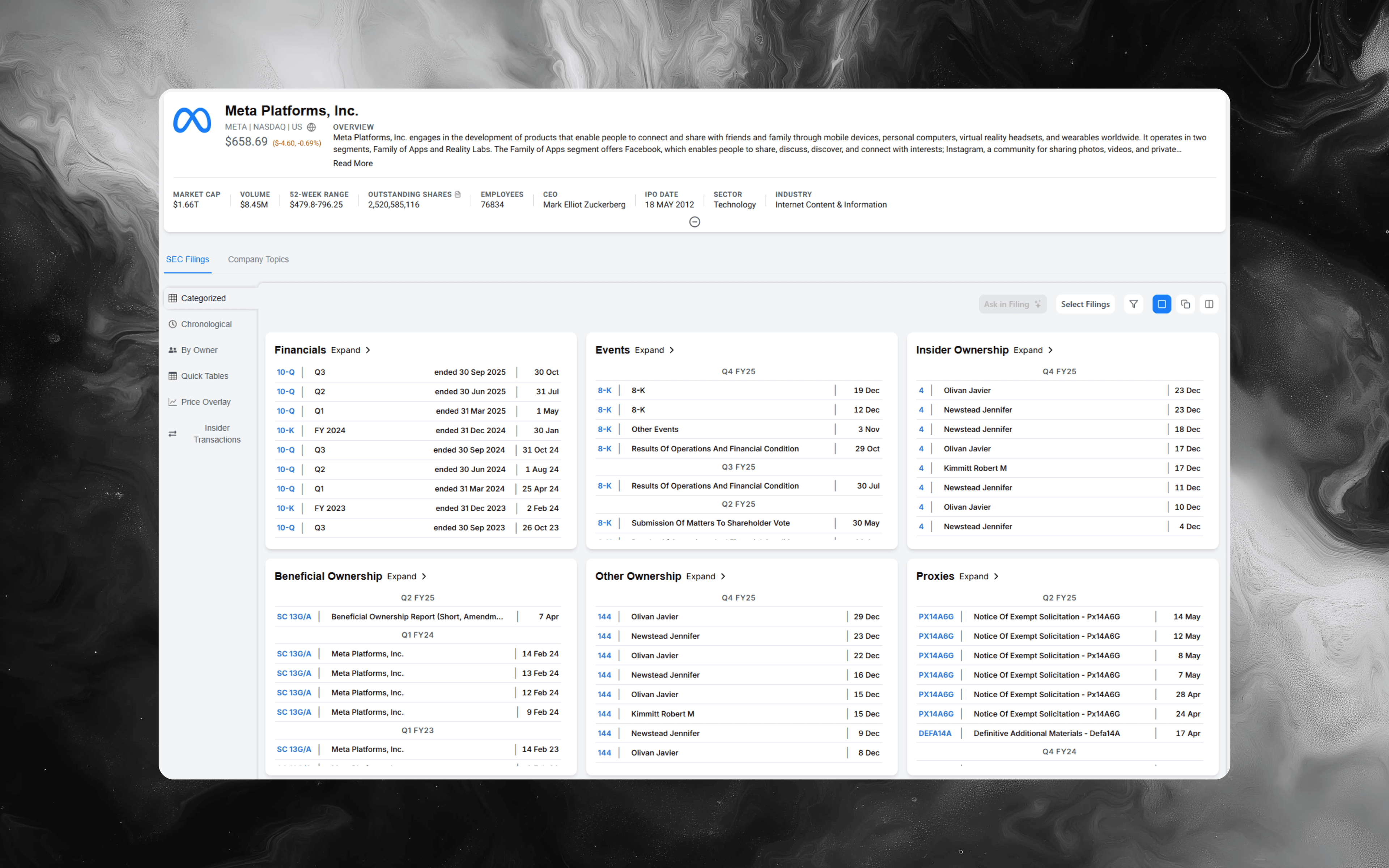
Table of contents
- The fastest mental model: Meta sells “attention + outcomes” to advertisers
- The two segments Meta reports (and why investors track them separately)
- Family of Apps: the revenue and profit engine
- Reality Labs: hardware, software, and content with long time horizons
- Where recurring revenue shows up in META (and where it doesn’t)
- A quick checklist for reading META filings like an analyst
- Explore Meta filings in Alpha Analyst
The fastest mental model: Meta sells “attention + outcomes” to advertisers
A clean way to understand Meta is to stop thinking of it as a set of apps and start thinking of it as a marketplace:
- Supply: user time, engagement, and discovery across Meta’s apps
- Demand: businesses that want measurable marketing outcomes (awareness, leads, sales)
- Infrastructure: ad delivery, ranking, measurement, and safety systems powered by large-scale computing and AI
In Meta’s own segment discussion, substantially all revenue is tied to advertising placements across its Family of Apps. That’s the core cash-flow engine that enables investment in other initiatives, including AI and immersive computing.
The two segments Meta reports (and why investors track them separately)
Meta reports financial results for two reportable segments:
- Family of Apps (FoA): Facebook, Instagram, Messenger, WhatsApp, and other services
- Reality Labs (RL): virtual, augmented, and mixed reality consumer hardware, software, and content
This structure matters because it separates two very different economic profiles:
- FoA is where advertising revenue is generated and where operating income is typically produced.
- RL is where long-horizon product development costs concentrate, with revenue tied to consumer hardware and related software/content, and with the potential for sustained operating losses while the category matures.
For non-specialists, segment framing prevents the most common confusion: mixing “ad business execution” (FoA) with “next platform R&D” (RL).
For a broader perspective on how analysts approach segment reporting and why it's critical for investment analysis, see Day in the Life of an Investment Analyst: A Realistic Playbook.
Family of Apps: the revenue and profit engine
Think of FoA as Meta’s distribution system and monetization layer.
What FoA does in plain English:
- Attracts and retains users through social feeds, messaging, video, and discovery
- Uses AI-driven ranking and recommendations to show content people are more likely to engage with
- Matches advertisers to audiences and objectives, then measures results
How it makes money:
- Advertising placements sold to marketers across Meta’s apps (and in some cases across third-party apps and websites)
- Smaller “other revenue” lines exist, but the dominant driver is advertising
Business-model intuition:
- The product is performance: advertisers aren’t just buying impressions; they’re buying the probability of an outcome.
- The moat is system-level: measurement, targeting signals, content ranking, safety controls, and infrastructure co-evolve. That can make execution improvements (or setbacks) show up quickly in results.
- The key lever is efficiency of monetization: small changes in ad relevance, pricing, or delivery can scale across a massive surface area.
For more on how generative AI and language models support ranking, delivery, and enterprise applications beyond Meta, you might explore NLP in Financial Research: Practical Use Cases and Playbook, which unpacks these dynamics across modern language AI.
Reality Labs: hardware, software, and content with long time horizons
Think of RL as Meta’s attempt to build (or help shape) the next major computing platform.
What RL includes:
- Consumer devices and experiences tied to virtual, augmented, and mixed reality
- Related software and content that make the hardware useful and engaging
How it makes money (today):
- Revenue tied to sales of consumer hardware products, plus related software and content
Why the financial profile looks different:
- Hardware and platform ecosystems often require upfront spending (R&D, tooling, supply chain, developer support) before they reach durable scale.
- In filings, Meta explicitly discusses that RL may operate at a loss for an extended period, and that the ability to fund RL depends on generating sufficient profits elsewhere (primarily FoA).
Analyst takeaway: RL is usually less about current-quarter revenue and more about strategy, pacing of investment, and signals of product-market fit.
Where recurring revenue shows up in META (and where it doesn’t)
For a clean revenue map, these buckets are usually enough:
-
Advertising (the core engine) FoA is largely monetized by selling ads. Demand can fluctuate with macro conditions and advertiser budgets, but the business is not “subscription recurring” in the traditional sense.
-
Other revenue (smaller and mixed) This can include a variety of smaller lines. It’s helpful to treat it as supplementary unless filings indicate a strategic shift.
-
Consumer hardware and related software/content (Reality Labs) Hardware revenue is transactional by nature (unit sales). Software/content can have more repeat behavior, but it’s still not the same as enterprise subscription models.
A practical summary sentence:
Meta’s “recurrence” is driven less by contracts and more by habit: daily usage produces repeat ad inventory, which can create durable demand if ad performance remains strong.
For a sector-level comparison of recurring versus transactional revenue and business model shifts—across both technology and manufacturing—see Manufacturing Trends 2025: 5 Signals to Monitor.
A quick checklist for reading META filings like an analyst
When you review Meta each quarter/year, this checklist helps you separate noise from signals:
-
Segment narrative: FoA vs RL Track changes in how management frames priorities, investment focus, and performance for each segment.
-
Advertising mechanics language Look for shifts in wording around pricing, demand, measurement, and delivery. When the language changes, the underlying engine may be changing too.
-
Product surface area and engagement drivers Pay attention to what Meta emphasizes in Facebook, Instagram, and messaging. Feature priorities often foreshadow monetization priorities.
-
AI and infrastructure investment framing In filings, Meta discusses AI as supporting ranking, discovery, ad tools, and new generative AI experiences. Watch for changes in emphasis across those areas.
For a lens into the broader risk, governance, and investment discipline discussions that often show up in large-cap tech filings, see Generative AI Ethics in Business: A Practical Governance Playbook.
-
RL “progress markers” Instead of focusing only on losses, look for concrete markers: product roadmap clarity, ecosystem development, and how management defines success.
-
Cost allocation and investment discipline Segment reporting can reveal whether spending is becoming more concentrated, more efficient, or simply shifting categories.
A practical habit: maintain a saved keyword list you run every filing cycle (examples: “reportable segments”, “Family of Apps”, “Reality Labs”, “advertising placements”, “capital expenditures”, “infrastructure”, “generative AI”, “wearables”).
Explore Meta filings in Alpha Analyst
If you want to validate how Meta defines FoA and RL, track how advertising performance and investment priorities evolve, and quickly locate disclosures that can move a thesis, go straight to the filings: Meta Platforms, Inc. (META)
CTA: Use Alpha Analyst to search across META filings with advanced keyword operators, save your highest-signal searches for reuse, and add those saved searches to a dashboard filtered by your watchlist so new disclosures surface as soon as they land.
Related Posts
View all posts →
January 31, 2026
Fed Chair Nomination News: What Hassett’s Comments Signal
A practical guide to tracking Fed leadership changes, confirmation risk, and market reactions using filings, search, and dashboards

January 29, 2026
New York Fiscal Crisis: A Company Impact Playbook
How to map NYC budget stress to revenue, taxes, real estate, and credit risk across US equities

January 29, 2026
Monetary Debasement and the US Dollar: A Company Playbook
What “currency going to hell” really means, what could come next for USD, and how US businesses can defend margins, cash flows, and valuation

January 16, 2026
Amgen (AMGN) Deep Dive: Products, Pipeline, and Key Risks
A practical equity-research playbook for underwriting the next leg of growth, margin durability, and biosimilar exposure

January 16, 2026
Daikin Industries (6367): A Deep-Dive Equity Research Playbook
Business model, segment drivers, key risks, and how to build a thesis faster in Alpha Analyst
Explore More
View all posts →
February 4, 2026
Software Stocks and AI Disruption Fears: Investor Playbook
How to evaluate “AI risk” claims, pressure-test seat-based pricing, and track what matters in filings using Alpha Analyst

February 4, 2026
Enphase (ENPH) Upgrade After Earnings: What Changed
A practical investor brief on the BMO upgrade, Q4 beat, 2026 guideposts, and how to track follow-through in Alpha Analyst

February 4, 2026
Tether fundraising report: what changed and how to track it
A practical framework for monitoring stablecoin issuer valuation, liquidity, and regulatory signals with Alpha Analyst