

What Does Lasertec (6920.T) Actually Do?
A plain-English map of its semiconductor inspection and measurement business, how revenue shows up, and what to track in the Annual Securities Report

Table of Contents
A plain-English explanation of Lasertec’s business model (a “picks-and-shovels” supplier to chipmaking)
What does Lasertec (6920.T) actually do? In its Annual Securities Report, the company describes itself as a single business that designs, manufactures, and sells inspection and measurement equipment. In other words, Lasertec sells tools used to inspect, measure, and validate semiconductor-related manufacturing outcomes, plus associated services.
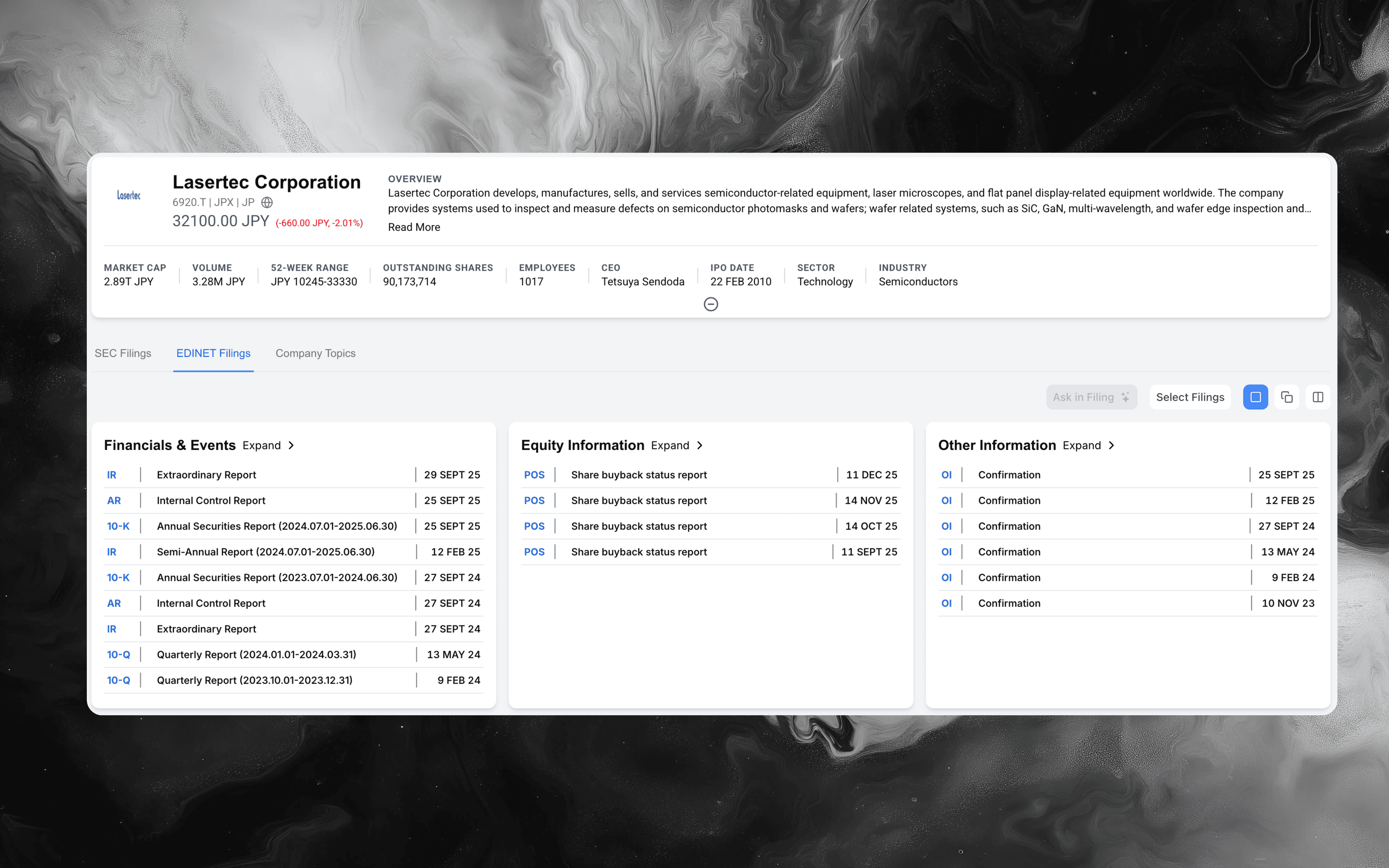
If you want the primary-source foundation for how the company frames its business (and how it breaks out products vs service), start with filings in Alpha Analyst here: Lasertec Corporation (6920.T)
The fastest mental model: enabling yield, not selling chips
A helpful way to understand “inspection and measurement” names is to separate them from chip designers and manufacturers:
- Chip designers monetize IP and product cycles
- Foundries and memory makers monetize wafer capacity and utilization
- Picks-and-shovels suppliers monetize the process: tool installs, upgrades, and ongoing service to keep yields high and problems visible
Lasertec sits in that third bucket. The tools are not the end product; they are part of the manufacturing system that helps customers find defects, monitor process drift, and qualify that production is meeting increasingly tight tolerances.
Analyst takeaway: when you cover an inspection/measurement supplier, you are usually underwriting intensity of process control, not just end-market unit volumes.
For more on the implications of semiconductor production cycles and how AI is reshaping manufacturing, see Memory Cycle Semiconductors: How AI Reshapes DRAM & NAND.
What Lasertec sells, in filing language (products + services)
From the Annual Securities Report view, Lasertec reports a single segment and then summarizes activity by item. A clean operating map is:
-
Semiconductor-related equipment (products) These are the core tools associated with semiconductor customers.
-
Other products A smaller product bucket that can include non-core systems depending on the period.
-
Service Service revenue often reflects installed-base support, maintenance, and other customer support activity tied to the tools already in the field.
A practical interpretation: products tend to be more order/backlog driven, while service can behave more like an installed-base annuity if the tool fleet is expanding and utilization remains healthy.
How revenue is created: from tool shipment cycles to installed-base pull-through
You can think of Lasertec’s revenue engine as a loop:
-
R&D and productization The company invests to launch equipment aligned to customer needs and new manufacturing requirements.
-
Customer orders and backlog Orders convert into backlog, which then converts to sales as tools are shipped/accepted.
-
Service system scale-up As tool installs grow, service demand often rises because customers need uptime, calibration, and ongoing support.
-
Mix determines margin quality Even without modeling every product line, the product vs service mix can be directionally informative. Service growth can matter because it may be less lumpy than large tool shipments.
One filing detail worth tracking over time: the company explicitly notes hiring to strengthen R&D, equipment launch, and the service system. That is a useful management “tell” about where constraints and priorities are.
If you’re interested in upstream and downstream dynamics beyond Lasertec, the Vertical Integration M&A: Why Companies Buy Their Supply Chains blog covers how companies structure control across their value chain.
Why “inspection and measurement” is strategic in semiconductors
Inspection and measurement tends to become more critical as:
- process steps increase and tolerances tighten
- the cost of a mistake rises (scrap, rework, wafer loss)
- customers need faster feedback loops to keep yields high
That dynamic is why many analysts describe this category as picks-and-shovels: these tools can be necessary across multiple chip end-markets because they support manufacturing control itself.
The key nuance: demand can still be cyclical, but the underlying reason these tools exist (visibility into manufacturing outcomes) usually does not go away.
A filing-driven way to analyze Lasertec: 5 questions that stay useful every year
Use these questions as a repeatable checklist when reading the Annual Securities Report:
-
Is the business still framed as a single segment, and did item-level disclosure change? When a company keeps reporting a single segment, the “items” tables and narrative sections become even more important for understanding what is really changing.
-
What is happening to the split between semiconductor-related equipment, other products, and service? You are looking for shifts in growth contribution, not perfection.
-
Are orders and backlog expanding or contracting, and what does that imply about the next year’s shipment cadence? Orders and backlog can help you separate “this year’s sales” from “next year’s capacity and delivery pipeline.”
-
Is service growing faster than products? That can hint at installed-base expansion, higher utilization, or stronger support attachment.
-
What is management building for: R&D, launches, or service coverage? Headcount and investment commentary can help you spot where the company expects demand or complexity to rise.
Customer concentration and geography: two real-world “risk layers” for a supplier
Even great picks-and-shovels businesses can have two practical exposure points:
-
Major customer concentration The Annual Securities Report includes disclosure of major customers in the semiconductor ecosystem. For analysts, the point is not just who they are, but what it implies about negotiation power, tool qualification cycles, and shipment timing.
-
Regional sales mix The filing also breaks out sales by geography. For a global semiconductor tool supplier, regional mix can reflect where manufacturing intensity is concentrated, and where execution (service coverage, logistics, onsite support) must be strong.
When you read new filings, focus on what changed in these disclosures, not just the absolute numbers.
Keywords to search in Lasertec filings (so you don’t miss the signal)
If you want a high-signal workflow, run the same searches every reporting cycle and compare how language evolves:
- “inspection and measurement equipment”
- “single segment”
- “semiconductor-related equipment”
- “service”
- “orders” and “order backlog”
- “production results”
- “major customer”
- “capital investment”
- “research and development”
- “service system” and “strengthening”
In Alpha Analyst, these become much more useful when you save the searches and reuse them across years, so you can quickly spot what was added, removed, or reframed.
How to research Lasertec faster in Alpha Analyst (a repeatable setup)
If you cover semicap tools repeatedly, the speed gains come from turning diligence into a system:
-
Build a saved-search bundle for the company Create searches for backlog/orders, service, major customers, capital investment, and R&D/launch language. Save them once.
-
Pin the bundle to a dashboard Add widgets like Recent Filings plus your saved searches filtered to your Lasertec watch context, so new disclosure changes surface without manual scanning.
-
Use AI Chat to translate filing tables into analyst answers Examples:
- “Summarize what changed in orders and backlog year-over-year and where the filing explains it.”
- “Where does the company describe service growth and the service system, and what is the stated rationale?”
- “List the places the filing defines the business as a single segment and what that implies for segment disclosure.”
-
Annotate the few lines that matter Highlight the passages that define the business (“inspection and measurement equipment”), the item-level tables (products vs service), and any discussion of launch/service expansion. Next year, those notes become your quickest baseline.
Explore Lasertec filings in Alpha Analyst
To validate how Lasertec defines its business, how products and service show up, and what changed in orders/backlog and customer disclosures, go straight to the primary-source filings: Lasertec Corporation (6920.T)
CTA: Use Alpha Analyst to search across Lasertec’s filings with advanced keyword operators, save your highest-signal queries (orders, backlog, service, major customers), and pin them to a dashboard so new disclosure changes surface immediately when they’re published.
Related Posts
View all posts →
January 16, 2026
Amgen (AMGN) Deep Dive: Products, Pipeline, and Key Risks
A practical equity-research playbook for underwriting the next leg of growth, margin durability, and biosimilar exposure

January 16, 2026
Daikin Industries (6367): A Deep-Dive Equity Research Playbook
Business model, segment drivers, key risks, and how to build a thesis faster in Alpha Analyst

January 16, 2026
Bridgestone (5108): Deep Dive on Segments, Strategy, and Risks
A fundamentals-first breakdown of how the tire leader makes money, what’s changing in 2024–2026, and what to monitor next

January 16, 2026
Panasonic (6752) Deep Dive: Segments, Strategy, and Key Watch Items
A filing-driven look at Panasonic Holdings’ business mix, portfolio moves, and the debates that matter for investors

January 16, 2026
Gilead Sciences (GILD) Deep Dive: Business, Moats, and Key Risks
A practical investor framework for underwriting Gilead’s HIV-led cash flows, oncology optionality, and policy-driven headwinds
Explore More
View all posts →
February 4, 2026
Software Stocks and AI Disruption Fears: Investor Playbook
How to evaluate “AI risk” claims, pressure-test seat-based pricing, and track what matters in filings using Alpha Analyst

February 4, 2026
Enphase (ENPH) Upgrade After Earnings: What Changed
A practical investor brief on the BMO upgrade, Q4 beat, 2026 guideposts, and how to track follow-through in Alpha Analyst

February 4, 2026
Tether fundraising report: what changed and how to track it
A practical framework for monitoring stablecoin issuer valuation, liquidity, and regulatory signals with Alpha Analyst