

What Does Hims & Hers (HIMS) Actually Do?
A plain-English walkthrough of the Hims & Hers platform, subscription economics, and what to track in filings
By Michael Chen

Table of Contents
A simple explanation of Hims & Hers (beyond “it’s telehealth”)
What does Hims & Hers (HIMS) actually do? In plain terms, Hims & Hers is a consumer-first health and wellness platform that connects people to licensed healthcare providers for telehealth, then fulfills eligible prescriptions through pharmacy partners and affiliated pharmacy infrastructure, with many purchases structured as recurring subscriptions.
If you want the primary-source map (business description, key risks, and accounting disclosures), start with the company’s filings in Alpha Analyst here: Hims & Hers Health, Inc. (HIMS)
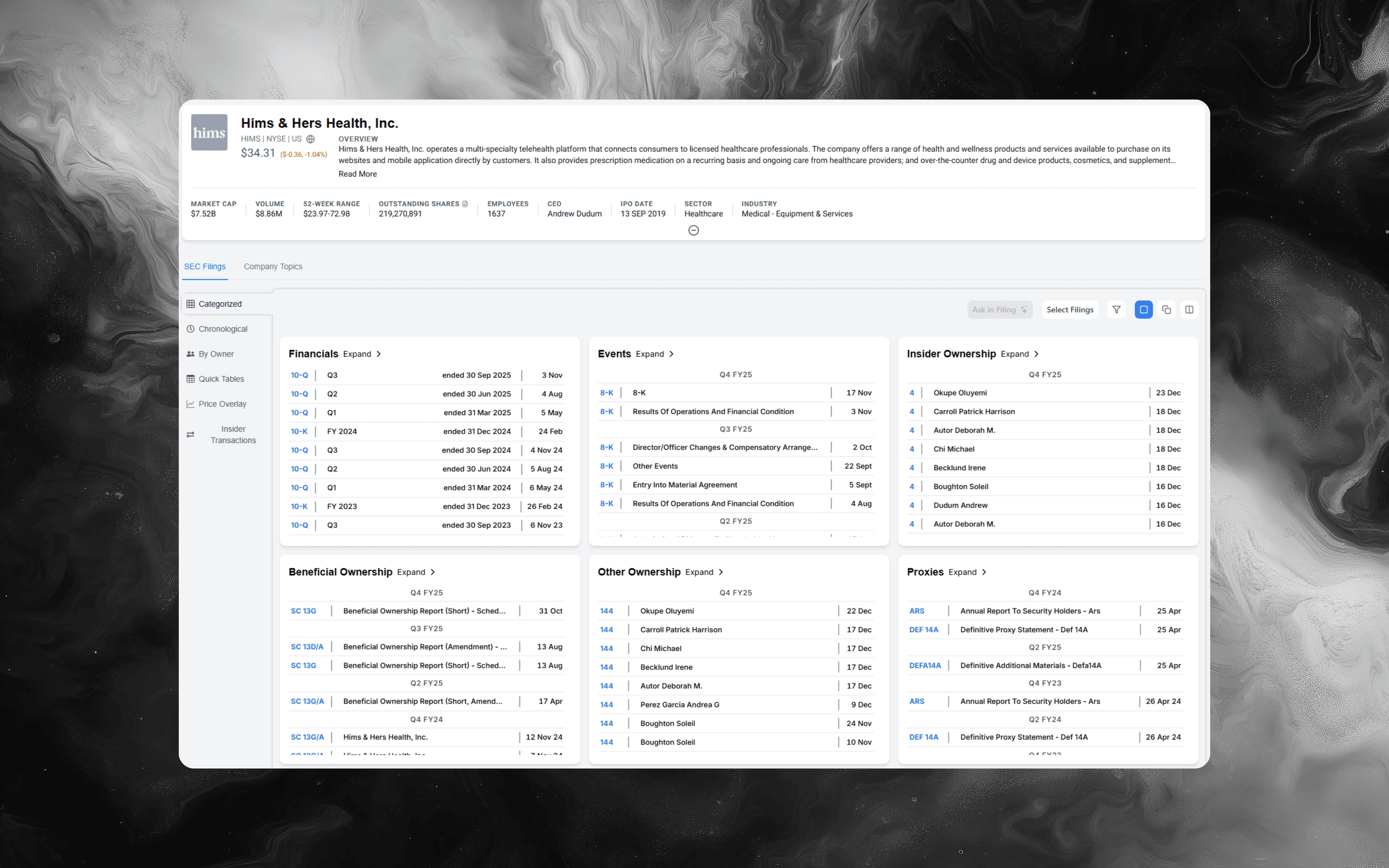
Table of contents
- The fastest mental model: a digital “front door” for routine care
- HIMS is reported as one operating segment (and why that matters)
- The core workflow: discover → consult → prescribe → fulfill → continue
- What HIMS sells: prescription treatments plus non-prescription products
- Where recurring revenue comes from (and what can break it)
- Why pharmacy fulfillment is strategic (not just logistics)
- A quick filings checklist for tracking HIMS like an analyst
- Explore HIMS filings in Alpha Analyst
The fastest mental model: a digital “front door” for routine care
Hims & Hers is easiest to understand as a consumer brand layered on top of a vertically integrated (or partially integrated) care workflow.
Instead of selling “appointments” the way a traditional clinic does, the platform aims to make ongoing treatment feel like e-commerce:
- A customer starts with a specific need (for example, a condition-focused on-ramp)
- They complete an online intake and connect with a provider for a telehealth consultation
- If appropriate, medication is prescribed
- The prescription is fulfilled and shipped through licensed pharmacies
- Ongoing treatment often continues on a subscription cadence
This is the key idea: the product is not only the visit. The business model is built around repeat treatment and repeat fulfillment.
HIMS is reported as one operating segment (and why that matters)
In its filings, Hims & Hers describes itself as managed as a single operating segment on a consolidated basis, with the CEO as the chief operating decision maker.
Why this matters for analysis:
- You should not expect the company to provide the kind of segment-by-segment profit breakdown you might see in a multi-division healthcare conglomerate.
- Your “segmentation” work becomes an analyst task: you build your own mental model around channels (online vs wholesale) and around major categories of offerings (prescription vs non-prescription).
- Changes in mix can still be very meaningful, but you’ll typically detect them through narrative disclosure, key metrics, and revenue recognition details rather than segment tables.
If you're interested in how other sectors, such as pharmaceuticals, structure and report segments, Pharmaceutical Industry Trends 2025: 5 Shifts Reshaping Pharma walks through trends in segment disclosures and their impact on analysis.
The core workflow: discover → consult → prescribe → fulfill → continue
A practical way to map the business is as a loop with four operational building blocks:
-
Demand generation (brand plus performance marketing)
HIMS acquires customers through multiple marketing channels. The company’s filings emphasize that customer acquisition is integral to growth and that marketing effectiveness can be a key swing factor. -
Telehealth and clinical layer
The platform provides access to a provider network and uses systems like electronic medical records and digital prescriptions to support the clinical workflow. -
Pharmacy fulfillment and delivery
Prescriptions can be fulfilled online through licensed pharmacies, and the company’s filings describe both affiliated pharmacy arrangements and additional partner pharmacies. -
Ongoing engagement and continuity of care
Many offerings are sold on a subscription basis, where customers choose a cadence and are billed on a recurring schedule unless they cancel or pause.
From an investor’s perspective, this loop is where unit economics live: acquisition cost up front, then retention, cadence, and cross-sell determine lifetime value.
For a broader look at recurring revenue engines and digital business models, Electric Vehicle Trends 2025: What to Watch Next explains how recurring engagement and platform strategies drive growth in adjacent sectors.
What HIMS sells: prescription treatments plus non-prescription products
Hims & Hers filings describe a platform that provides access to treatments across multiple conditions, including areas such as sexual health, hair loss, dermatology, mental health, and weight loss, with prescriptions fulfilled online through licensed pharmacies on a subscription basis when appropriate.
It also sells non-prescription health and wellness products (for example, over-the-counter and other consumer products), including through retail partnerships. A simple way to bucket the offering set:
- Prescription products and related services (typically the core economic engine)
- Non-prescription products sold direct-to-consumer and through wholesale/retail channels
- Digital experience and support features that improve conversion and retention (education, content, and other services described in filings)
When you read the business description, it helps to separate “what the customer buys” from “how the company delivers it.” The platform’s delivery stack (provider network + pharmacy fulfillment + technology) is part of why HIMS can scale.
Where recurring revenue comes from (and what can break it)
Hims & Hers describes that most offerings on its websites and mobile applications are sold on a subscription basis. In practice, recurring revenue is supported by a few mechanics:
-
Cadence-based billing and shipments
Customers select how frequently they receive treatments (cadences can vary by product). That turns many purchases into a predictable billing stream. -
Ongoing treatment needs
Many conditions being treated involve continued use and continued care, which supports retention if outcomes and experience are strong. -
Cross-sell across conditions
As the product portfolio expands, the platform can potentially increase revenue per customer through additional offerings.
What can break the recurrence (high-level categories to monitor in filings):
- Regulatory shifts affecting telehealth, pharmacy operations, or compounding
- Supply constraints or fulfillment disruptions (pharmacies, shipping, manufacturing suppliers)
- Customer acquisition getting more expensive or less efficient
- Competitive pricing pressure that reduces conversion or retention
Recurring revenue vulnerability and risk-factor language are tracked in filings in many industries. For practical approaches to using search technology to flag these kinds of risks, AI Search for SEC Filings, Rebuilt From the Ground Up provides guidance on identifying fast-changing disclosures.
Why pharmacy fulfillment is strategic (not just logistics)
It’s tempting to treat fulfillment as “back office,” but for HIMS it is closely tied to customer experience, margins, and the ability to expand into adjacent categories.
In filings, Hims & Hers describes pharmacy infrastructure and relationships that support fulfillment, including affiliated pharmacy arrangements and partner pharmacies. It also describes a compounding outsourcing facility acquisition (a 503B outsourcing facility) used to compound products primarily for Hims & Hers customers.
From a business model standpoint, fulfillment influences:
- Speed and reliability of delivery (which impacts retention)
- Ability to bundle, personalize, or consolidate shipments (which impacts cost structure)
- Exposure to regulatory and supply-chain risks (which can show up suddenly)
For example, filings also discuss how the landscape for certain compounded products can change as drug shortage status and regulatory interpretation evolves. That makes it a high-signal area for ongoing monitoring.
To understand broader supply chain and manufacturing trends that impact fulfillment risk, Manufacturing Trends 2025: 5 Signals to Monitor covers relevant signals across regulated and consumer health sectors.
A quick filings checklist for tracking HIMS like an analyst
If you want a repeatable quarterly workflow, track these areas consistently:
- How the company describes its platform and its “what we do” narrative (small wording shifts can signal strategic change)
- Subscription mechanics and any changes to how subscriptions are defined or discussed
- Revenue concentration language (what drives the substantial majority of revenue)
- Pharmacy and supplier dependencies (affiliated and partner relationships, ownership transitions, and operational continuity)
- Regulatory risk language (telehealth rules, pharmacy laws, compounding and fulfillment requirements, privacy and consumer protection)
- Any evolving disclosure around specific product categories that may have unusual supply, regulatory, or margin sensitivity
Explore HIMS filings in Alpha Analyst
To validate how Hims & Hers explains its platform, understand the subscription model in management’s own words, and monitor fast-changing risk language, use Alpha Analyst to search across filings, save high-signal queries, and track updates over time.
CTA: Build a HIMS monitoring workspace in Alpha Analyst by saving a few keyword searches (for example, “subscription”, “pharmacy”, “compounding”, “telehealth”, “regulatory”, “provider network”), then add them to a dashboard filtered by your watchlist so new disclosures surface as soon as they’re filed.
Related Posts
View all posts →
January 31, 2026
Fed Chair Nomination News: What Hassett’s Comments Signal
A practical guide to tracking Fed leadership changes, confirmation risk, and market reactions using filings, search, and dashboards

January 29, 2026
New York Fiscal Crisis: A Company Impact Playbook
How to map NYC budget stress to revenue, taxes, real estate, and credit risk across US equities

January 29, 2026
Monetary Debasement and the US Dollar: A Company Playbook
What “currency going to hell” really means, what could come next for USD, and how US businesses can defend margins, cash flows, and valuation

January 16, 2026
Amgen (AMGN) Deep Dive: Products, Pipeline, and Key Risks
A practical equity-research playbook for underwriting the next leg of growth, margin durability, and biosimilar exposure

January 16, 2026
Daikin Industries (6367): A Deep-Dive Equity Research Playbook
Business model, segment drivers, key risks, and how to build a thesis faster in Alpha Analyst
Explore More
View all posts →
February 4, 2026
Software Stocks and AI Disruption Fears: Investor Playbook
How to evaluate “AI risk” claims, pressure-test seat-based pricing, and track what matters in filings using Alpha Analyst

February 4, 2026
Enphase (ENPH) Upgrade After Earnings: What Changed
A practical investor brief on the BMO upgrade, Q4 beat, 2026 guideposts, and how to track follow-through in Alpha Analyst

February 4, 2026
Tether fundraising report: what changed and how to track it
A practical framework for monitoring stablecoin issuer valuation, liquidity, and regulatory signals with Alpha Analyst