

What Does DISCO Corporation (6146.T) Actually Do?
A plain-English map of DISCO’s dicing/grinding business model, why tools matter, and what to track in EDINET filings

Table of Contents
A plain-English explanation of DISCO’s business (equipment + consumables + process know-how)
What does DISCO Corporation (6146.T) actually do? In plain terms, DISCO sells the machines and the “wear parts” used to cut, grind, and polish semiconductor wafers and electronic component substrates—and it supports customers with process verification and maintenance so those steps run reliably at high volume.
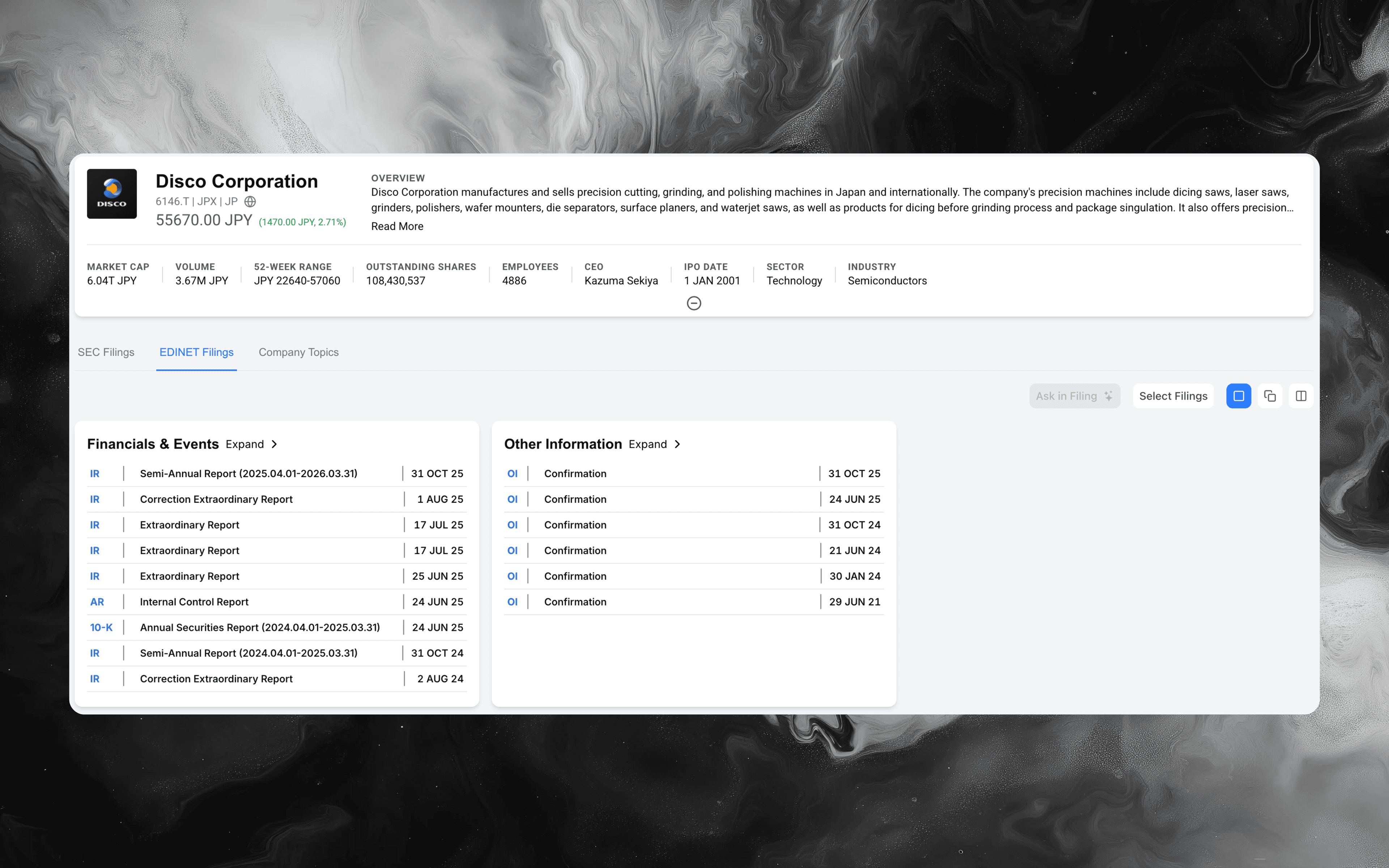
If you want the primary-source version of how DISCO describes its business (product categories, business model language, and risks tied to semiconductor capex cycles), start with the filings in Alpha Analyst here: Disco Corporation (6146.T)
The fastest mental model: “Kiru, Kezuru, Migaku” as a production system
DISCO frames its technical domain as:
- Cutting (Kiru)
- Grinding (Kezuru)
- Polishing (Migaku)
A useful analyst mental model is to treat DISCO as an “enabling layer” inside wafer and advanced packaging value chains:
- Customers buy precision processing equipment (capex-driven)
- Then they repeatedly buy precision processing tools (consumables) to keep production running
- DISCO’s application technology (process recipes + optimization) helps customers hit yield/throughput targets
- Maintenance and services support uptime and lifecycle economics
This combination matters because in many fab cycles, equipment demand and consumables demand can behave differently.
What DISCO sells, in analyst language (and why the mix matters)
Based on DISCO’s own business description, the company’s core offering is:
-
Precision processing equipment (semiconductor manufacturing equipment) Examples include dicing saws, laser saws, grinders, polishers, and surface planers.
-
Precision processing tools (consumables) Examples include dicing blades, grinding wheels, and dry polishing wheels (plus related grindstone application products).
For modeling and diligence, it helps to bucket revenue drivers into two simple buckets:
- Equipment: purchase decisions, qualification cycles, and customer capex intensity
- Tools/consumables: customer production volume, utilization rates, and process intensity (how “hard” the process is on blades/wheels)
Even without assuming any specific split or margin profile, the key idea is that “installed base” dynamics typically show up more strongly in consumables than in equipment.
DISCO’s differentiation: total solution delivery, not just hardware
DISCO describes a “total solution” approach built on three capabilities:
- Equipment
- Consumables
- Application technology (the combination of equipment + consumables + optimal processing conditions)
A practical translation: DISCO is trying to own the process outcome (quality, throughput, yield stability), not only the machine sale.
One detail worth tracking closely in filings is DISCO’s emphasis on processing verification (“test cuts”). In this model, DISCO engineers run verification work on customer workpieces to help dial in the right combination of tool selection and processing conditions—so the customer can make a purchase decision with more confidence and lower process risk.
Where DISCO sits in wafer/dicing/grinding value chains
If you cover semiconductor manufacturing equipment broadly, DISCO often appears where value is created late in the wafer flow (and in related electronic component processes):
- Wafer thinning and surface prep (grinding/polishing steps)
- Wafer singulation (dicing/laser)
- Process optimization for new materials and tighter tolerances
A useful way to think about the “why” behind demand is not just “more chips,” but “harder chips”:
- New materials that are tougher to cut/grind
- More advanced packaging formats
- Higher precision requirements that increase process complexity
That tends to make application technology and tool performance strategically important.
For a look at how other companies use vertical integration and equipment + process control to drive margins and resilience, see Vertical Integration M&A: Why Companies Buy Their Supply Chains, which covers strategic manufacturing moves across the tech and industrial landscape.
A repeatable checklist for reading DISCO’s filings like an analyst
Use this as your quarter-to-quarter (or annual) workflow:
-
Start with the business contents section Confirm how the company groups products (equipment vs tools vs services) and note any wording changes.
-
Tie results back to two demand engines
- customer capex appetite (equipment), and
- customer utilization / production intensity (tools).
-
Track what DISCO says about “processing technology risk” DISCO explicitly flags the risk that new processing approaches could change the role of current tools (and also discusses development of alternative processing technologies for difficult materials). When this language changes, it can be a signal about shifting technical direction.
-
Separate “market cycle” from “company execution” DISCO operates in a semiconductor environment known for cyclicality. Your job is to separate cycle exposure from signals about product mix, process leadership, and operational execution.
What to monitor over time (the DISCO-specific KPI lens)
Depending on how deep you go, these are the recurring questions that usually matter most:
- Is the narrative more “equipment shipment strength” or “tool demand strength”?
- Are high-value-added projects or advanced applications becoming more central in commentary?
- What’s the stated posture on R&D and engineering investment?
- Are there notable changes in manufacturing footprint plans (capacity, resilience, or consolidation)?
- How does DISCO describe the semiconductor market environment and where demand is resilient?
You don’t need to predict the whole semiconductor cycle to build an informed view—you need a consistent way to track how the company explains demand, mix, and technical priorities.
High-signal keywords to search in DISCO filings
If you want a repeatable research process, run the same keyword set every filing cycle and compare language changes:
- “precision processing equipment”
- “precision processing tools” and “consumables”
- “dicing saw” and “laser saw”
- “grinder” and “polisher”
- “test cuts” and “processing verification”
- “application technology” and “processing conditions”
- “silicon cycle” and “semiconductor market”
- “power semiconductors” and “AI” (when discussed as demand drivers)
- “research and development” and “engineers”
- “business risks” and “new technologies”
In Alpha Analyst, phrase matching and proximity-style operators are especially useful for separating true process commentary from incidental mentions.
How to research DISCO faster in Alpha Analyst (workflow you can reuse)
Here’s a practical way to turn DISCO coverage into a system:
-
Build a saved search pack for DISCO Create a small set of searches (equipment, tools/consumables, test cuts/application technology, risk factors, R&D, facilities/capex). Save them once and reuse them each filing cycle.
-
Put monitoring on a dashboard Add widgets like Recent Filings plus your saved keyword searches filtered to DISCO, so you see new disclosures as soon as they’re published.
-
Use AI Chat to translate “process language” into decision-ready summaries Example prompts:
- “Summarize DISCO’s business model and why tools/consumables are strategic.”
- “What changed in the company’s description of application technology or test cuts?”
- “List the key risks they highlight about new processing technologies.”
-
Annotate the few passages that drive your thesis Highlight the parts that explain demand (capex vs utilization), technical direction (materials/process evolution), and capacity strategy. Next cycle, you can jump straight to the deltas.
For more context on semiconductor manufacturing cycles and memory supply discipline, browse Memory Cycle Semiconductors: How AI Reshapes DRAM & NAND, which explores overlapping industry dynamics.
Explore DISCO filings in Alpha Analyst
If you want to validate how DISCO defines its product categories, how it describes its “equipment + consumables + application technology” approach, and what it flags as the core business risks, go straight to the primary-source filings: Disco Corporation (6146.T)
Related Posts
View all posts →
January 16, 2026
Amgen (AMGN) Deep Dive: Products, Pipeline, and Key Risks
A practical equity-research playbook for underwriting the next leg of growth, margin durability, and biosimilar exposure

January 16, 2026
Daikin Industries (6367): A Deep-Dive Equity Research Playbook
Business model, segment drivers, key risks, and how to build a thesis faster in Alpha Analyst

January 16, 2026
Bridgestone (5108): Deep Dive on Segments, Strategy, and Risks
A fundamentals-first breakdown of how the tire leader makes money, what’s changing in 2024–2026, and what to monitor next

January 16, 2026
Panasonic (6752) Deep Dive: Segments, Strategy, and Key Watch Items
A filing-driven look at Panasonic Holdings’ business mix, portfolio moves, and the debates that matter for investors

January 16, 2026
Gilead Sciences (GILD) Deep Dive: Business, Moats, and Key Risks
A practical investor framework for underwriting Gilead’s HIV-led cash flows, oncology optionality, and policy-driven headwinds
Explore More
View all posts →
February 4, 2026
Software Stocks and AI Disruption Fears: Investor Playbook
How to evaluate “AI risk” claims, pressure-test seat-based pricing, and track what matters in filings using Alpha Analyst

February 4, 2026
Enphase (ENPH) Upgrade After Earnings: What Changed
A practical investor brief on the BMO upgrade, Q4 beat, 2026 guideposts, and how to track follow-through in Alpha Analyst

February 4, 2026
Tether fundraising report: what changed and how to track it
A practical framework for monitoring stablecoin issuer valuation, liquidity, and regulatory signals with Alpha Analyst