

What Does AMD (AMD) Actually Do?
A plain-English map of the product portfolio, who buys each chip family, and how AMD’s three segments show up in filings
By Michael Chen

Table of Contents
A simple explanation of AMD’s business model (it’s a chip design and platforms company)
What does AMD (AMD) actually do? AMD designs high-performance semiconductors and related platform components that power data centers, PCs, gaming devices, and embedded systems. AMD then brings those designs to market through a mix of external manufacturing and a broad ecosystem of OEMs, cloud providers, and channel partners.
If you want the primary-source foundation (business description, segment reporting, risk factors, and the tables management uses to talk about results), start with AMD’s filings in Alpha Analyst here: Advanced Micro Devices, Inc. (AMD)
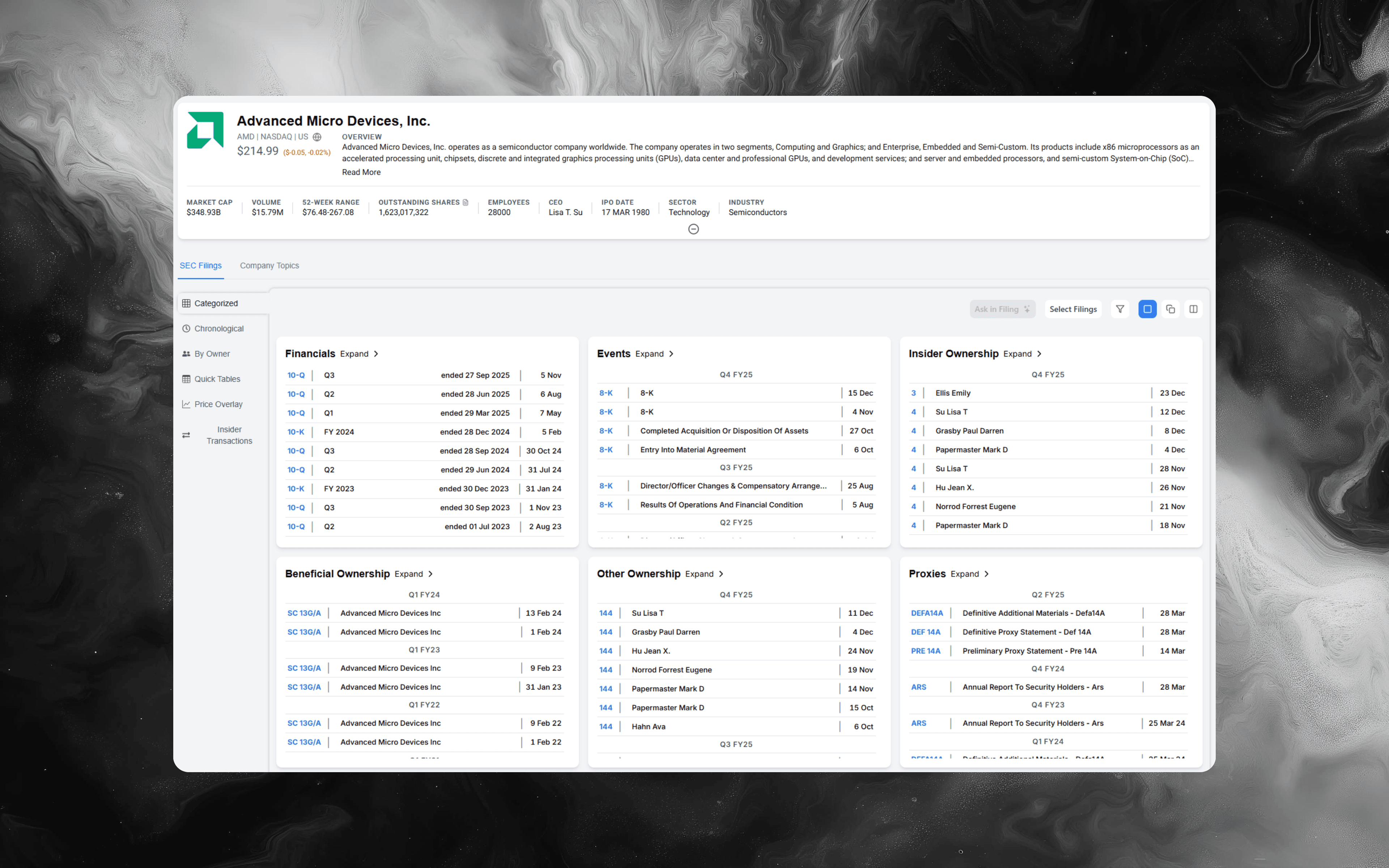
Table of contents
- The fastest mental model: AMD sells compute engines to four end markets
- The buyer map: who pays for AMD chips (and why it matters)
- What AMD actually ships: CPUs, GPUs, AI accelerators, and adaptive silicon
- The three reportable segments to know (and what sits inside each)
- A filing-first way to read AMD’s segment table (without getting lost)
- The recurring debate: “data center growth” vs “PC cycle” vs “console mix”
- A quick checklist for reading AMD filings like an analyst
- Explore AMD filings in Alpha Analyst
The fastest mental model: AMD sells compute engines to four end markets
A clean way to explain AMD to a non-specialist is:
AMD sells the processing “engines” that run modern computing, and it earns revenue when customers choose AMD’s silicon for their systems.
To keep your analysis grounded, it helps to think in terms of where the chip ends up:
- Data centers (cloud and enterprise): servers and AI infrastructure
- PCs: desktop and notebook processors
- Gaming: GPUs and semi-custom chips used in consoles and other gaming devices
- Embedded: processors and adaptive chips used inside industrial, communications, and other specialized systems
This mental model prevents a common mistake: treating AMD as “just a PC CPU company.” In filings, AMD is explicit about a broad portfolio that spans CPUs, GPUs, AI accelerators, DPUs, FPGAs, and adaptive SoCs.
For a broader sector outlook that touches on AI, automation, and supply chain shifts impacting semiconductors, see Manufacturing Trends 2025: 5 Signals to Monitor.
The buyer map: who pays for AMD chips (and why it matters)
When you model AMD, it’s useful to separate the end user from the economic buyer:
- Cloud providers and enterprise OEMs buy data center CPUs and AI accelerators as part of servers and complete platforms
- PC OEMs and channel partners influence unit volume and product mix for client processors
- Console ecosystems can drive large, program-based “semi-custom” volumes with different seasonality than PCs
- Industrial and embedded customers can behave differently from consumer markets, especially when inventory levels rise or fall
Why this matters for investors: the same “unit growth” headline can mean very different things depending on who is ordering, which platform is ramping, and whether customers are building inventory or drawing it down.
What AMD actually ships: CPUs, GPUs, AI accelerators, and adaptive silicon
AMD’s filings describe a product set that covers multiple compute modalities:
-
CPUs for servers and PCs The CPU is still a core “control plane” in most systems, and CPU platform transitions can reshape competitive positioning.
-
GPUs and AI accelerators In data centers, accelerators and GPUs increasingly drive performance for AI and other parallel workloads.
-
Platform and networking-adjacent components Products like DPUs and SmartNICs show up in AMD’s data center portfolio description as part of broader system infrastructure.
-
Adaptive and embedded silicon FPGA and adaptive SoC offerings can land in longer-lived embedded use cases, where customers often care about lifecycle, reliability, and qualification timelines.
From time to time, AMD also notes that it may sell or license portions of its IP portfolio, which can appear as smaller, non-core revenue streams.
For more on how language AI and analytics are used in financial research—including in the semiconductor sector—see NLP in Financial Research: Practical Use Cases and Playbook.
The three reportable segments to know (and what sits inside each)
AMD’s filings currently present three reportable segments:
-
Data Center This segment includes products sold into data centers, including AI accelerators, server CPUs, and related data center products (for example, certain GPUs, DPUs, SmartNICs, and adaptive products).
-
Client and Gaming AMD combines Client and Gaming into one reportable segment, while still separately disclosing Client revenue and Gaming revenue within that segment. This segment includes PC CPUs/APUs and chipsets, discrete GPUs, and semi-custom SoCs plus development services.
-
Embedded This segment includes embedded CPUs/GPUs/APUs, FPGAs, system-on-modules, and adaptive SoC products that go into specialized and often longer-cycle end markets.
AMD also uses an “All Other” category that is not a reportable segment. In plain English, it’s where certain corporate-level and acquisition-related items are recorded that management does not allocate when evaluating segment performance.
For company-specific segment analysis and recent trends across product lines, you may also be interested in the AI Data Center Optics Stocks: COHR, LITE, MRVL + More report, covering competitive landscape and adjacent components.
A filing-first way to read AMD’s segment table (without getting lost)
AMD’s segment note is one of the most useful tables in the entire 10-Q/10-K because it shows, side-by-side:
- Net revenue by segment (and, within Client and Gaming, separate Client vs Gaming revenue disclosure)
- Segment-level operating income (loss)
- A bridge-like view into what sits outside segments (“All Other”)
A practical workflow:
-
Start with segment net revenue Look for which segment is driving the change in total net revenue period over period.
-
Separate “growth” from “mix” A segment can grow while operating income falls if cost headwinds or one-time items hit cost of sales or operating expenses. The segment table and MD&A narrative typically explain why.
-
Check whether the segment structure changed AMD has changed segment presentation over time. When segment structure changes, comparisons need extra care because prior periods may be adjusted.
-
Tie segment commentary back to product families In AMD’s language, segment performance is often explained using product family demand (for example, server CPU ramps, AI accelerator demand, PC processor mix/ASP, semi-custom volumes, and embedded demand conditions).
The recurring debate: “data center growth” vs “PC cycle” vs “console mix”
AMD tends to be analyzed through three rotating lenses. Each lens is real, but none is sufficient by itself.
-
Data center and AI infrastructure lens Investors focus on data center CPUs and AI accelerators because these products are tied to large-scale compute buildouts and can shift the revenue and margin profile.
-
PC cycle lens (client processors) Client demand is cyclical, and the mix between premium and mainstream processors can matter as much as unit volume. Watch how management explains changes in average selling prices and unit shipments in the client disclosure.
-
Gaming lens (semi-custom and GPU) Gaming results can be heavily influenced by semi-custom console SoC demand and by discrete GPU demand. These drivers can move differently from PCs and differently from data center.
A clean takeaway: AMD is a portfolio company where segment mix is often the story. The filings help you see that mix clearly, even when headlines oversimplify it.
For broader industry context on tariff impacts and cost structure shifts for sectors like gaming and industrial hardware, Tariffs and Energy & Industrials: A Sector Impact Playbook provides an actionable framework.
A quick checklist for reading AMD filings like an analyst
Use this checklist to keep your AMD review consistent quarter to quarter:
-
Read the segment note before the earnings narrative The segment table gives you the “what changed” map.
-
Track the split inside Client and Gaming Even though Client and Gaming is one reportable segment, separate disclosure of Client and Gaming revenue can help you spot whether the PC side or the gaming side is driving the move.
-
Watch for one-time items and policy constraints Items like export controls, inventory-related charges, acquisition-related costs, and other non-allocated expenses can meaningfully affect profitability and how investors interpret “core” performance.
-
Use keywords to keep your process repeatable Save searches like: “segment reporting”, “Data Center”, “Client”, “Gaming”, “Embedded”, “gross margin”, “inventory”, “export control”, “AI accelerators”, and “semi-custom”.
-
Compare language changes, not just numbers Changes in how management describes demand, customer behavior, and competitive intensity often show up first in wording.
For a practical guide to analyst research routines, playbook strategies, and workflow optimization, see Day in the Life of an Investment Analyst: A Realistic Playbook.
Explore AMD filings in Alpha Analyst
To validate how AMD describes its product portfolio, track segment trends cleanly, and surface the disclosures most likely to move your thesis, go straight to the primary-source filings: Advanced Micro Devices, Inc. (AMD)
CTA: Use Alpha Analyst to search across AMD filings with advanced keyword operators, save your best queries, and pin them to a dashboard filtered by your watchlist so new AMD disclosures surface the moment they land.
Related Posts
View all posts →
January 31, 2026
Fed Chair Nomination News: What Hassett’s Comments Signal
A practical guide to tracking Fed leadership changes, confirmation risk, and market reactions using filings, search, and dashboards

January 29, 2026
New York Fiscal Crisis: A Company Impact Playbook
How to map NYC budget stress to revenue, taxes, real estate, and credit risk across US equities

January 29, 2026
Monetary Debasement and the US Dollar: A Company Playbook
What “currency going to hell” really means, what could come next for USD, and how US businesses can defend margins, cash flows, and valuation

January 16, 2026
Amgen (AMGN) Deep Dive: Products, Pipeline, and Key Risks
A practical equity-research playbook for underwriting the next leg of growth, margin durability, and biosimilar exposure

January 16, 2026
Daikin Industries (6367): A Deep-Dive Equity Research Playbook
Business model, segment drivers, key risks, and how to build a thesis faster in Alpha Analyst
Explore More
View all posts →
February 4, 2026
Software Stocks and AI Disruption Fears: Investor Playbook
How to evaluate “AI risk” claims, pressure-test seat-based pricing, and track what matters in filings using Alpha Analyst

February 4, 2026
Enphase (ENPH) Upgrade After Earnings: What Changed
A practical investor brief on the BMO upgrade, Q4 beat, 2026 guideposts, and how to track follow-through in Alpha Analyst

February 4, 2026
Tether fundraising report: what changed and how to track it
A practical framework for monitoring stablecoin issuer valuation, liquidity, and regulatory signals with Alpha Analyst