

What Does Amazon (AMZN) Actually Do?

Table of Contents
A clear explanation of Amazon’s business model (beyond “it’s ecommerce”)
What does Amazon (AMZN) actually do? In plain terms, Amazon runs a set of customer-facing businesses (shopping, seller services, subscriptions, and ads) plus a large cloud computing business (AWS), all supported by a massive logistics and technology engine.
In its latest annual filing, Amazon describes its aim as being “Earth’s most customer-centric company,” and it frames its customer sets broadly: consumers, sellers, developers, enterprises, content creators, advertisers, and employees. That list is a good clue: Amazon isn’t one product. It’s a platform company with multiple “customers” that feed each other.
For primary-source context (business description, segments, risk factors, and financial statements), you can pull up Amazon’s standardized filings inside Alpha Analyst here: Amazon.com, Inc. (AMZN)
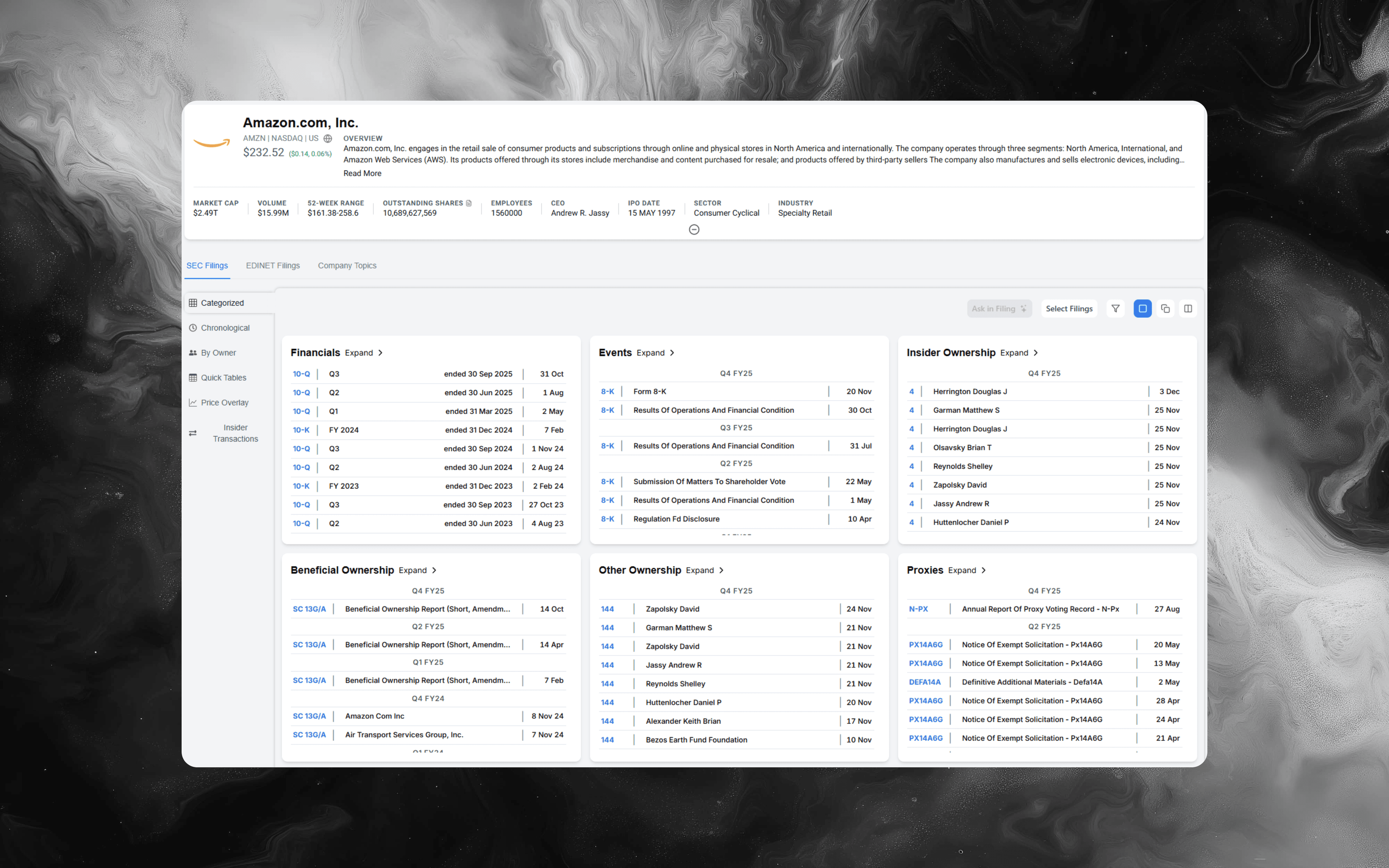
Table of contents
- The simplest way to understand Amazon: the flywheel
- Amazon’s three reporting segments (North America, International, AWS)
- What Amazon sells to consumers (and why Prime matters)
- What Amazon sells to sellers (the marketplace and fulfillment engine)
- Advertising: the “inside the store” revenue stream
- AWS: cloud infrastructure as a separate profit pool
- How Amazon makes money in practice (a revenue mix lens)
- What to monitor in filings (a quick checklist)
- Explore Amazon filings in Alpha Analyst
The simplest way to understand Amazon: the flywheel
If you ignore brand names and focus on incentives, Amazon is built around a reinforcing loop:
- More selection attracts more shoppers
- More shoppers attract more third-party sellers
- More sellers increase selection and price competition
- Faster delivery and convenience increase conversion and repeat usage
- Prime memberships can raise frequency and retention
- More on-site activity creates more ad inventory and better ad performance
- Scale funds logistics, technology, and (in AWS) infrastructure investment
This flywheel explanation is more useful than “Amazon is ecommerce,” because it highlights why Amazon keeps investing in fulfillment speed, seller tools, and subscription benefits even when those choices look expensive in isolation.
Amazon’s three reporting segments (North America, International, AWS)
Amazon reports results in three segments:
- North America: retail sales (including from sellers) plus advertising and subscription services through North America-focused online and physical stores
- International: retail sales (including from sellers) plus advertising and subscription services through internationally-focused online stores
- AWS: global sales of compute, storage, database, and other services for start-ups, enterprises, government agencies, and academic institutions
That segment split is your first map for understanding what drives the income statement, because it separates the “store and logistics” businesses from the cloud business.
A helpful mental model:
- North America + International are commerce platforms that run on a fulfillment network
- AWS is an infrastructure and services platform that runs on data centers
For perspective on sector segmentation and how it can affect business performance, you might also be interested in Manufacturing Trends 2025: 5 Signals to Monitor, which discusses platform models, supply chains, and digital infrastructure.
What Amazon sells to consumers (and why Prime matters)
On the consumer side, Amazon sells convenience at scale:
- A broad catalog across online and physical stores
- Competitive pricing dynamics (often supported by marketplace competition)
- Fast delivery (enabled by fulfillment centers, sortation, and last-mile networks)
- Digital experiences layered on top of shopping (e.g., subscriptions and content)
Prime is often misunderstood as “free shipping.” In practice, Prime is also a behavior-shaping product: it can turn occasional shoppers into habitual shoppers by reducing friction and increasing perceived value. In its filing, Amazon notes that it views Prime member benefits and shipping offers as effective worldwide marketing tools and intends to continue offering them indefinitely.
What Amazon sells to sellers (the marketplace and fulfillment engine)
One of Amazon’s most important “products” is what it offers to third-party sellers.
In its business description, Amazon highlights programs that enable sellers to grow their businesses, sell their products in Amazon stores, and fulfill orders using Amazon’s services. That is the marketplace playbook:
- Demand: shoppers already come to Amazon with intent
- Tools: sellers get listing, merchandising, and operational tooling
- Services: sellers can outsource parts of logistics and customer service
- Reach: sellers can access cross-border demand in a standardized way
Why this matters financially: seller success can expand selection without Amazon taking full inventory risk on every item. Even when Amazon isn’t the seller of record, it can still monetize the transaction through services.
Advertising: the “inside the store” revenue stream
A simple way to explain Amazon advertising is: brands and sellers pay to influence discovery where purchase intent is already high.
In its filing, Amazon describes providing advertising services through programs such as sponsored ads, display, and video advertising. That’s important because it’s not just “marketing spend in the abstract.” Ads are tightly connected to shopping behavior, which can make the economics very different from traditional media.
From an investor research angle, ads can matter because:
- the revenue can scale with marketplace activity
- the product is embedded directly into the shopping workflow
- ad demand can rise with seller competition and category density
For broader context on how advertising, subscriptions, and digital platforms generate new revenue streams, see Electric Vehicle Trends 2025: What to Watch Next, which covers reinvention of revenue models in technology-driven sectors.
AWS: cloud infrastructure as a separate profit pool
AWS serves developers and enterprises with on-demand technology services. In Amazon’s own framing, AWS offers a broad set of services including compute, storage, database, analytics, and machine learning, among others.
In practical terms, AWS is Amazon selling:
- infrastructure capacity (compute, storage, networking)
- managed building blocks (databases, analytics)
- higher-level capabilities (including machine learning services)
AWS is strategically important because it’s a different business model than retail:
- customers are companies and institutions, not individual consumers
- usage-based consumption and long-term relationships can drive recurring demand
- economics depend on infrastructure utilization, pricing, and product mix
If you are interested in how language models and cloud-based analytics platforms are transforming business research and workflows, NLP in Financial Research: Practical Use Cases and Playbook offers practical examples from the financial sector.
How Amazon makes money in practice (a revenue mix lens)
If you’re trying to explain how Amazon makes money without getting lost in product names, use these buckets:
- First-party retail: Amazon buys and sells goods
- Third-party marketplace: sellers sell; Amazon provides the store and services
- Seller services and fulfillment: operational services that help sellers deliver
- Subscriptions: Prime and other subscription services
- Advertising: sponsored ads, display, and video ads sold to sellers and brands
- AWS: cloud services sold to organizations
The key point is that several of these revenue streams reinforce each other. For example:
- Faster fulfillment improves consumer conversion, which improves seller outcomes, which increases selection, which increases shopper traffic, which increases ad value.
- AWS monetizes Amazon’s infrastructure and technology capabilities in a different customer category.
One more practical clue from Amazon’s segment disclosure: in 2024, it reported operating income by segment of $25.0B (North America), $3.8B (International), and $39.8B (AWS). That’s a reminder that “Amazon profitability” is often as much about segment mix and efficiency as it is about topline growth.
What to monitor in filings (a quick checklist)
When you’re tracking Amazon quarter to quarter or building an investment memo, these are high-signal areas to watch in disclosures:
- Segment trends: North America vs International vs AWS (growth and operating income direction)
- The balance between shipping speed, fulfillment costs, and unit economics
- Advertising narrative: how management discusses performance and drivers
- Subscription positioning: how Prime and related benefits are framed strategically
- AWS commentary: demand environment, investment levels, and service expansion language
- Risk factors that change: competition, regulation, technology transitions, and macro sensitivity
For a playbook on how analysts can build research discipline and stay ahead on names like AMZN, see Day in the Life of an Investment Analyst: A Realistic Playbook.
Explore Amazon filings inside Alpha Analyst
If you want to validate business descriptions, track how the segment story evolves, or quickly find disclosures on ads, Prime, and AWS, the fastest path is to work directly from the primary-source filings in a searchable format: Amazon.com, Inc. (AMZN)
CTA: If you’re monitoring AMZN over time, use Alpha Analyst to search across filings with advanced keyword operators, save those searches, and set up dashboards filtered by watchlists so new disclosures surface the day they land.
Related Posts
View all posts →
January 31, 2026
Fed Chair Nomination News: What Hassett’s Comments Signal
A practical guide to tracking Fed leadership changes, confirmation risk, and market reactions using filings, search, and dashboards

January 29, 2026
New York Fiscal Crisis: A Company Impact Playbook
How to map NYC budget stress to revenue, taxes, real estate, and credit risk across US equities

January 29, 2026
Monetary Debasement and the US Dollar: A Company Playbook
What “currency going to hell” really means, what could come next for USD, and how US businesses can defend margins, cash flows, and valuation

January 16, 2026
Amgen (AMGN) Deep Dive: Products, Pipeline, and Key Risks
A practical equity-research playbook for underwriting the next leg of growth, margin durability, and biosimilar exposure

January 16, 2026
Daikin Industries (6367): A Deep-Dive Equity Research Playbook
Business model, segment drivers, key risks, and how to build a thesis faster in Alpha Analyst
Explore More
View all posts →
February 4, 2026
Software Stocks and AI Disruption Fears: Investor Playbook
How to evaluate “AI risk” claims, pressure-test seat-based pricing, and track what matters in filings using Alpha Analyst

February 4, 2026
Enphase (ENPH) Upgrade After Earnings: What Changed
A practical investor brief on the BMO upgrade, Q4 beat, 2026 guideposts, and how to track follow-through in Alpha Analyst

February 4, 2026
Tether fundraising report: what changed and how to track it
A practical framework for monitoring stablecoin issuer valuation, liquidity, and regulatory signals with Alpha Analyst