

What Does Alphabet (GOOG) Actually Do?
A plain-English map of Google Services, Google Cloud, and Other Bets—and how ads, subscriptions, and usage-based cloud fees fit together
By Michael Chen

Table of Contents
A simple explanation of Alphabet’s business model (it’s not “just search ads”)
What does Alphabet (GOOG) actually do? In plain English, Alphabet is a collection of businesses led by Google. It monetizes attention (ads), monetizes utility (subscriptions and transaction-like fees inside consumer products), and monetizes computing (cloud infrastructure and software sold to enterprises). It also runs a portfolio of earlier-stage bets that are grouped together because they’re not large enough to be reported separately.
Alphabet reports results in three main segments: Google Services, Google Cloud, and Other Bets. It also has Alphabet-level activities (costs and initiatives managed centrally) that aren’t fully allocated to the segments.
If you want the primary-source map (business overview, segment definitions, risks, and the segment note), start with filings in Alpha Analyst here: Alphabet Inc. (GOOG)
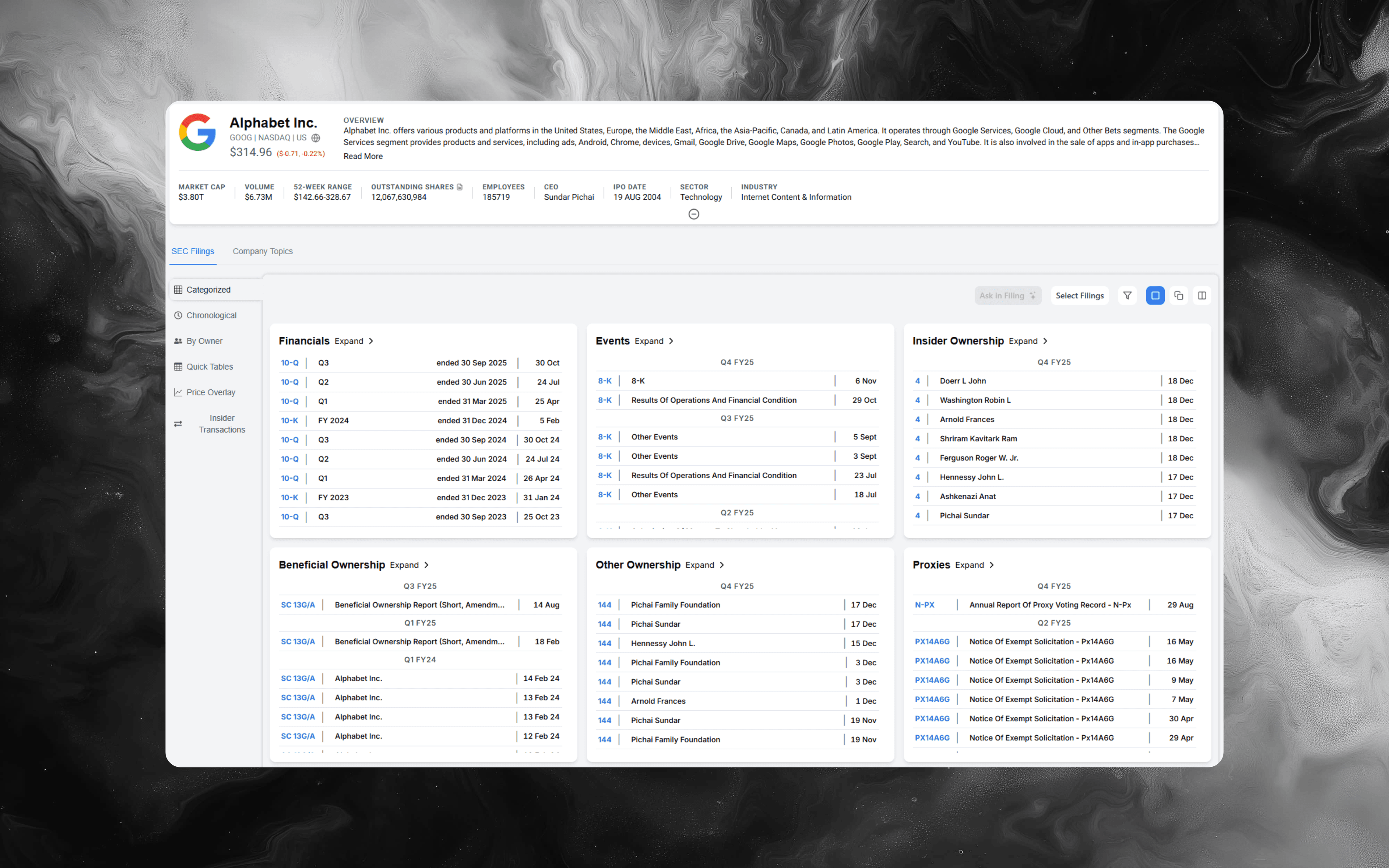
Table of contents
- The fastest mental model: Alphabet sells outcomes at internet scale
- The segments Alphabet reports (and why the segment split matters)
- Google Services: a bundle of consumer products with multiple revenue streams
- Google Cloud: enterprise infrastructure and software with usage and subscriptions
- Other Bets: why it exists and how to think about it
- Where recurring revenue shows up in GOOG (and where it doesn’t)
- A quick checklist for reading GOOG filings like an analyst
- Explore Alphabet filings in Alpha Analyst
The fastest mental model: Alphabet sells outcomes at internet scale
Alphabet is easiest to understand if you stop trying to define it by a single product (Search, YouTube, Android) and instead define it by what customers are paying for:
- Businesses pay for demand generation and measurement (advertising).
- Consumers pay for upgraded experiences and access (subscriptions and content packages) and sometimes for digital goods (apps and in-app purchases).
- Enterprises pay for computing capacity and software tools (cloud services), often priced by consumption and/or seat-based subscriptions.
The important nuance: Alphabet’s product surface area is huge, but the reporting structure simplifies the story into a few economic engines you can track over time.
The segments Alphabet reports (and why the segment split matters)
In its filings, Alphabet describes Google as reported in two segments (Google Services and Google Cloud) and reports non-Google businesses collectively as Other Bets. In addition, certain initiatives and shared costs are captured in Alphabet-level activities.
This matters because each segment tends to have different drivers:
- Google Services can be tied to advertising demand, consumer engagement, and shifts in how people discover information and watch content.
- Google Cloud often reflects enterprise IT budgets, competitive dynamics in infrastructure and platforms, and the mix between usage-based revenue and subscriptions.
- Other Bets is more about optionality, experimentation, and time-to-scale than near-term margin maximization.
Segment framing keeps your analysis from blending together very different narratives (ad cycle vs enterprise cloud vs venture-style incubation). For a broader look at how analysts approach segment reporting and company monitoring, Day in the Life of an Investment Analyst: A Realistic Playbook offers practical workflow tips.
Google Services: a bundle of consumer products with multiple revenue streams
Think of Google Services as “the consumer internet business,” but with more than one way to get paid.
Alphabet’s segment description highlights that Google Services includes products and services such as ads, Android, Chrome, devices, Google Maps, Google Play, Search, and YouTube. The segment generates revenue primarily from advertising, plus fees from consumer subscription-based products, plus app and in-app purchase economics, and device-related revenue.
A simple way to explain it:
Google Services is a portfolio of consumer products where Alphabet monetizes either (a) user attention via advertising, or (b) premium utility via subscriptions and transactions.
Practical revenue intuition:
- Ads are often the headline, but the segment can include multiple “mini-business models” under one roof.
- Many products reinforce each other (distribution, engagement, data signals, and brand), even if they’re not each standalone profit centers.
- The mix can shift as user behavior moves across devices and formats (for example, different ad formats and engagement patterns across Search vs video vs apps).
Google Cloud: enterprise infrastructure and software with usage and subscriptions
Think of Google Cloud as “selling computing and productivity tools to organizations.”
Alphabet’s segment definition describes Google Cloud as including infrastructure and platform services, applications, and other services for enterprise customers. Revenue is generated primarily from consumption-based fees and subscriptions (including offerings such as cloud platform services and collaboration/communication tools).
A plain-English explanation:
Google Cloud sells building blocks that companies use to run workloads, store data, build applications, and collaborate—where customers typically pay either based on what they use (consumption) or what they’ve licensed (subscriptions/seats).
Business-model intuition to track in filings:
- Consumption-based revenue often grows when customers increase workloads and usage; it can also be sensitive to optimization efforts.
- Subscription components can look more “contract-shaped” and may be visible through disclosures that hint at multi-period commitments and customer expansion.
- Profitability trends can change materially as scale improves, product mix shifts, and infrastructure investment cadence changes.
For more context on how cloud, AI, and modern software models interface with financial analysis, NLP in Financial Research: Practical Use Cases and Playbook provides useful parallels for understanding enterprise tech shifts.
Other Bets: why it exists and how to think about it
Other Bets is best understood as “everything that’s not big enough to stand alone, but strategically important enough to disclose.”
Alphabet describes Other Bets as a combination of multiple operating segments that are not individually material. These businesses can include projects and companies with very different timelines, unit economics, and operating risk profiles than the core Google segments.
A useful analyst mindset:
- Treat Other Bets as a portfolio, not a single business.
- The key questions are usually directionality and discipline: what’s scaling, what’s being rationalized, and how management frames the path to sustainability (if any).
- Because these businesses are grouped, reading commentary and risk factors becomes especially important for understanding what’s inside the bucket.
Where recurring revenue shows up in GOOG (and where it doesn’t)
If you need a clean mental ledger for Alphabet’s revenue shape, use these buckets:
-
Advertising (repeat behavior, not contractual) Advertising can be “recurring” in the sense that it repeats every day, but it’s not the same as contracted revenue. Spend can change quickly with budgets, competition, pricing dynamics, and macro conditions.
-
Consumer subscriptions (more renewal-like) Subscription products can produce steadier revenue patterns than ads because customers pay for ongoing access. Churn, pricing, and bundling still matter, but the mechanics are generally more repeatable.
-
Digital commerce and ecosystem fees (transaction-like) App stores, in-app purchases, and certain consumer services can behave like an ecosystem take-rate model, influenced by engagement and developer economics.
-
Cloud consumption fees (usage-driven) Cloud can look durable if customers keep building and expanding, but it’s still tied to usage, optimization, and workload shifts.
-
Cloud subscriptions (contract-shaped) Seat-based and subscription components tend to be more predictable, with expansion and retention being key levers.
A simple summary sentence:
Alphabet blends a high-frequency demand engine (ads) with more contract- or renewal-shaped streams (subscriptions and parts of cloud), while still carrying a portfolio of longer-dated bets.
A quick checklist for reading GOOG filings like an analyst
If you want to monitor Alphabet consistently, this short checklist helps you avoid getting distracted by headlines:
-
Start with the segment definitions Confirm what management includes in Google Services, Google Cloud, and Other Bets, and note any changes in language over time.
-
Track the revenue engine by “who pays and why” Write down, in one sentence per segment, what the customer is buying (attention, utility, compute, access). Update only when filings force you to.
-
Watch for mix shifts inside Google Services Even without breaking everything out, filings often signal where engagement and monetization are shifting (format, device, product emphasis).
-
Read the segment profitability section the same way every quarter/year You’re looking for narrative changes: what’s driving improvements or pressure in each segment and in Alphabet-level activities.
-
Don’t ignore Alphabet-level activities Centralized costs and initiatives can move meaningfully and can change how you interpret “segment” improvements.
-
Keep a repeatable keyword list Examples: “reportable segments”, “Google Services”, “Google Cloud”, “Other Bets”, “Alphabet-level activities”, “consumption-based”, “subscriptions”, “traffic acquisition”, “content acquisition”, “cost allocation”.
For practical guidance on research process and staying organized through changing disclosures, see Day in the Life of an Investment Analyst: A Realistic Playbook.
Explore Alphabet filings in Alpha Analyst
To validate how Alphabet defines each segment, see what’s moving profitability in Google Services vs Google Cloud, and monitor evolving disclosures in one place, go straight to the primary-source filings: Alphabet Inc. (GOOG)
CTA: Use Alpha Analyst to search across GOOG filings with advanced keyword operators, save a repeatable segment-monitoring query set, and pin it to a dashboard filtered by your watchlist so new disclosures surface the moment they’re filed.
Related Posts
View all posts →
January 31, 2026
Fed Chair Nomination News: What Hassett’s Comments Signal
A practical guide to tracking Fed leadership changes, confirmation risk, and market reactions using filings, search, and dashboards

January 29, 2026
New York Fiscal Crisis: A Company Impact Playbook
How to map NYC budget stress to revenue, taxes, real estate, and credit risk across US equities

January 29, 2026
Monetary Debasement and the US Dollar: A Company Playbook
What “currency going to hell” really means, what could come next for USD, and how US businesses can defend margins, cash flows, and valuation

January 16, 2026
Amgen (AMGN) Deep Dive: Products, Pipeline, and Key Risks
A practical equity-research playbook for underwriting the next leg of growth, margin durability, and biosimilar exposure

January 16, 2026
Daikin Industries (6367): A Deep-Dive Equity Research Playbook
Business model, segment drivers, key risks, and how to build a thesis faster in Alpha Analyst
Explore More
View all posts →
February 4, 2026
Software Stocks and AI Disruption Fears: Investor Playbook
How to evaluate “AI risk” claims, pressure-test seat-based pricing, and track what matters in filings using Alpha Analyst

February 4, 2026
Enphase (ENPH) Upgrade After Earnings: What Changed
A practical investor brief on the BMO upgrade, Q4 beat, 2026 guideposts, and how to track follow-through in Alpha Analyst

February 4, 2026
Tether fundraising report: what changed and how to track it
A practical framework for monitoring stablecoin issuer valuation, liquidity, and regulatory signals with Alpha Analyst